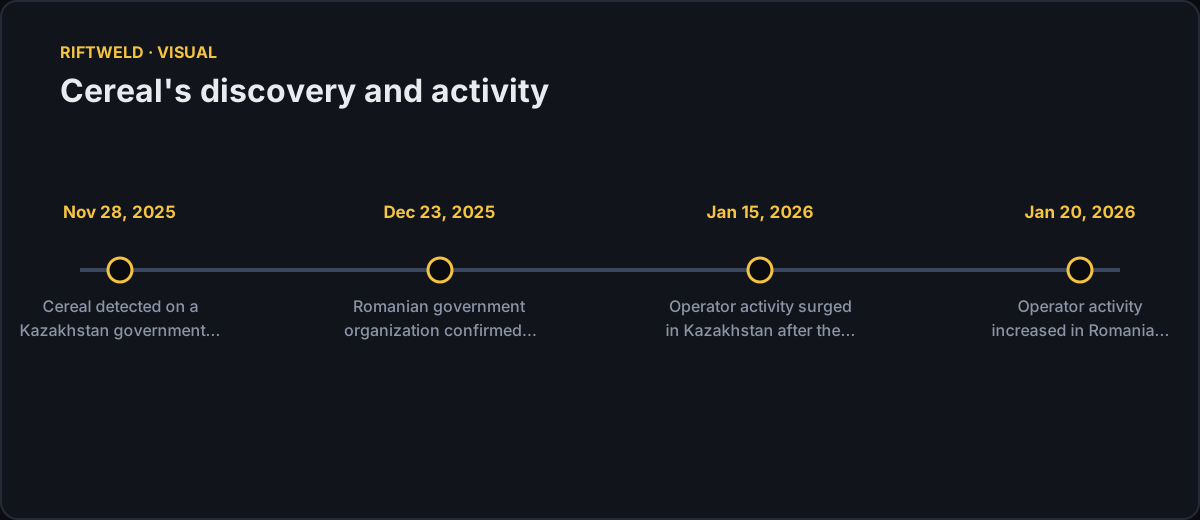
ESET found the same toolset on government Exchange servers in Kazakhstan on November 28, 2025, and Romania on December 23, 2025, yet identified no attacker-owned command server. The victims' own mail servers were the command infrastructure.
In this article
Why this matters
The defensive assumption that fails here is not merely "a checkbox was missed." It is the assumption that an internet-facing Exchange server is a trusted service whose traffic, processes, and configuration can be treated as legitimate by default. Cereal is built to operate inside that trust boundary: it runs in Exchange processes, reuses Exchange web paths, and leaves the mail flow intact while copying messages out of it.
That design removes a familiar defender advantage. Turla did not need to register a domain, host a server, or beacon to infrastructure that could be blocked or sinkholed. The command channel was the victim's own HTTPS endpoint, and the collection point was the victim's own transport service. A network team watching for suspicious destinations would see ordinary Exchange traffic; an administrator reviewing registered transport agents would see nothing new.
The operation also illustrates a second failed assumption: that successful delivery of a message means the message has only traveled through the systems administrators expect. In the Romanian case, CerealBox was configured to select mail sent to or received from NATO and European Union institutional addresses. The intelligence value sat in the content of legitimate correspondence, not in disruption of the service.
What happened
ESET Research discovered Cereal on an Exchange server belonging to a national governmental organization in Kazakhstan on November 28, 2025. After refining its detections, the company identified a Romanian governmental organization compromised from at least December 23, 2025. Operator activity in Kazakhstan surged on January 15, 2026, the day after the Old New Year holiday, and increased in Romania on January 20, 2026. ESET Research
ESET attributes the toolset to the Russia-aligned APT group Turla with high confidence, citing concurrent use of a component publicly linked to Turla and conceptual similarities to older Turla malware. Turla, also known as Snake, has been active since at least 2004 and is widely assessed to be part of Russia's Federal Security Service. The two confirmed compromises — in Central Asia and Europe — align with Turla's established targeting of governments, diplomatic missions, and defense organizations. ESET Research
Cereal is a modular .NET toolset whose components cover loading, in-memory execution, command receipt, network activity, and mail collection. ESET names the components after their heavy reliance on serialization: CerealLoader, CerealRunner, CerealSprinter, CerealNeuron, CerealHermit, CerealIron, CerealBox, and CerealMoth. CerealNeuron is the only component that communicates with hosts outside the compromised network; the rest of the execution chain is designed to stay in memory. ESET white paper
| Claim | Status | Basis |
|---|---|---|
| Cereal was found on Exchange servers in Kazakhstan and Romania | Confirmed | ESET detection on November 28, 2025 and compromise from at least December 23, 2025 |
| Turla operates the toolset | Confirmed | ESET attribution with high confidence based on concurrent use of a publicly linked component and similarities to older Turla malware |
| The victims' Exchange servers served as command infrastructure | Confirmed | CerealNeuron passively listens on Exchange-like HTTPS paths; no external C&C infrastructure observed |
| Romanian collection targeted NATO and EU institutional mail | Confirmed | CerealBox configuration described by ESET |
| Initial access exploited an Exchange vulnerability | Not established | ESET could not determine the initial access method; exploitation is described as possible |
| The operators' motive was to monitor Russian dissidents in Kazakhstan | Inferred | ESET presents this as a scenario, not a confirmed objective |
How the control failed
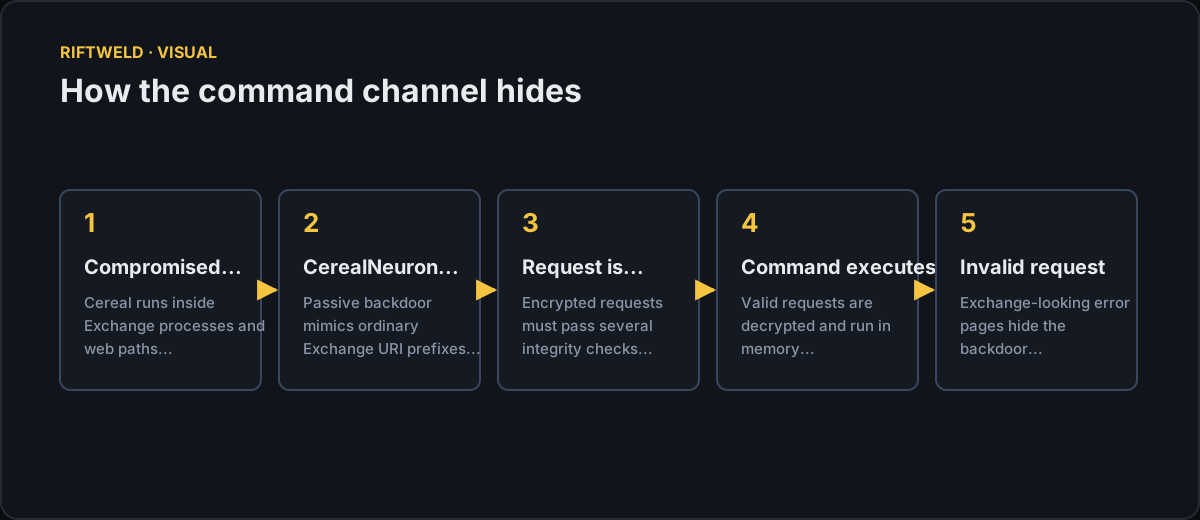
The command channel is the most consequential design choice. CerealNeuron is a passive backdoor with no built-in command list. It listens on URI prefixes that mimic ordinary Exchange services, including /owa/sdds/ and Autodiscover paths. A request that is properly encrypted and passes several integrity checks is decrypted and executed as a command; anything else receives a legitimate-looking Exchange error page. ESET could not identify the IP addresses from which operators connected, so the origin of the traffic remains unknown. ESET white paper
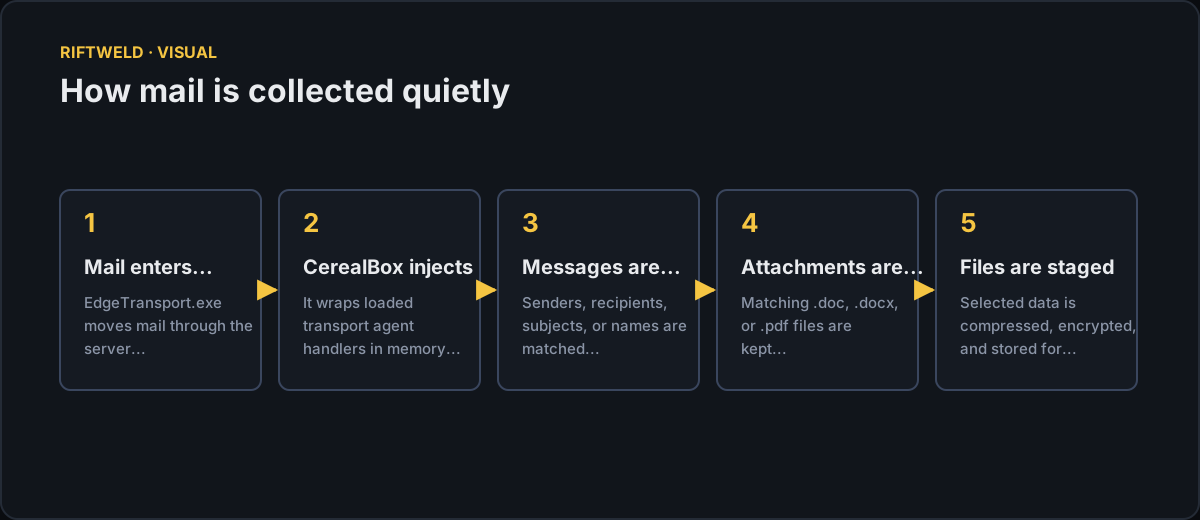
Mail collection works by a different form of concealment. Turla has previously abused Exchange transport agents, which are plugins that hook into mail flow and appear in Exchange configuration when registered. CerealBox instead injects itself into EdgeTransport.exe, the process that moves mail, and wraps the handlers of transport agents already loaded in memory. Mail continues to flow and no new agent appears in configuration. ESET states that this in-memory injection and hooking technique has not previously been documented for any malware family. Help Net Security
Selection is automated. CerealBox retains messages carrying .doc, .docx, or .pdf attachments that match hardcoded lists of senders, recipients, subject strings, or attachment names, then compresses, encrypts, and stages them on disk for later collection. In Romania, the configured lists included nato.int and europa.eu addresses. The original messages continue to their intended recipients, which is why the operation can persist without generating user-visible disruption. Help Net Security
The loader adds a further layer of evasion. CerealLoader is the only component written to disk as a recognizable .NET file, and it executes native code before any managed .NET code runs, using a native entry point and VTable Fixups. In one chain it posed as ncobjapi.dll in C:\Windows\System32\wbem, where the WMI Provider Host loaded it automatically; in another it posed as wbemcomn.dll. Copies were also placed in the .NET native image cache under names such as Microsoft.Exchange.Search.Mdb.ni.dll, so Exchange loaded the malicious file first and fell back to the legitimate library. CerealSprinter includes an AMSI bypass that sets amsiInitFailed to true. ESET white paper
What the record does not establish
The record is detailed on mechanism and thin on origin and impact. ESET could not determine how the attackers first reached either Exchange server. Because the servers were internet-facing, the researchers state that exploitation of a vulnerability is possible, but no specific vulnerability, exploit, or intrusion vector is identified. The exact compromise dates in both countries are also unknown; the published dates mark detection and the earliest confirmed compromise, not the point of entry. ESET white paper
Impact is likewise unquantified. ESET could not determine how much information was exfiltrated, nor whether operators connected directly, through anonymization services, or from other compromised hosts. The staged, encrypted files on disk demonstrate a collection capability, not the volume or sensitivity of what was actually taken. No Microsoft advisory specific to Cereal was identified at the time of publication, and no independent security-vendor analysis of the toolset was found. The Record
Geopolitical interpretation should be read as inference. ESET links the Romanian targeting to regional tensions and the Kazakh compromise to the reported deportation of Russian exiles and regime critics, but presents the latter as a scenario in which operators might seek visibility into people known to Kazakh authorities. Neither motive is confirmed by the technical evidence. The claim that the transport-hooking technique is unprecedented rests on ESET's own research coverage rather than an independent survey of malware families. ESET Research
Method and sources
This analysis rests on ESET Research's primary publication and companion white paper, both dated November 10, 2026, supplemented by ESET's public Turla indicators-of-compromise repository and Palo Alto Networks Unit 42's earlier IronNetInjector research, which ESET cites for the bootstrapper family used by CerealIron. ESET IoC repository
Secondary coverage from BleepingComputer, The Record, mlq.ai, CIO.inc, and Help Net Security was consistent with ESET's findings and added no independent technical facts. Attribution, victimology, and technique claims in this report are therefore ESET's, and the limits above reflect what ESET could not determine rather than a broader absence of reporting. BleepingComputer