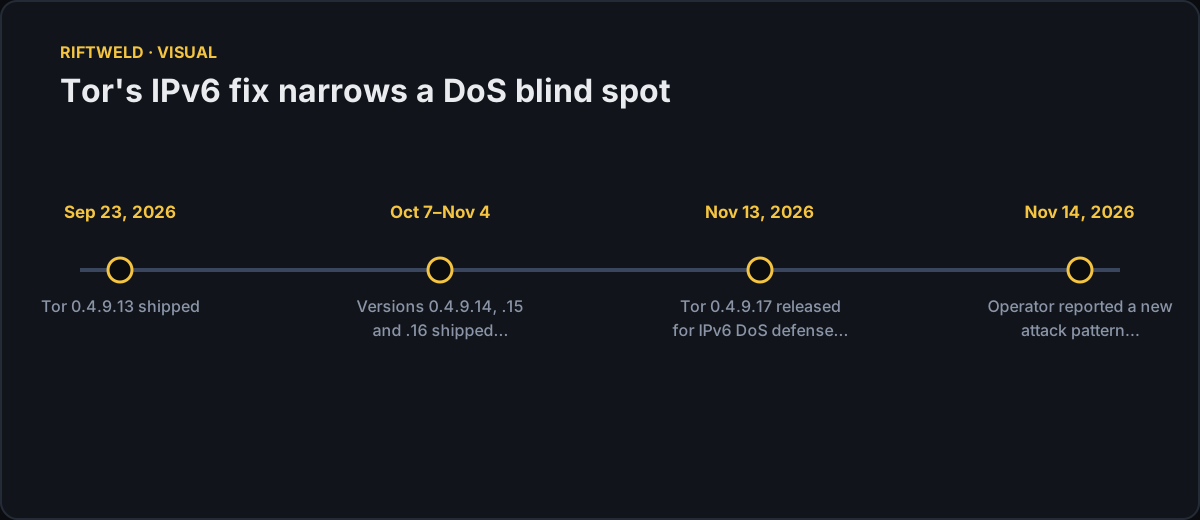
On November 13, 2026, a relay operator reported roughly 200,000 TCP connections against a normal range of 2,000–8,000. The next day, another operator said the attack had shifted to a new pattern about ten minutes after upgrading to Tor 0.4.9.17.
In this article
Why this matters
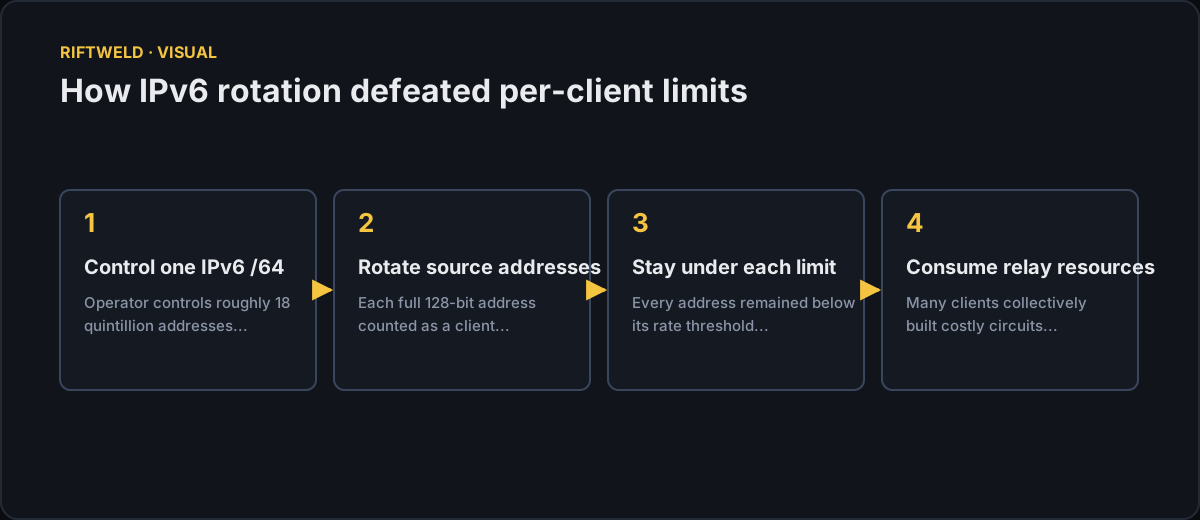
Tor's relay defenses are built on the assumption that a client can be identified well enough to apply a per-client limit. The 0.4.9.17 release breaks that assumption for IPv6: before the fix, a relay counted each full 128-bit address as a separate client, so an operator controlling a single IPv6 /64 block — roughly 18 quintillion addresses — could rotate source addresses and appear as a crowd of individually well-behaved clients, each comfortably under its own rate limit, while collectively consuming relay resources (audiotale).
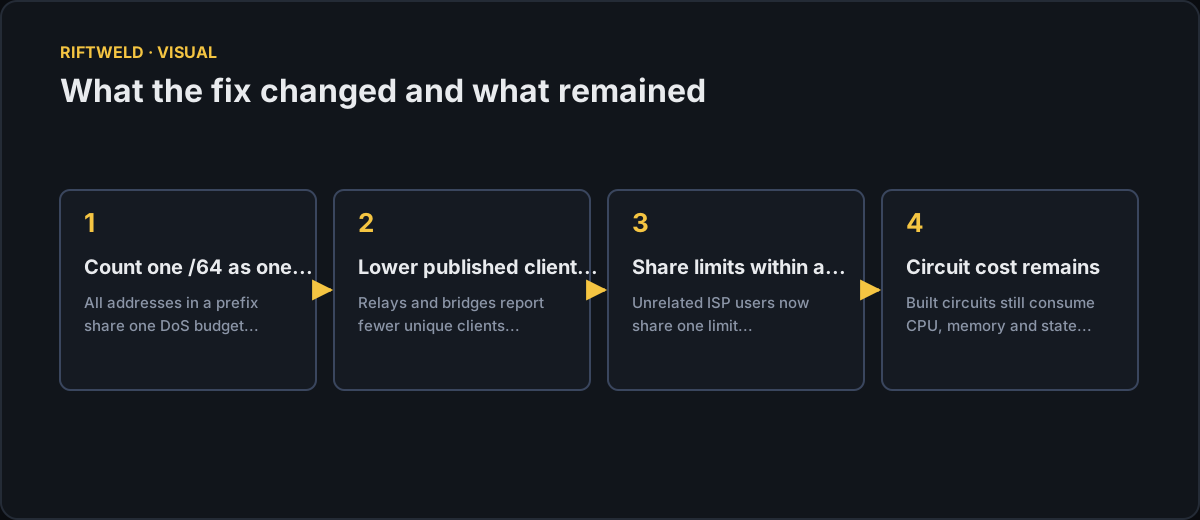
That is a protocol-level narrowing of the identity used for abuse control, not a cosmetic patch. It also changes what the network reports: relays and bridges now count an IPv6 /64 as a single client in their extra-info documents, so published unique-client counts will fall after upgrading (Fossies release notes). The change is tracked as TROVE-2026-031 and bug 41344, and the release notes date the underlying gap to Tor 0.3.3.2-alpha — meaning the weakness spanned multiple stable series rather than appearing with the current campaign.
The stakes are operational. The Tor Project said the release was a rapid response to an ongoing DDoS attack that "has affected most relay operators," with relays "being overwhelmed by a massive flood of client circuits," and it asked relay operators to upgrade as soon as possible (Tor Project forum). The project also said it was "actively evaluating additional defenses" and expected further releases, which is the clearest signal in the record that 0.4.9.17 was one step in an ongoing response rather than a resolution.
What happened
The release sequence shows a compressed patching cadence. Tor shipped 0.4.9.13 on September 23, 0.4.9.14 on October 7, 0.4.9.15 on October 28, 0.4.9.16 on November 4, and 0.4.9.17 on November 13 — five 0.4.9.x security or stable releases in roughly seven weeks (Fossies release notes). The GitLab tag tor-0.4.9.17 points to commit a00b3e0b, a merge of maint-0.4.9 into release-0.4.9 that changes the version string from 0.4.9.16-dev to 0.4.9.17 and moves the approximate release date from November 4 to November 13 (GitLab commit).
The 0.4.9.15 release had already added defenses against a "BEGIN_DIR thunderstorm attack," including per-circuit BEGIN_DIR rate limiting, one BEGIN_DIR per circuit from authenticated relays, and one HSDir descriptor fetch or upload per circuit. Tor cautioned that these would "mitigate the vast majority of BEGIN_DIR requests" but would not "magically make the hundreds of circuits per second we see on a single relay disappear" (tor-relays announcement). On November 13, operator "forest" reported that a BEGIN_DIR flood had bypassed the "incomplete fix from 0.4.9.15," alongside several other distinct attacks, and described roughly 200,000 TCP connections against a normal 2,000–8,000 (tor-relays thread).
The day after 0.4.9.17 shipped, operator "Red_Oaive" described three traffic patterns: Type A at roughly a 6:1 ingress-to-output ratio, Type B at roughly 1:2 with more than 400,000 "Your computer is too slow" messages per minute, and a new Type C involving traffic shutdown, "relay unresponsive" messages, low CPU around 30%, and HSDir flag loss. The operator concluded the 0.4.9.17 mitigations were "insufficient to protect HSDir" and that the attack shifted roughly ten minutes after upgrade (tor-relays update).
The assumption that failed
The failed control was not a missing configuration option. It was the assumption that per-address rate limiting meaningfully bounds a single adversary's circuit-building capacity over IPv6. Because the limit was keyed to the full address, an adversary with a large routed prefix could multiply its effective allowance simply by varying the address it used, while each individual address remained below the threshold that would trigger enforcement.
The 0.4.9.17 change restores the intended invariant by keying the limit to the /64 prefix, so all addresses within one prefix consume a single client's budget. That is a direct answer to the specific abuse pattern the release notes describe, and it is the reason the project called the fix "especially important for relay DoS defenses related to IPv6 handling" (Tor Project forum).
The fix does not, however, address the broader resource-exhaustion mechanism. Tor characterizes the attack as a flood of client circuits rather than a bandwidth flood; circuits are built hop by hop, each relay performs cryptographic handshakes and retains per-circuit state, and circuits left idle consume CPU and memory while carrying almost no traffic. The C implementation does not monitor CPU directly, so it limits protocol resources that drive load instead (audiotale). Narrowing client identity constrains one way to multiply circuit-building attempts; it does not change the cost of the circuits that do get built.
Limits of the evidence
The record is thin on attribution, scale, and duration, and those gaps should not be papered over.
| Claim | Status | Basis |
|---|---|---|
| Tor 0.4.9.17 was released November 13, 2026 as an emergency response to an ongoing DDoS attack | Confirmed | Tor Project forum announcement and GitLab tag tor-0.4.9.17 |
| Relays now track IPv6 clients by /64 prefix for DoS defense | Confirmed | Release notes and Tor Project announcement |
| The attack affected most relay operators and involved a massive flood of client circuits | Company statement | Tor Project announcement |
| A BEGIN_DIR flood bypassed the incomplete 0.4.9.15 fix | Reported | Operator "forest" on the tor-relays list |
| The attack shifted to a new pattern roughly ten minutes after the 0.4.9.17 upgrade | Reported | Operator "Red_Oaive" on the tor-relays list |
| The attacker is adapting faster than the mitigations | Inferred | Operator observations of pattern changes; no project confirmation |
| The attack was caused by IPv6 address rotation | Inferred | Rationale in release notes and independent analysis; not stated as the sole cause |
| A CVE has been assigned for any 0.4.9.17 fix | Not established | Release notes and forum post cite TROVE identifiers only; Threadlinqs, CyberSIXT, and audiotale note no CVE |
| The attacker has been identified or attributed | Not established | No attribution published by the Tor Project |
| Network-wide traffic volume, attack duration, or relay dropout count | Not established | No figures published by the Tor Project as of the research date |
| The June–July 2026 circuit-building wave is the same campaign as the November attack | Not established | 1AEO explicitly declines to tie its traffic to the November campaign |
One trade-off deserves attention and is not discussed in the release notes: unrelated users sharing a /64, such as subscribers behind the same ISP IPv6 prefix, will now share a single DoS limit. No published analysis of that effect was found in the sources reviewed (audiotale). Separately, 1AEO's June–July telemetry — open circuits peaking at roughly 18.5 times baseline, INTRODUCE2 rejections near 12,000 per second, and ntor_v3 handshakes comprising 90–97% of worker assignments during peaks — provides useful context for circuit-building abuse but is explicitly not confirmed as the same campaign (1AEO).
Method and sources
This analysis draws on the Tor Project's own security release announcement for 0.4.9.17, the GitLab tag and merge commit for that release, the upstream release notes mirrored by Fossies, and operator posts on the tor-relays list covering the 0.4.9.15 defenses, the November 13 attack observations, and the post-upgrade update. Independent reporting from CyberSIXT, audiotale, and Threadlinqs was used to corroborate the absence of a CVE and to identify the IPv6 /64 rationale and the shared-prefix trade-off; 1AEO's June 2026 analysis was used only as explicitly labelled context.
Claims are labelled by evidentiary strength: confirmed where the project or repository states them directly, reported where they rest on operator accounts, company statement where they are the project's own characterisation without independent measurement, inferred where the record supports a conclusion but not a direct statement, and not established where the sources are silent. No traffic figures, attribution, CVE identifier, or attack end date is asserted beyond what the cited sources state. The record does not support treating this incident as closed.