Wordfence's blocking rule matched its first request nine minutes after deployment on October 28, 2026, and logged more than 18,500 requests in the following 21 hours. Yet the update that installs the fix still unpacks WordPress with the vulnerable updater already sitting on disk.
In this article
Why this matters
The failed control is not a missing checkbox in a release checklist. It is the assumption that the update workspace is not an execution surface. WordPress core updates download a package, extract it beneath wp-content/upgrade/, copy the extracted distribution over the live site, and then delete the working directory. On a typical installation, PHP inside wp-content/ executes, so the extraction step briefly creates a second, web-reachable WordPress instance with its own installer (Picus Security).
A second assumption compounds it: that installing a patch means the patched code governs the entire operation. It does not. The update that installs the fix is executed by the old, unpatched updater already on the site, so the vulnerable staging behavior is still present during the very update operators run to remediate it (The Hacker News).
That distinction changes the operational answer. "Update to 7.1.4" is necessary but incomplete as a control. The residual exposure is created by the update process itself, and the documented mitigation is to deny web access to wp-content/upgrade/ before the update begins, not after it completes (The Hacker News).
What happened
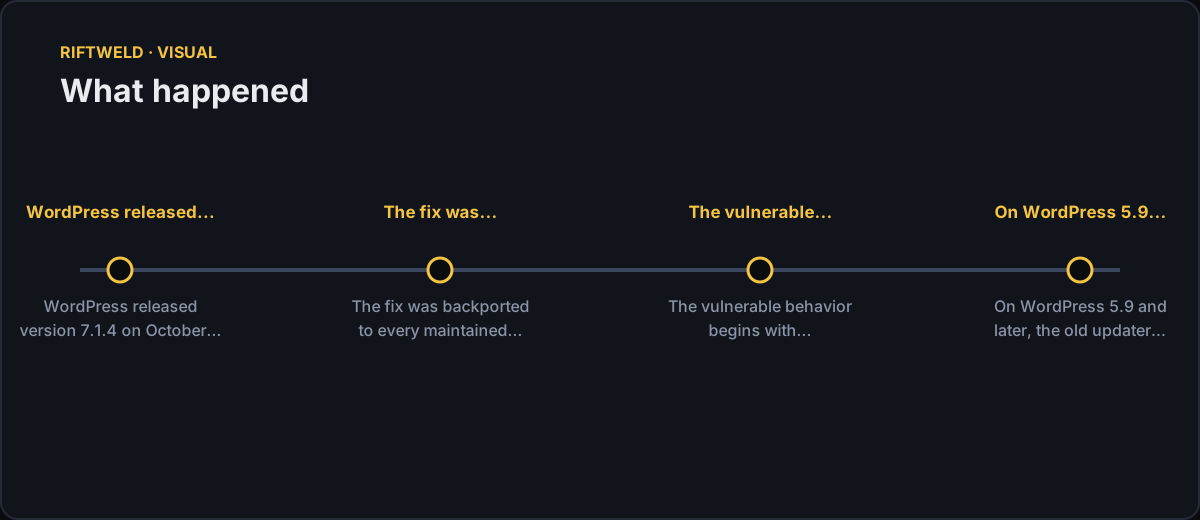
WordPress released version 7.1.4 on October 28, 2026, as a security release addressing 22 vulnerabilities, including an unauthenticated upgrade-window race condition that can lead to remote code execution. The fix was backported to every maintained branch back to 4.7, with patched releases running from 4.7.39 through 7.1.4 (Wordfence).
The vulnerable behavior begins with WP_Upgrader::unpack_package(), which derives the working directory from the package filename by stripping .tmp and .zip suffixes. On WordPress 5.9 and later, the old updater names the folder after the downloaded file, making the path predictable. On WordPress 4.4 through 5.8, the old code appends random characters, which hides the path unless the site leaks it through an error message or similar side channel (The Hacker News).
Two exploitation paths follow, and they should not be conflated. In the configuration-overwrite path, the attacker supplies database parameters for a database they control; the temporary installer writes a wp-config.php into the staged tree, and the updater's copy step does not exclude that file, so it can replace the live configuration. Pointing the site at an empty database exposes the installation workflow, allowing creation of the first administrator account and, on a typical single-site installation, upload of a malicious plugin for PHP execution (Picus Security).
In the direct-execution path, the attacker configures the temporary copy against their own database, logs into it, and runs PHP with the web server's permissions before the staged tree is deleted, then reads or writes files in the live site. This path does not depend on the configuration overwrite surviving the copy step (The Hacker News).
The fix randomizes the staging directory, adds an index guard, and prevents unsafe promotion of staged configuration data. Critically, the configuration-overwrite protection is already active during the update that installs the fix, because WordPress copies files into place using the new code. What the old code still does is unpack the package into a predictable, web-reachable directory containing a live installer, leaving the direct-execution path open for the duration of the update (Wordfence).
| Claim | Status | Basis |
|---|---|---|
| The update that installs the fix uses the old updater to unpack files | Confirmed | WordPress 7.1.3 class-core-upgrader.php; The Hacker News |
| Staging directory name is predictable on WordPress 5.9 and later | Confirmed | The Hacker News; Picus Security |
Staged wp-config.php can overwrite the live configuration before the fix |
Confirmed | Picus Security |
| Direct PHP execution in the staged tree remains possible during the patched update | Reported | Picus Security; The Hacker News |
| The flaw is being exploited in the wild | Confirmed | CISA KEV catalog addition, November 3, 2026, as reported by Picus Security and The Hacker News |
| Successful compromise of a specific site | Not established | No source describes a confirmed site compromise |
Exposure and impact
The affected population is any WordPress site running 4.7 through 7.1.3 that performs a core update using a complete package while wp-content/upgrade/ is web-reachable. WordPress 4.6 and earlier receive no security updates and have no fix; the flaw traces back to WordPress 2.7, released in 2008, so those installations need to move to a supported release (The Hacker News).
Package type materially changes exposure. Complete packages always include the installer files; a smaller partial package built for one specific starting version exposes a site only if it happens to contain them. The Hacker News checked WordPress.org's update service and found that within-branch updates, such as 7.1.3 to 7.1.4, were offered as partial packages including for automatic updates, while cross-branch moves such as 7.0.7 to 7.1.4 were offered only as complete packages. Automatic background updates use the same updater and the same steps, so they inherit the same exposure (The Hacker News).
The tradecraft is opportunistic and automated rather than targeted. Wordfence observed two of the largest sources repeatedly polling small groups of sites for roughly 14.5 hours, behavior consistent with trying to catch the brief upgrade window, while other sources tested many staging-directory and version-name variations. The exploit requests a staged PHP file directly without first loading WordPress, which is why Wordfence states that Extended Protection matters for this specific issue (Wordfence).
The impact ceiling is unauthenticated remote code execution with the web server's privileges, followed by read or write access to files in the live WordPress site. Wordfence rates the issue CVSS 8.1 High, and Picus Security also cites CVSS 8.1 (Wordfence).
Operational guidance
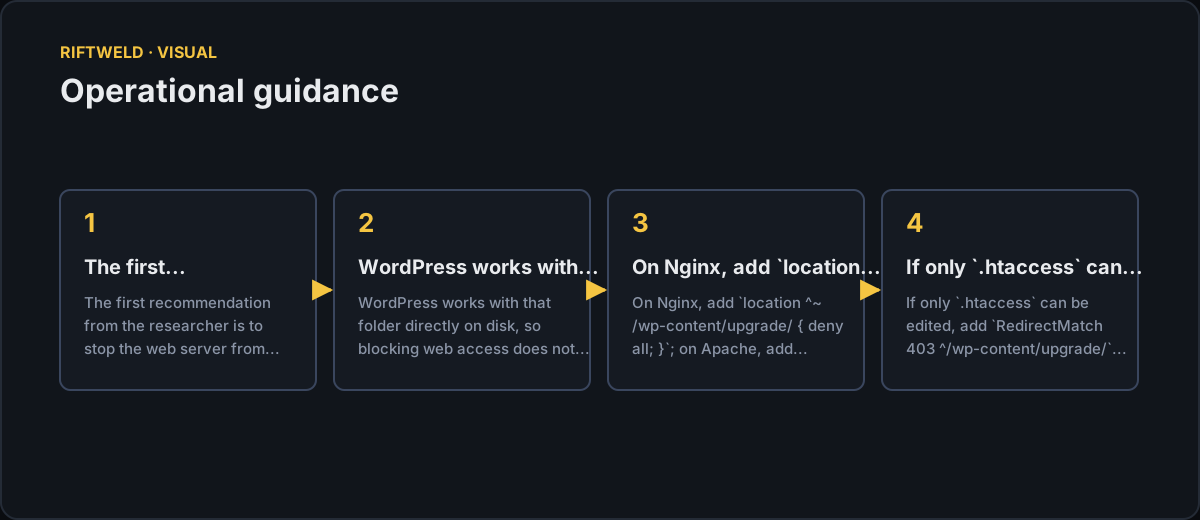
The first recommendation from the researcher is to stop the web server from serving wp-content/upgrade/ at all. WordPress works with that folder directly on disk, so blocking web access does not break updates. On Nginx, add location ^~ /wp-content/upgrade/ { deny all; }; on Apache, add Require all denied inside a <Directory> block for that folder in the virtual host configuration. If only .htaccess can be edited, add RedirectMatch 403 ^/wp-content/upgrade/ above the WordPress rewrite rules (The Hacker News).
One trap deserves emphasis: do not place an .htaccess file inside wp-content/upgrade/ itself. The old updater deletes everything in that folder before unpacking an update, so the file would be gone when it is needed. Operators should confirm that a request to /wp-content/upgrade/ returns a 403 error, then update to 7.1.4 or the fixed release for the branch (The Hacker News).
The alternative safe route is a manual update performed outside the web root: back up site files and database, unpack the new release in a directory the web server does not serve, copy core files into place without touching wp-config.php or wp-content, then run the WordPress database update. No temporary installer is ever created in a web-reachable folder. WP-CLI's wp core update is not a substitute, because it runs the same updater and unpacks the package into the same folder (The Hacker News).
Limits of the evidence
The record is thin in several places, and the gaps should shape confidence. The WordPress advisory itself lists severity as Low, records no CVE ID, and lists no CWEs, while Wordfence and Picus Security both cite CVSS 8.1 and The Hacker News tracks the issue as CVE-2026-119977. The advisory also enumerates affected ranges beginning at 7.1.0 and working down by branch, whereas The Hacker News describes the affected population as 4.7 through 7.1.3. These are unresolved discrepancies in the published record, not details to reconcile by assumption (WordPress security advisory).
CISA's catalog addition was based on evidence of active exploitation, but the agency did not describe the attacks. No source in the record identifies a specific successfully compromised site, and the observed traffic establishes attempts rather than outcomes. Timing is also the practical constraint: in normal lab environments the vulnerable staging directory remained available for only seconds, making a one-off request unlikely to succeed, though automated polling changes that calculus (The Hacker News).
Finally, the mitigation is not uniformly available. Wordfence Free users were scheduled to receive the same firewall rule on November 27, 2026, after the standard 30-day delay, leaving a period in which protection depended on manual configuration or another control (Wordfence).
Method and sources
This analysis draws on five sources. The WordPress security advisory establishes the affected and patched branch releases, the backport to 4.7, and the advisory's own severity and metadata. The WordPress 7.1.3 class-core-upgrader.php source is the code reference for the pre-fix updater behavior. Picus Security's technical write-up by Umut Bayram supplies the update workflow, the two exploitation paths, the installer configuration-search behavior, and the copy-step analysis. The Hacker News reporting supplies the update-service package observations, the version-dependent naming behavior, and the operational recommendations. Wordfence supplies the exploitation telemetry, the firewall-rule timeline, the CVSS rating, and the Free-tier delay.
Where the sources disagree, the disagreement is reported rather than resolved. Where they are silent — on confirmed compromises, on the precise duration of the window in production, and on the severity discrepancy — the record does not support a conclusion.