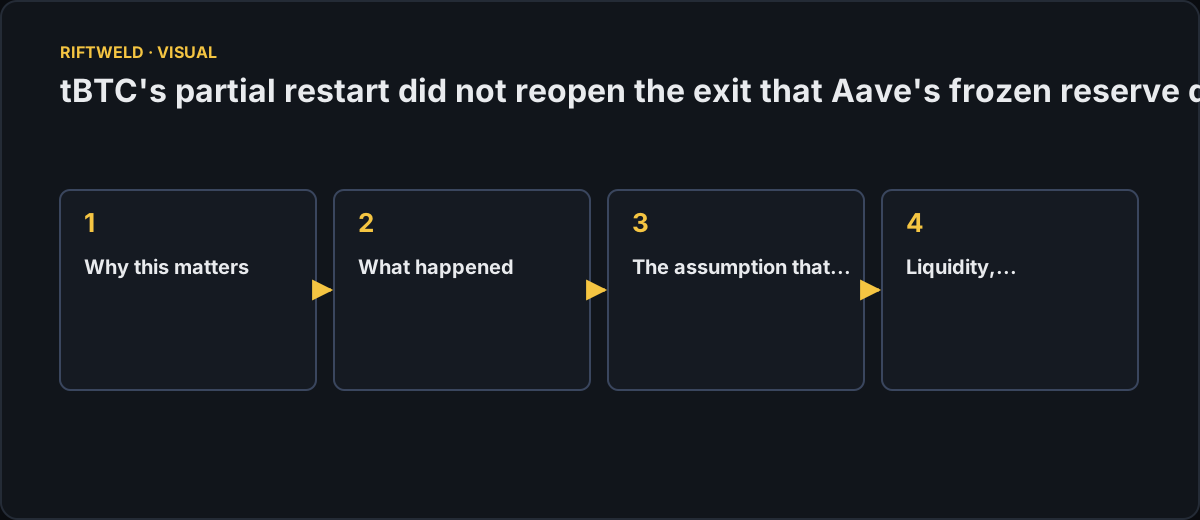
A 200 tBTC quote returned 191 WBTC on November 3, a 4.6% shortfall, even as Threshold's underlying network was restarting with patched operators. The contradiction is that tBTC's accounting value remained close to BTC while the route that converts it into BTC was still closed.
In this article
Why this matters
The tBTC incident is best understood as an infrastructure failure that became a liquidity problem. Threshold halted minting and redemption after operators encountered a critical Linux kernel vulnerability that could permit remote code execution on unpatched servers. The project said it found no evidence that the flaw had been exploited against tBTC nodes, and it reported no unauthorized Bitcoin transfers or token minting. The immediate risk was therefore operational rather than a demonstrated loss of funds (Cointelegraph).
The financial consequence was not confined to the bridge. Aave's guardian multisig froze the tBTC reserve on Ethereum Core at 10:01 UTC on October 31, blocking new tBTC deposits and preventing tBTC from adding borrowing power. The freeze did not trap every borrower: repayment, withdrawal of other collateral, liquidation and borrowing against other collateral continued. What it removed was the assumption that a frozen reserve could still be exited through the asset's primary redemption mechanism (Aave governance).
That distinction matters because tBTC's economic value depends on redeemability. Roughly 4,320 BTC remained in bridge wallets against about 4,185 tBTC in circulation, according to Threshold. The excess BTC is a solvency buffer, but it does not establish that every holder can convert tokens at par while redemptions are closed. The practical question is whether the bridge settles redemptions and whether secondary markets can absorb forced sales (Cointelegraph).
What happened
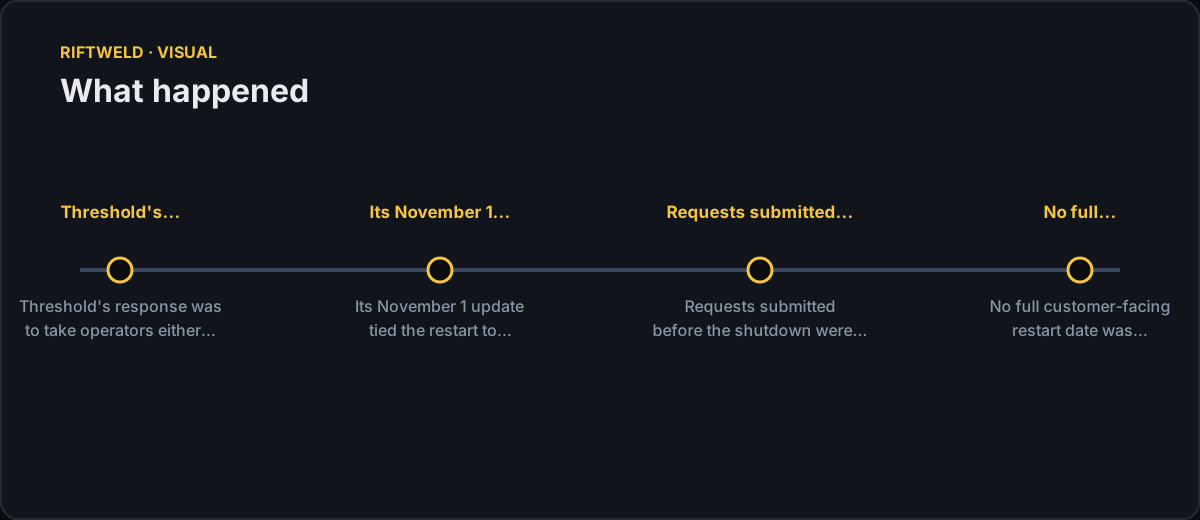
Threshold's response was to take operators either patched or offline. Its November 1 update tied the restart to nodes returning on patched systems and noted that a wallet requires a majority of independent operators to sign a Bitcoin transaction. Requests submitted before the shutdown were expected to be processed as operators returned, but the application would not accept new deposits, minting or redemptions until enough nodes were online. No full customer-facing restart date was announced (Aave governance).
The sequence therefore had two stages. The underlying network began restarting on November 8, while the customer-facing application remained closed. Aave's reserve remained frozen, with LlamaRisk stating that it would propose restoring the reserve after Threshold's operations returned to normal. “Operations return to normal” was not defined as a single verifiable event, and the governance thread explicitly noted that Threshold's updates did not say minting, new redemption requests and settlement of pending requests would return together (Cointelegraph).
There is also a one-day discrepancy in the record. Threshold's project announcement and Cointelegraph date the halt to October 30, while LlamaRisk's governance post refers to a preemptive pause notice dated October 31. The difference appears to reflect how each source dated the pause rather than two separate incidents, but the record does not fully resolve it (Aave governance).
| Claim | Status | Basis |
|---|---|---|
| Threshold halted tBTC minting and redemption over a critical Linux kernel vulnerability | Confirmed | Threshold announcement as reported by Cointelegraph |
| The vulnerability was exploited against tBTC nodes | Not established | Threshold said it found no evidence of exploitation |
| Roughly 4,320 BTC remained against about 4,185 tBTC in circulation | Company statement | Threshold figures reported by Cointelegraph |
| Aave froze tBTC on Ethereum Core at 10:01 UTC on October 31 | Confirmed | LlamaRisk governance post and executed transaction link |
| The Aave reserve held about $120 million in tBTC | Reported | Cointelegraph and republications trace to one editorial report |
| The reserve held 1,749.5 tBTC, about 42% of Ethereum supply | Reported | SrAugust's governance analysis |
| A 200 tBTC quote returned 191 WBTC | Observed | ParaSwap quote at block 26,332,529 reported in governance |
The assumption that failed
The first failed assumption was infrastructural: that operator independence would contain a shared software risk. Threshold's threshold-signing design limits the damage from one compromised operator, but it does not prevent a common flaw from reaching several operators at once. If the vulnerable kernel component was present across the fleet, an attacker could target multiple nodes through the same remote-code-execution path without having to break the signing threshold cryptographically. Taking nodes offline was therefore the operative control, and its cost was a nine-day pause in customer-facing bridge functions (Cointelegraph).
The second failed assumption was financial: that Aave's BTC/USD oracle value would remain realizable by borrowers. SrAugust stated that tBTC on Ethereum Core is priced with a BTC/USD feed rather than a DEX-based adapter, and that tBTC had stayed within 0.2% of BTC since October 31. This configuration protects health factors from direct DEX manipulation, but it also means a secondary-market discount does not automatically reduce a borrower's collateral value. A borrower can therefore face an economic loss that the oracle does not yet reflect (Aave governance).
The result is a gap between accounting value and exit value. A frozen tBTC reserve cannot be added to a position, so a borrower cannot cure a health-factor deficit with more tBTC. If the borrower must unwind, the available routes are repayment, withdrawal of other collateral, liquidation or conversion into other assets on secondary markets. The last route depends on order-book depth rather than the oracle price.
Liquidity, concentration and the margin for stress
The measured depth was thin at the scale that mattered. At block 26,332,529, routes up to 150 tBTC remained within 1.6% of WBTC, while a 200 tBTC quote returned 191 WBTC, a 4.6% shortfall. The record truncates before giving the full result for a 250 tBTC quote, so the deterioration beyond 200 tBTC cannot be quantified from the available text. A governance participant separately argued that after roughly $1 million to $2 million in the 0.998 tBTC-to-WBTC tick range, exits required very high premiums (Aave governance).
Concentration determines how that depth would be used. The 50 largest suppliers held 88% of the reserve and carried 90.8 million in debt. SrAugust's stress calculation found that repricing tBTC at market with a 20% discount would push three of the largest supplier accounts below a health factor of 1, while a 30% discount would leave one account's collateral below its debt. These are scenario calculations by a forum participant, not realized outcomes, but they identify where a prolonged outage would concentrate losses (Aave governance).
The absence of an alternative Aave venue compounds the constraint. tBTC is listed on Aave V3 on Ethereum Core, Base and Arbitrum, but the Base and Arbitrum reserves had already been frozen in earlier asset deprecation rounds. Ethereum Core was therefore the only market where tBTC could still support new borrowing, and the current freeze did not create a new restriction on the other two. It did mean borrowers had no other Aave market to migrate to (Aave governance).
Limits of the record
The approximately $120 million headline figure is not independently measured. Cointelegraph, ct.com and LCX carry the same editorial report, so their agreement reflects republication rather than three separate valuations. The more granular governance figure of 1,749.5 tBTC comes from a forum participant's analysis and is not an audited reserve disclosure. Neither figure should be treated as a verified mark of the frozen reserve (Cointelegraph; LCX).
The record also does not establish exploitation, attacker attribution, a completed theft, or the ultimate duration of the outage. It does not show that the kernel vulnerability was present on every operator's server, only that operators encountered it and that patched nodes were returning. The 250 tBTC quote result, the full order-book depth beyond the observed points, and any post-restart redemption settlement data are not available in the material reviewed.
Method and sources
This analysis draws on Cointelegraph's November 9, 2026 report, the Aave governance thread “tBTC Mint & Redeem Pause: Aave's Response,” and the ct.com and LCX republications of the Cointelegraph article. Governance posts are attributed to their authors: LlamaRisk for the freeze mechanics and next steps, SrAugust for reserve composition, oracle configuration, stress calculations and the ParaSwap quote, and Foreshock for the distinction between reopening and full operational restoration.
Claims are separated by evidentiary status. Project and risk-provider statements are labeled as such; forum calculations and quotes are treated as reported or observed; the $120 million valuation is treated as a single-source report; and the possibility of coordinated exploitation of a shared kernel flaw is treated as an inference about attack surface, not an established event. The central conclusion rests on documented mechanics: the bridge's primary exit remained closed, Aave's reserve stayed frozen, and secondary-market depth was measurably limited at 200 tBTC.
Method and sources
This analysis draws on Cointelegraph's November 9, 2026 report, the Aave governance thread “tBTC Mint & Redeem Pause: Aave's Response,” and the ct.com and LCX republications of the Cointelegraph article. Governance posts are attributed to their authors: LlamaRisk for the freeze mechanics and next steps, SrAugust for reserve composition, oracle configuration, stress calculations and the ParaSwap quote, and Foreshock for the distinction between reopening and full operational restoration.
Claims are separated by evidentiary status. Project and risk-provider statements are labeled as such; forum calculations and quotes are treated as reported or observed; the $120 million valuation is treated as a single-source report; and the possibility of coordinated exploitation of a shared kernel flaw is treated as an inference about attack surface, not an established event. The central conclusion rests on documented mechanics: the bridge's primary exit remained closed, Aave's reserve stayed frozen, and secondary-market depth was measurably limited at 200 tBTC.