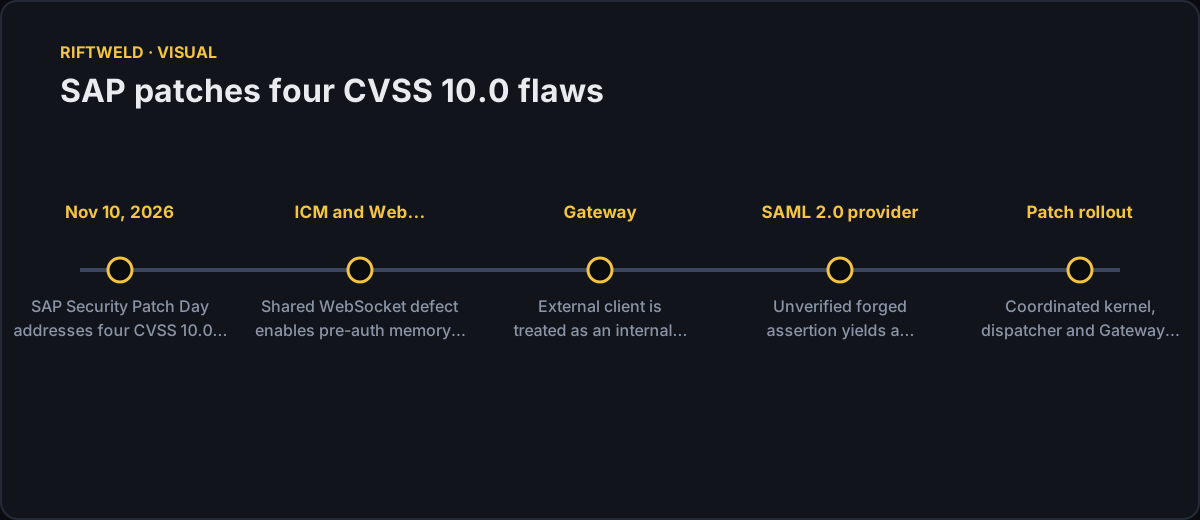
Four CVSS 10.0 flaws fixed on November 10, 2026, could let an unauthenticated attacker run commands as <sid>adm, the operating-system account that owns the SAP installation. The contradiction is stark: WebSocket support is enabled by default even when no application uses it, while Gateway hardening guidance concentrates on access lists that do not govern the vulnerable path.
In this article
Why this matters
The practical consequence of these flaws is not a limited application foothold. The <sid>adm account owns the SAP installation’s executables, instance profiles, secure store and database connectivity, so command execution under that identity can expose credentials, permit changes to configuration or binaries, and provide a path into connected SAP and non-SAP systems (Onapsis ICM2SHELL advisory).
That matters because the affected components sit on paths that defenders often treat as trusted. The Internet Communication Manager, or ICM, receives HTTP, HTTPS and WebSocket traffic for SAP systems, including browser sessions, Fiori applications, OData calls and web service requests. The SAP Web Dispatcher, frequently deployed at the network edge, shares the same vulnerable kernel code and performs WebSocket message reassembly itself rather than merely forwarding traffic (Onapsis ICM2SHELL advisory).
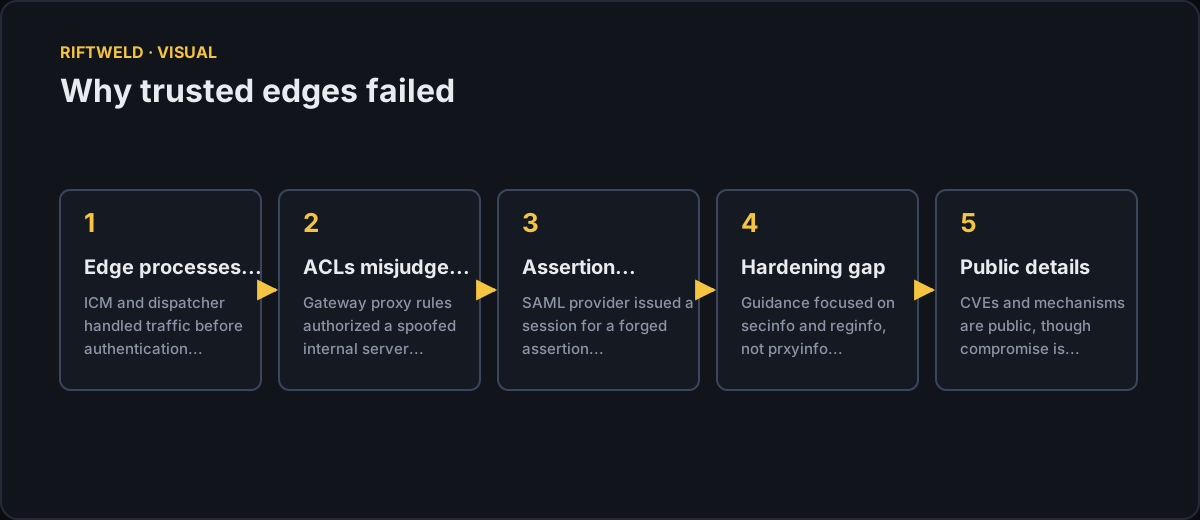
The common failure was an assumption about where trust begins. In the ICM and Web Dispatcher case, the assumption was that a network-facing component could safely process protocol traffic before authentication. In the Gateway case, it was that access-control lists would correctly distinguish an internal application server from an external client. In the SAML case, it was that an assertion presented to the service provider would be verified before a session was issued (The Hacker News).
What happened
SAP’s November 2026 Security Patch Day addressed four flaws, each rated CVSS 10.0 and each described as exploitable without logging in. The Hacker News reported that three flaws were in the SAP NetWeaver application server and one in the Web Dispatcher, and that none required user action (The Hacker News).
| CVE | Component | SAP Note | Reported effect |
|---|---|---|---|
| CVE-2026-76964 | ICM, SAP NetWeaver AS ABAP | 3778530 | Pre-authentication memory corruption and command execution as <sid>adm |
| CVE-2026-89126 | SAP Web Dispatcher | 3778556 | Same shared WebSocket defect, including the Web Dispatcher embedded in SAP HANA XS |
| CVE-2026-89103 | SAP Gateway | 3798345 | External client treated as an internal application server, potentially enabling command execution |
| CVE-2026-120017 | SAML 2.0 service provider, ABAP Platform | 3849308 | Forged assertion accepted, allowing login as a targeted user, including administrators |
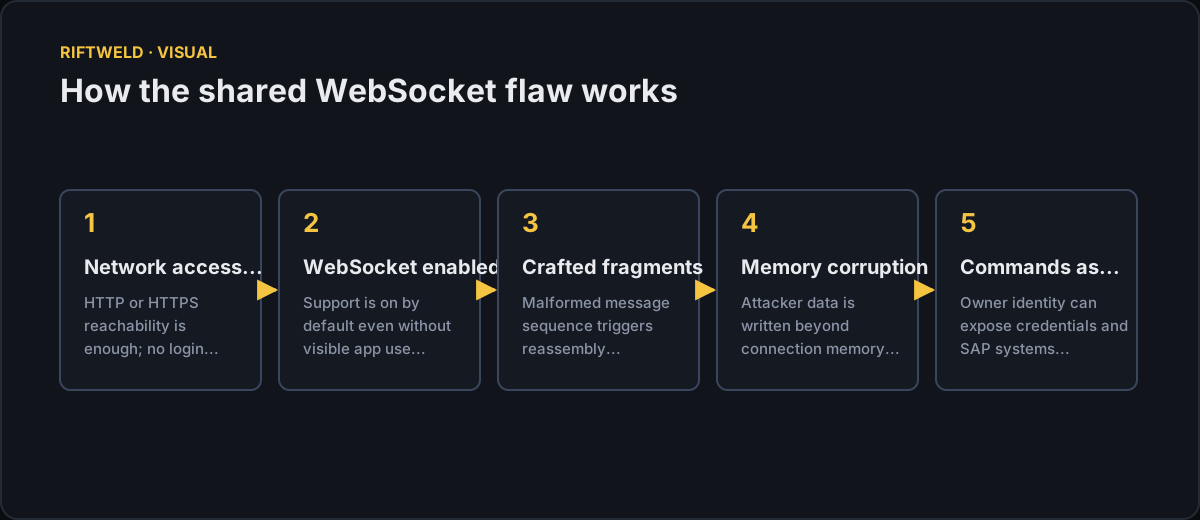
The first two flaws share a root cause that Onapsis calls ICM2SHELL. During WebSocket fragment reassembly, a crafted sequence of messages causes the ICM or Web Dispatcher to write attacker-controlled data beyond the memory reserved for the connection. The result can be a process crash or controlled memory corruption that the attacker converts into arbitrary operating-system commands running as <sid>adm (Onapsis ICM2SHELL advisory).
Onapsis said it supplied SAP with a working exploit achieving full unauthenticated remote code execution end to end, and that the denial-of-service condition reproduced on every SAP kernel release tested. The advisory states that exploitation requires only network access to the HTTP or HTTPS port, with no credentials, user interaction or misconfiguration (Onapsis ICM2SHELL advisory).
The Gateway flaw, tracked by Onapsis as PROXYGATE, operates differently. SAP Gateway uses three access-control lists: secinfo governs which programs may be started and where, reginfo governs which external programs may register, and prxyinfo governs which connections the gateway may relay or open for a client. A crafted request sequence causes the gateway’s CPI-C layer to treat an unauthenticated external client as an internal application server, after which the configured access rules authorize the request (Onapsis PROXYGATE advisory).
The SAML 2.0 service-provider flaw completes the set. On affected configurations, an attacker can forge an assertion that the service provider fails to verify, obtaining a session for a targeted user. The Hacker News reported that privileged users could be targeted, with full compromise potentially following (The Hacker News).
Exposure and control failures
The ICM2SHELL exposure is broader than the list of applications that visibly use WebSocket. WebSocket support is enabled by default in both ICM and the Web Dispatcher, and SAP S/4HANA ships with ICF services that accept WebSocket connections without authentication. In other configurations, the flaw is reachable before authentication takes place (Onapsis ICM2SHELL advisory).
The affected-version lists are correspondingly broad. The Hacker News listed kernels 7.53, 7.54, 7.77, 7.93, 9.16, 9.18 and 9.20 for the ICM flaw, with the Web Dispatcher list also including HDB 2.00, XS_ADVANCED_RUNTIME 1.00 and SAP_EXTENDED_APP_SERVICES 1. The Gateway list included kernels 7.22, 7.53, 7.54, 7.77, 7.93, 8.04, 9.16, 9.20 and 9.21, while the SAML flaw affected SAP_BASIS releases 702 through 920, 921 and 922 as listed (The Hacker News).
Onapsis also listed kernels 7.40, 7.41, 7.42, 7.45, 7.49, 7.73, 7.81, 7.85 and 7.89 as affected by the ICM and Web Dispatcher flaws, and the same kernels plus 7.20 and 7.21 for the Gateway flaw. The Hacker News reported that these out-of-maintenance kernels may never receive fixes and may require an upgrade to a maintained release (The Hacker News).
The Gateway case exposes a specific gap in hardening practice. Guidance concentrates on secinfo and reginfo, but exposure depends on prxyinfo, or on the profile parameter gw/acl_mode_proxy when the file is absent. A restrictive proxy policy prevents the attack from starting, while permissive configurations, including some defaults, leave the system exposed (Onapsis PROXYGATE advisory).
Remediation priorities
The first priority is the coordinated kernel and Web Dispatcher rollout. RedRays found 38 SAP for Me notes dated November 10, comprising nine HotNews, thirteen High, fifteen Medium and one Low, with 35 new notes and three revisions. Seventeen of the patch-day fixes were in the SAP kernel, the standalone Web Dispatcher, or both, which is why a single coordinated rollout addresses the largest share of the month’s risk (RedRays).
The relevant notes are 3778530 for the ICM, 3778556 for the Web Dispatcher and FAQ Note 3778788 for ICM2SHELL. For the Gateway, the fix is Note 3798345 with FAQ Note 3810197. The SAML 2.0 service-provider fix is Note 3849308 for CVE-2026-120017 (Onapsis ICM2SHELL advisory).
Gateway remediation is not only a patch operation. On most kernel releases, SAP’s fix combines a kernel patch with setting gw/acl_mode_proxy = 1. RedRays noted that the kernel fix adds gw/acl_mode_proxy for kernels up to 7.77 and advised ensuring that secinfo and reginfo contain explicit rules (RedRays).
Limits of the record
The record establishes working exploitation capability, not observed compromise. Onapsis stated that its researchers had not observed active exploitation of the ICM, Web Dispatcher or Gateway flaws as of its November 10, 2026 publications. That absence changes the operational tempo rather than the severity, because the CVE identifiers, affected components and configuration gates are now public (Onapsis PROXYGATE advisory).
Public technical detail is also deliberately limited. Onapsis omitted exploitation details from both advisories, stating that the posts were intended for exposure assessment and remediation. The record therefore supports the existence and mechanism of the vulnerabilities, but does not establish how many organizations are exposed, whether any specific installation has been compromised, or whether exploitation has occurred since publication (Onapsis ICM2SHELL advisory).
Method and sources
This analysis draws on SAP’s November 2026 security bulletin, The Hacker News’ November 10 report, Onapsis Research Labs’ ICM2SHELL and PROXYGATE advisories, and RedRays’ review of the patch day. SAP’s bulletin and the SAP for Me notes are the authoritative sources for affected versions and remediation; the Onapsis advisories supply the technical mechanisms and exploitation status; The Hacker News and RedRays provide independent reporting and patch-day context (SAP security bulletin).
Claims about exploitation capability are attributed to Onapsis, which discovered and reported the ICM, Web Dispatcher and Gateway flaws. Claims about affected versions and the absence of fixes for out-of-maintenance kernels are attributed to The Hacker News’ reporting of SAP and Onapsis material. No independent compromise telemetry, incident count or post-publication exploitation data appears in the record, so those questions remain unresolved.