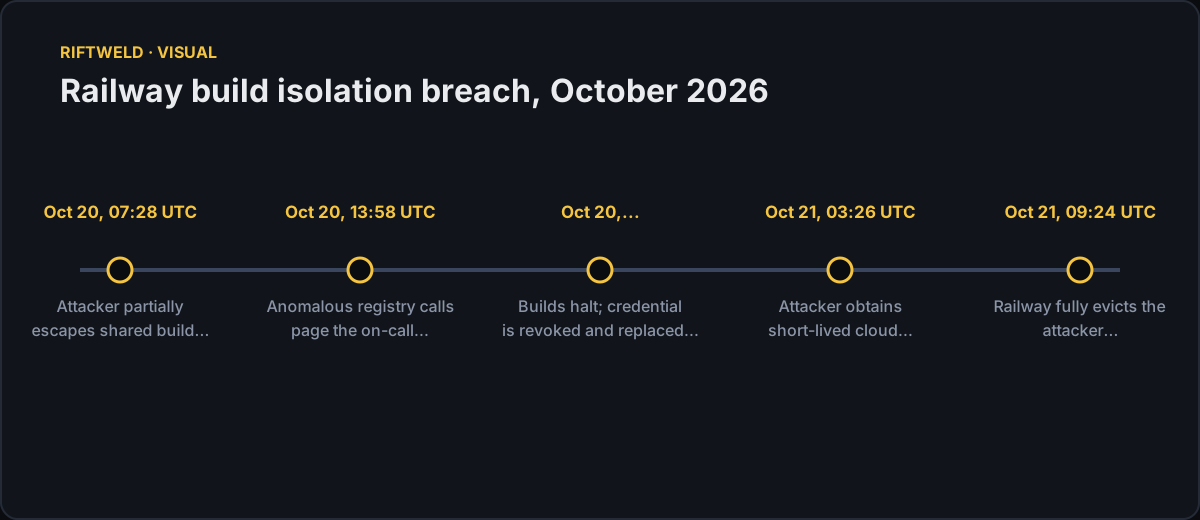
At 07:28 UTC on October 20, 2026, an attacker escaped the filesystem isolation of Railway’s multi-tenant build infrastructure and obtained an internal credential. By 09:24 UTC on October 21, Railway had evicted the intruder—but stolen AI credentials had already produced approximately $740,000 in fraudulent usage.
In this article
Why this matters
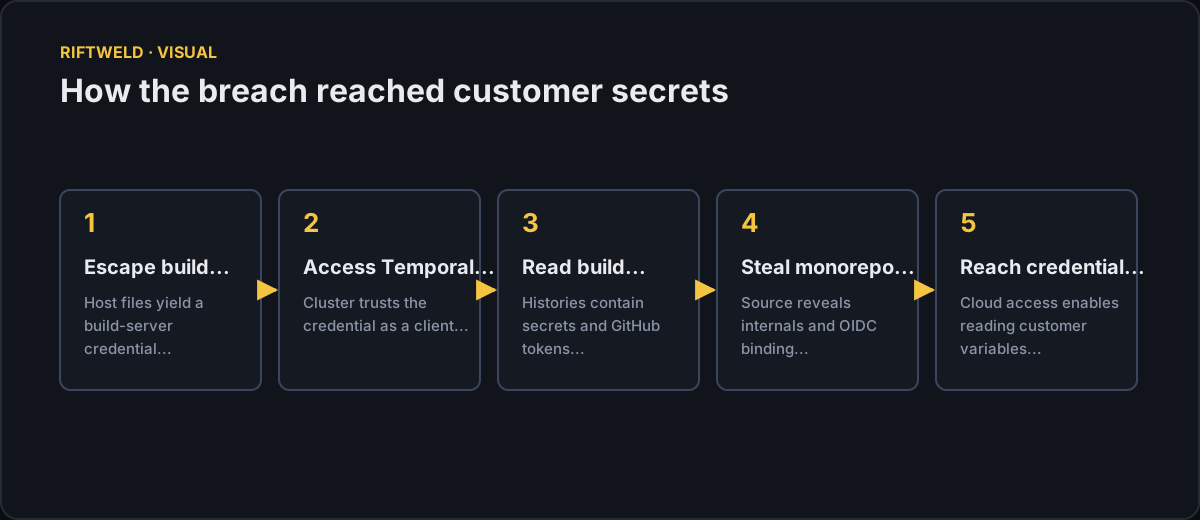
The Railway incident is not simply another report of exposed API keys. It describes a failure of architectural assumptions: that builds running on a shared virtual machine were isolated from one another, that a build-completion credential could not be accepted as a trusted client by an internal task system, and that a cloud identity binding could not be used to reach credentials protecting customer environment variables.
Those assumptions connected Railway’s build platform to customer secrets. The attacker first partially escaped filesystem isolation, then used the resulting credential to read build histories through Railway’s self-hosted Temporal cluster. Those histories contained environment variables, secrets, repository-scoped GitHub application tokens, and build metadata. A retrieved snapshot of Railway’s internal monorepo then gave the attacker a map of the platform, including an erroneously defined OIDC binding that yielded a short-lived cloud credential and a route to the internal credential store protecting customer variables (Railway incident report).
The practical lesson is that the control that failed was not simply “missing a checkbox.” It was the assumption that build infrastructure was a lower-trust layer than production. In Railway’s architecture, build infrastructure held source code, build histories, customer environment variables, and cloud trust bindings. Treating it as tier zero would have changed credential scope, network reachability, isolation design, and monitoring priorities.
| Claim | Status | Basis |
|---|---|---|
| The attacker partially escaped filesystem isolation on a shared build host | Confirmed | Railway’s forensic timeline identifies the exploit at 07:28 UTC on October 20 |
| Decrypted customer environment variables were obtained for at most 1.85% of workspaces, approximately 100,000 | Confirmed | Railway states this was the maximum potentially affected population |
| The number of workspaces whose secrets were actually stolen | Not established | Railway identifies 1.85% as a maximum, not a confirmed theft count |
| Linked-account tokens for 1,852 users were exposed | Confirmed | Railway reset the tokens and notified affected users |
| Stolen credentials generated approximately $740,000 in unauthorized AI usage | Confirmed | Railway and BleepingComputer report the figure |
| Customer Git repositories or databases were accessed | Not established | Railway found no evidence of either |
| The attackers targeted AI credentials for resale or distillation | Company statement | Railway’s forensic assessment, supported by Wiz’s campaign analysis |
What happened
Railway’s account begins with reconnaissance at 06:50 UTC on October 20. At 07:28, the attacker exploited a previously unknown vulnerability to partially escape filesystem isolation and read some files on the host virtual machine. Those files yielded a credential used by build servers to authenticate to a subset of internal systems, including pushing images after builds completed. Railway says the attacker initially failed when using that credential against a variety of systems (Railway incident report).
The credential’s intended scope was narrow, but Railway’s self-hosted Temporal cluster accepted it as a trusted client. Because the architecture allowed the attacker to call APIs intended for a Temporal client elsewhere, the attacker read a limited subset of stored build histories, including build variables. One retrieved build was for Railway’s support platform, deployed from the internal monorepo. Because the credential could fetch repository-state snapshots used for caching, the attacker obtained a copy of that monorepo. Railway says this gave the attacker a privileged view of its internals, enabling agent fanouts, exploit discovery, and lateral movement.
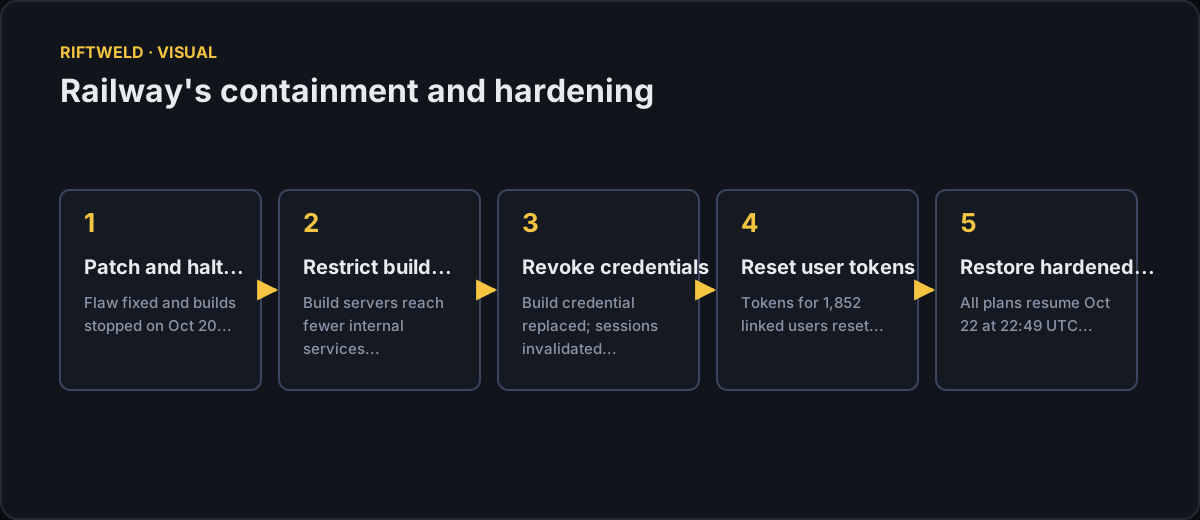
Detection came at 13:58 UTC, when anomalous registry API calls paged the on-call engineer. The team traced those calls to the compromised build credential and the isolation escape, then worked in parallel to patch the flaw, halt builds, and harden infrastructure. Railway halted builds at 17:03, revoked and replaced the credential at 17:28, and restricted what services build servers could reach. Builds were later re-enabled, but the attacker had already obtained the monorepo and used it to search for new escalation paths (Railway incident report).
The second entry point emerged from that source-code access. Railway’s CI/CD system could obtain short-lived cloud credentials for production deployment. The attacker found an erroneously defined OIDC binding in one cloud environment and, at 03:26 UTC on October 21, obtained a short-lived cloud credential through it. Railway identifies two relevant internal credentials: a longer-lived credential that, combined with internal VPC access, enabled reading encrypted environment variables from a production database, and an SSH private key used by the CD system to push binaries to specific machines. The available incident-report excerpt truncates before describing the SSH key’s full effect, so its precise role beyond that stated use is not established here.
Railway halted builds again at 07:22 UTC on October 21 and fully evicted the attacker at 09:24. It invalidated every user session and token at 20:19, then restored builds for all plans at 22:49 on October 22 after significant hardening. The interval from the initial exploit to full eviction was roughly 26 hours, during which Railway says both sides probed and hardened routes in parallel. The company characterized the confrontation as a “contest of agent speed,” with defenders facing abliterated models and a harness similar to ARTEX, according to Wiz (BleepingComputer).
What the evidence establishes—and what it does not
The strongest confirmed impact is financial and credential-specific. Railway says attackers obtained decrypted customer environment variables for at most 1.85% of workspaces, approximately 100,000, and that stolen credentials generated about $740,000 in unauthorized AI usage. The company is working with affected AI providers to reimburse customers and says it will cover charges providers decline to refund. Linked-account tokens for 1,852 users—including GitHub OAuth tokens and AI agent keys—were exposed, reset, and the affected users notified (BleepingComputer).
The 100,000-workspace figure requires care. Railway explicitly describes it as the maximum number of potentially impacted workspaces, not the confirmed number whose secrets were stolen. It is therefore an upper bound on exposure, not a measured theft count. The record also does not establish how many of those workspaces contained AI provider credentials capable of generating charges, how the $740,000 was calculated, or whether Railway bore the full amount.
Railway found no evidence that attackers downloaded customer Git repositories or accessed customer databases. That is not equivalent to proof that neither occurred. The company’s reconstruction of attacker requests from build logs supports the narrower statement that its investigation did not establish such access. Likewise, Wiz’s references to approximately $371,000 in cryptocurrency theft using keys stored in Railway are anecdotal social-media reports, not a verified loss figure from Railway’s investigation (Wiz).
The attribution to resale and model distillation is a forensic assessment rather than a demonstrated end-to-end chain of custody. Railway says its investigation indicates the attacker specifically targeted AI provider credentials for sale to distributed transfer stations used in distillation. Wiz notes that OpenCode and CommandCode explicitly attributed their incidents to distillation attempts, and that Fireworks, OpenCode, and Warp reported signs of an “agent swarm” attack. The broader pattern is well supported; the precise identity and intent of Railway’s attacker remain unestablished.
Defensive implications
The first implication is to constrain credentials by their actual blast radius. A credential intended for registry pushes should not be accepted as a trusted client by a system holding customer secrets. Railway’s own response included restricting what services build servers could reach, but the deeper control is architectural: build identities should be narrowly scoped, separately authenticated, and unable to traverse into task histories or production credential stores.
The second is to treat source-code snapshots as sensitive assets. The monorepo did not merely expose implementation details; it enabled the attacker to find dormant endpoints and an OIDC misconfiguration that opened a new path. Cloud identity bindings should therefore be inventoried against actual live references, and stale or erroneous configurations should be removed rather than left discoverable in code.
The third is to prepare for machine-speed abuse. Wiz observed downstream cases in which unauthorized activity began within 30 minutes of reported vendor credential access. In one case, an actor made approximately 800,000 Bedrock calls over more than thirty hours, with roughly a 90 percent success rate before remediation. Detection based on periodic review or human-speed triage is poorly matched to that behavior (Wiz).
For Railway customers, the practical response is to rotate secrets that passed through affected workspaces, invalidate sessions and tokens, review AI-provider billing for anomalous usage, and audit cloud bindings. Railway has already reset the 1,852 affected linked-account tokens, but customer-held secrets remain the customer’s responsibility.
Method and sources
This analysis relies on Railway’s November 10, 2026 incident report, BleepingComputer’s coverage published the same day, and Wiz’s “Black October” threat analysis. Railway’s report provides the primary technical chronology and company findings; BleepingComputer corroborates the reported financial impact and token exposure; Wiz supplies the campaign-level pattern and observed downstream abuse.
Claims are labeled according to their evidentiary status. Confirmed findings are stated directly by Railway’s investigation or reported consistently by the outlets. Company statement identifies Railway’s forensic conclusions, including the targeting rationale. Reported identifies Wiz’s campaign observations. Not established marks matters the record does not resolve, including the actual number of workspaces whose secrets were stolen and the absence of customer repository or database access. The available Railway excerpt is truncated during its description of the SSH private key, so no broader conclusion is drawn about that credential’s subsequent use.