Five GitHub advisories, one anonymous entry point, and a warning that "with current AI tools it may not take long to turn them into a working exploit" — yet no exploit or confirmed victim appears anywhere in the record. The Plone/Zope Security Team released fixes for a five-package remote code execution chain on 2026-11-10, and the same announcement tells operators to inspect their databases for conditions that the patch will not clean up.
In this article
Why this matters
The failure was not a single bug but a broken trust boundary. Plone's Restricted Python sandbox is designed on the assumption that restricted code can reach only names the platform deliberately publishes. In the affected packages, allow_module() calls published entire modules — and everything those modules imported — to restricted code, while the conditional-modifier classes in Products.CMFEditions carried no security declarations at all, leaving their edit method publishable without a permission check. The assumption that "publishable" implies "authorized" and that "module exposure" implies "narrow exposure" both failed at once (GHSA-67qm-q795-jh7h, GHSA-92qw-564p-pmg6).
The practical consequence is severe because the entry point is anonymous. The Plone/Zope Security Team states that the chain "together let an anonymous visitor run code on the server," and that all supported Plone versions — 6.0, 6.1 and 6.2 — are affected, with older versions affected back to at least Plone 4.3. The team also notes that Plone 5.2 and older have been out of security support for several years, and that it made an exception for them because of the severity (Plone security hotfix 20261110).
What happened
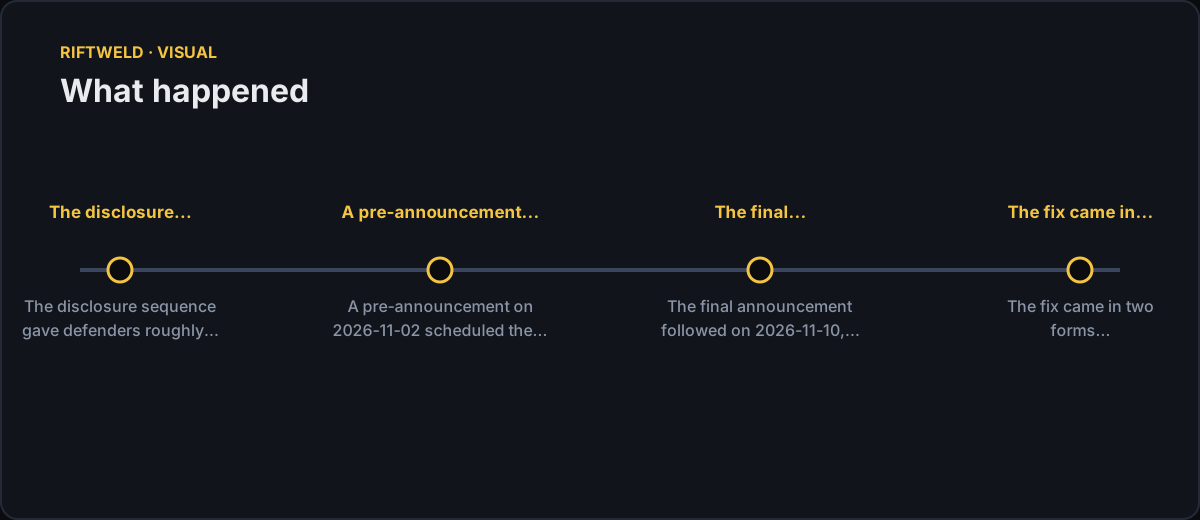
The disclosure sequence gave defenders roughly eight days. A pre-announcement on 2026-11-02 scheduled the fix for 2026-11-10 around 13:00 UTC and instructed operators to block URLs containing portal_modifier at the web server, warning that an AI might create an exploit from that information alone. The final announcement followed on 2026-11-10, with the oss-sec mirror dated 2026-11-11 00:29 CET (pre-announcement, oss-sec).
The fix came in two forms. Operators on Plone 6.0, 6.1 or 6.2 were told to update package versions; operators on any Plone version from 4.3 to 6.2 could install the Products.PloneHotfix20261110 package, which works on Python 2.7 and Python 3. Full releases Plone 6.0.16, 6.1.6 and 6.2.3, including Docker images, were published in the following hours (Plone 6.2.3 released, PyPI).
| Claim | Status | Basis |
|---|---|---|
| The chain lets an anonymous visitor run code on the server | Company statement | Plone/Zope Security Team announcement |
| All supported Plone versions and versions back to at least 4.3 are affected | Company statement | Hotfix announcement |
Products.CMFEditions modifier classes lacked security declarations |
Confirmed | GHSA-67qm-q795-jh7h |
Products.CMFPlone, Products.MimetypesRegistry and plone.batching exposed whole modules via allow_module |
Confirmed | GHSA-92qw-564p-pmg6, GHSA-xcj2-cmp9-fj62, GHSA-6hcx-c235-cxh3 |
plone.restapi exposed json, enabling calls to protected methods without permission |
Confirmed | GHSA-vgxm-pwch-89q6 |
| A working exploit exists or has been used in the wild | Not established | No exploit or incident report in the record |
| CVE identifiers have been assigned | Not established | Numbers requested; no CVE records found at research time |
The chain and the failed assumption
The first link is Products.CMFEditions. Conditional modifiers held in portal_modifier had no security declarations, so an anonymous visitor could change a modifier's TALES condition and then run it. The condition is also evaluated when an editor saves versioned content, meaning the flaw can execute with the editor's privileges even without the rest of the chain. The fix protects edit with the "Manage portal" permission, protects accessors with "View management screens," and makes the size-guard hooks private (GHSA-67qm-q795-jh7h).
The second group breaks the sandbox. Products.CMFPlone called allow_module() on Products.CMFPlone.utils, Products.CMFPlone.browser.navtree and OFS.ObjectManager; Products.MimetypesRegistry published Products.MimetypesRegistry.common; and plone.batching published plone.batching. Because allow_module() exposes every name in a module, helper objects imported from elsewhere became reachable, letting restricted code escape the sandbox and reach modules such as os. The remediations replace blanket exposure with explicit public-name lists and add defense-in-depth denials for dangerous functions (GHSA-92qw-564p-pmg6, GHSA-xcj2-cmp9-fj62).
The fifth issue is plone.restapi, which called allow_module("json") on import, exposing the standard-library json module to restricted code. Some json functions could then call protected methods on any object without the required permission. The advisory traces the call to a 2015 commit that added it for a customized standard_error_message skin script using json.dumps; the script was removed shortly afterward, but the declaration remained, and no release needs it (GHSA-vgxm-pwch-89q6, commit 1ff230c).
Limits of the record
Several boundaries matter. The AI-exploitation warning is the Plone/Zope Security Team's own assessment, not an observed exploit; no proof-of-concept or independent exploit appears in the record. The same applies to active exploitation: the announcement asks operators to check whether modifier conditions were changed, but explicitly warns that "a difference does not necessarily mean that your site was attacked," because defaults have shifted over time and add-ons or administrators may have made legitimate changes (hotfix announcement).
CVE identifiers were requested and were to be added to the advisories when assigned; no CVE records were found for the five GHSA identifiers at the time of research, so the GHSA identifiers are the only stable references. The severity labels also differ slightly between sources: the oss-sec mirror lists plone.restapi as medium, while the research report describes it as moderate, and the other four as critical. The record also does not establish how many sites were exposed, whether any site was compromised, or whether the portal_modifier workaround was applied before publication.
One operational point is confirmed and easy to miss: a changed modifier condition persists in the database after the fix is installed. With updated Products.CMFEditions, a Manager can visit @@check-modifier-conditions at the site root to compare stored conditions against defaults and revert them; with the hotfix, startup logs POSSIBLE ATTACK: MODIFIED VERSIONING CONDITIONS FOUND when a condition differs. The team advises treating an unrecognized condition as a compromised server (hotfix announcement).
Method and sources
This analysis draws on the Plone/Zope Security Team's pre-announcement of 2026-11-02 and hotfix announcement of 2026-11-10, the oss-sec mirror, the five GitHub Security Advisories for Products.CMFEditions, Products.CMFPlone, Products.MimetypesRegistry, plone.batching and plone.restapi, the plone.restapi commit history, the PyPI listing for Products.PloneHotfix20261110, and the release threads for Plone 6.0.16, 6.1.6 and 6.2.3. The reporter was Mokrane ABDELMALEK via the Ghent University VDP programme, with additional fix ideas from Andreas Jung.
Claims drawn from vendor announcements are labeled as company statements; package-level defects are treated as confirmed by the advisories; the exploitation and CVE status are marked as not established. The record is detailed on mechanism and remediation but thin on incident evidence, so no conclusion about real-world exploitation is drawn here.