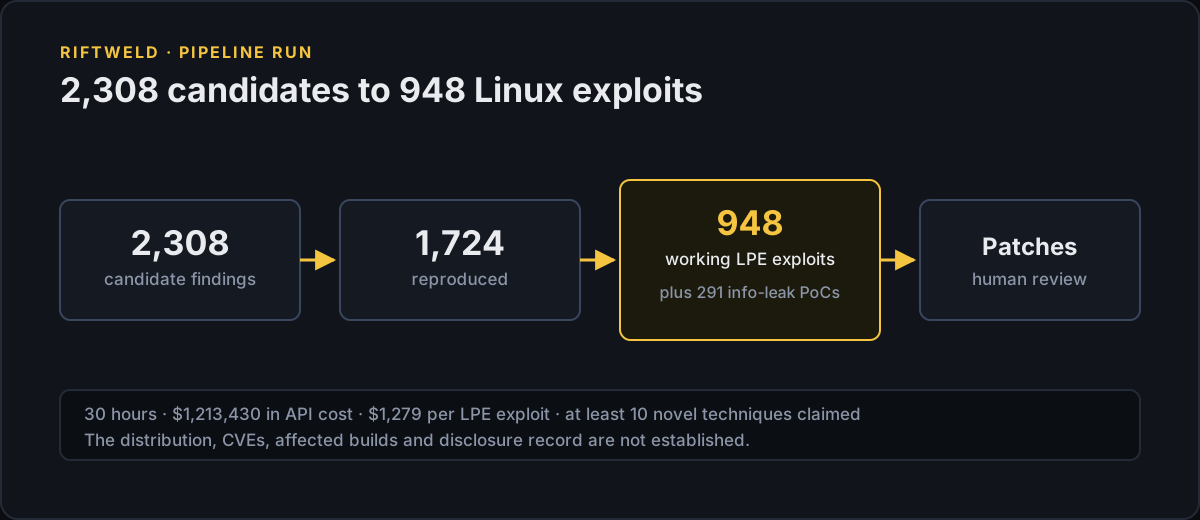
OpenAI says its agents turned 2,308 Linux kernel candidates into 948 working local privilege escalation exploits in 30 hours. The claim is about scale. The disclosure record is the part that decides what it means.
The run reportedly cost $1,213,430 in API credits, or about $1,279 per LPE.
In this article
Why this matters
If the numbers hold, the economics of kernel exploitation have moved. A local unprivileged account is often treated as a contained foothold. OpenAI's own conclusion is blunter: on an operating system that is not current on its latest patches, a low-privileged account should be treated as functionally equivalent to root for a well-resourced threat actor (The Hacker News).
That changes the defensive priority. Detection still matters, but patch latency and backport coverage become the controls that decide whether a local foothold stays local. A fleet with slow kernel patching is not facing a hypothetical future risk; it is facing the exact condition the pipeline is designed to exploit.
The disclosure gap matters just as much. A count of working exploits without a named distribution, kernel versions, CVE assignments or maintainer confirmation is an operational unknown. Defenders cannot map the 948 findings to their own builds from the public account.
The pipeline also pairs exploit generation with patch generation and a human review gate before findings are reported to maintainers. That is the mitigating design. What the record does not show is whether the patches were accepted, whether CVEs were assigned, or whether the findings reached the right maintainers at all.
What happened
OpenAI detailed the work on Wednesday; The Hacker News reported it on November 5, 2026. The system used an upcoming cyber-focused model to identify and analyze 2,308 candidate Linux kernel findings, dynamically reproduce 1,724 vulnerabilities, generate proofs of concept for 291 information-leak vulnerabilities, and produce 948 working local privilege escalation exploits for what the report calls “a commonly used Linux distribution” (The Hacker News).
The run took place in mid-October 2026 and lasted 30 hours. OpenAI put the total API cost at $1,213,430, or about $1,279 per LPE exploit. It said the agents discovered and used at least 10 novel Linux exploitation techniques, which it grouped into two persistent elastic objects for object spraying, two page-grooming techniques, five data-only techniques, and one arbitrary type-confusion technique (The Hacker News).
The findings build on 24 LPE exploits that OpenAI says its GPT-5.5-Cyber model discovered in June 2026. The new work turns the process into an agentic pipeline rather than a single model pass.
What the pipeline does
OpenAI describes five stages, and the ordering is the engineering claim:
- Vulnerability discovery — agents choose high-value audit targets and surface candidate findings.
- Dynamic validation — agents try to reproduce each candidate in a sandbox and preserve runtime evidence.
- Exploitability assessment — agents test whether a validated bug can produce information disclosure or LPE, and build a proof of concept.
- Patch generation — agents generate a fix for the finding.
- Human review — researchers review the exploit, patch and proposed severity before the finding is reported to maintainers.
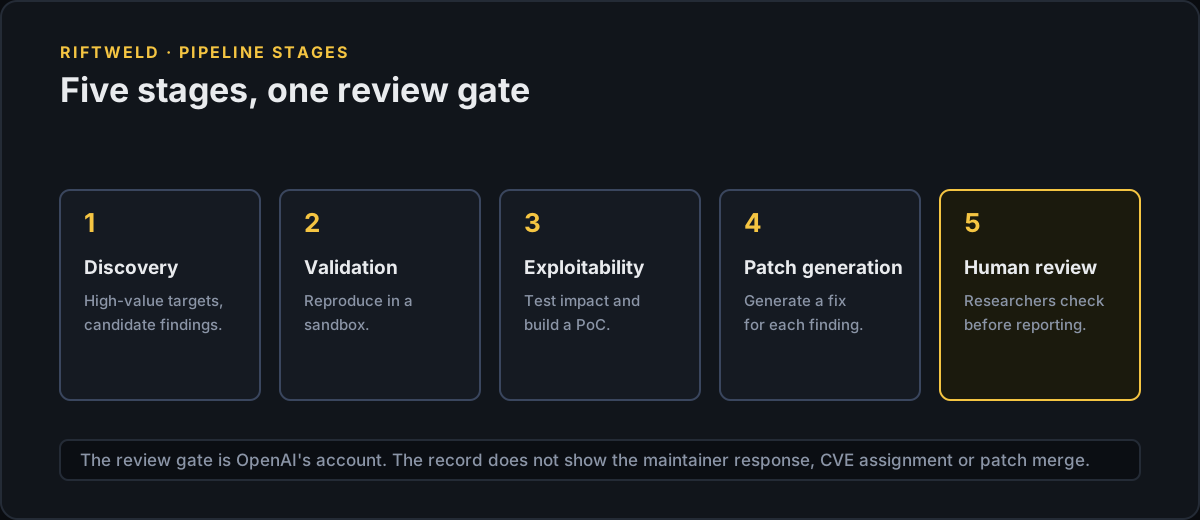
The stage that matters most for defenders is the last one. A generated exploit is not a disclosed vulnerability. A generated patch is not a merged fix. The record describes a human review step before reporting, but it does not describe what happened after the report.
What the record supports, and where it stops
The public record here is OpenAI's account carried by The Hacker News, plus the context the outlet cites. It is not a primary technical disclosure, a maintainer statement or an independent audit.
| Claim | Status | Basis |
|---|---|---|
| OpenAI detailed a five-stage pipeline using an upcoming cyber-focused model | Reported | The Hacker News, 5 November 2026 |
| 2,308 candidates; 1,724 reproduced; 948 LPE exploits; 291 info-leak PoCs | Reported | OpenAI's account via The Hacker News |
| 30-hour run; $1,213,430 API cost; about $1,279 per LPE; at least 10 novel techniques | Reported | OpenAI's account via The Hacker News |
| Builds on 24 LPEs found by GPT-5.5-Cyber in June 2026 | Reported | OpenAI's account via The Hacker News |
| Human review before findings are reported to maintainers | Reported | OpenAI's description of the pipeline |
| Independent reproduction of the 948 exploits | Not established | No third-party audit or exploit samples in the record |
| Affected distribution, kernel versions or configurations | Not established | Described only as “a commonly used Linux distribution” |
| CVE assignment or patch merge with maintainers | Not established | No identifier or maintainer record in the public account |
| Public release or weaponisation of the exploits | Not established | No release detail in the record |
| Derived rates: 74.7% reproduced, 55.0% of reproduced became LPE, 71.9% produced any PoC, about $40,000 per hour | Inferred | Arithmetic on the reported figures |
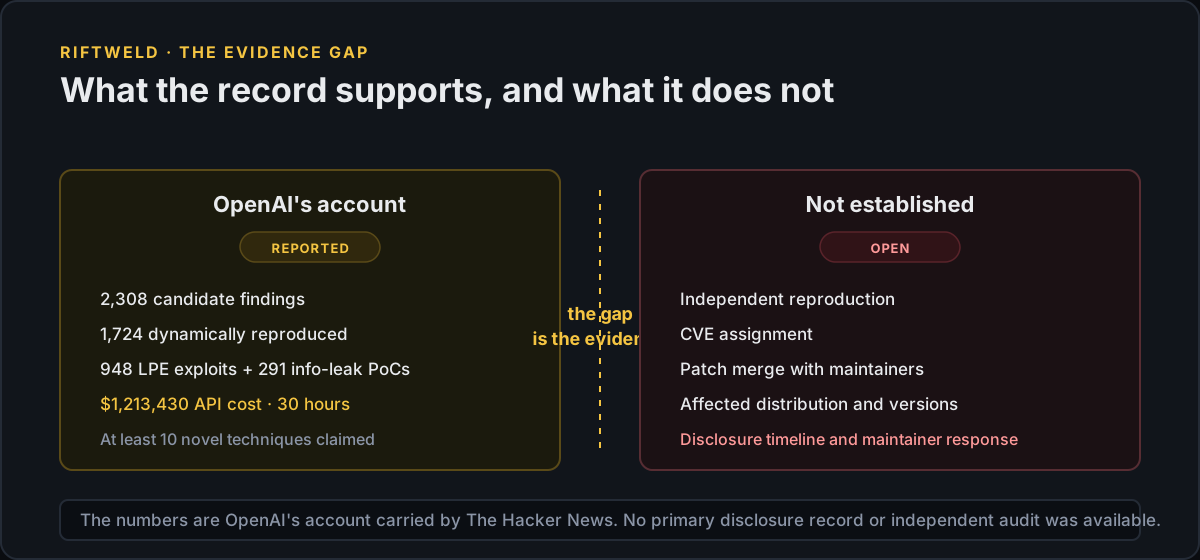
The arithmetic is useful but easy to overread. Of 2,308 candidates, 1,724 were reproduced (about 74.7%). Of those, 948 became working LPE exploits (about 55.0%), and 291 became information-leak PoCs. The 948 and the 291 are not the same kind of output; the pipeline produced 1,239 PoCs in total, or about 71.9% of the reproduced set. The $1,279 per LPE figure is OpenAI's; dividing the reported cost by the 948 LPEs gives roughly $1,280, and by 30 hours gives roughly $40,000 per hour. Those are derived ratios, not independently verified measurements.
The context the outlet cites points in the same direction: Google Threat Intelligence Group data shows monthly vulnerability disclosures rising from 5,045 in January 2026 to 10,740 in August 2026, and high-risk disclosures rising from 131 to 350. The U.K. NCSC says AI-powered tools have almost certainly increased zero-day discovery. VulnCheck calls AI-assisted vulnerability discovery a growing risk category. None of that validates OpenAI's specific count; it explains why the count matters.
What to do
Treat a local account on an unpatched kernel as root. OpenAI's own framing is the right planning assumption for a well-resourced adversary. Prioritise kernel patch latency and backport coverage on multi-tenant, internet-facing and high-value hosts.
Map the gap, not the headline. Until the distribution, versions and CVE record exist, the 948 figure cannot be mapped to a fleet. Track maintainer advisories and CVE assignments for the kernels you run, and do not treat the vendor's count as an inventory.
Measure patch latency. If a kernel bug can be turned into a working LPE in a 30-hour automated run, the window between disclosure and exploitation is shorter than most patch cycles. Measure the time from advisory to production patch, not the time from ticket to ticket closure.
Use AI-assisted patching with human review. The pipeline's patch-generation stage is the mitigation, but a generated patch is not a merged fix. Require review, tests and backport verification before treating an AI-generated patch as production-ready.
Reduce local footholds. The exploit class needs a local starting point. Remove unnecessary local accounts, constrain interactive access on sensitive hosts, and monitor for privilege-escalation behaviour rather than only for exploitation of a known CVE.
Method and sources
This analysis relies on The Hacker News article by Ravie Lakshmanan, published 5 November 2026, which carries OpenAI's account, and on the context the outlet cites from Google Threat Intelligence Group, the U.K. National Cyber Security Centre and VulnCheck. The pipeline mechanics, counts, cost and technique categories are OpenAI's claims as reported; they were not independently verified here.
The record does not name the Linux distribution, the kernel versions, the maintainers who received the findings, the CVE identifiers or the patch-merge outcome. Where the record is incomplete, this article says so rather than filling the gap.