More than 30 proof-of-concept scripts appeared in a public repository on November 9, 2026, and N-able took its hosted N-central environments offline the same day. The contradiction is stark: a platform built to manage fleets of managed devices was itself the target, and the vendor's own status page still listed the incident as "Investigating" with no end time.
In this article
Why this matters
N-central is not an ordinary web application. It is a privileged remote monitoring and management platform that holds credentials for the estate it administers and can write configuration across appliances. The failed assumption is that a management console can be treated as a low-value administrative surface, patched on a normal maintenance cycle, and left running while defenders stage a fix. The disclosed proof-of-concept set attacks that assumption directly: the repository includes scripts for credential access, cross-appliance writes, system configuration writes, remote-control audit tampering and multiple paths to remote code execution (Oracle-Security GitHub repository).
That changes the containment calculus. If an attacker reaches a monitoring server that already holds privileged access to managed endpoints, the attacker does not need to exploit each managed host individually. The management plane becomes the pivot. N-able's decision to remove hosted N-central from service across the Americas, APAC and Europe, and to advise on-premises operators to keep their servers offline until a hotfix is available and successfully applied, is consistent with that reading rather than with a routine patch rollout (N-able uptime page).
The availability cost is visible and immediate. The security cost is larger and less bounded. SecurityWeek reports that the disclosed weaknesses can be used to execute arbitrary commands, create unauthorized administrative accounts, and leak sensitive data including configurations and credentials (SecurityWeek). A patched instance that was exposed during the disclosure window cannot simply be assumed clean, because the published set includes primitives for creating administrative accounts and tampering with remote-control audit records.
What happened
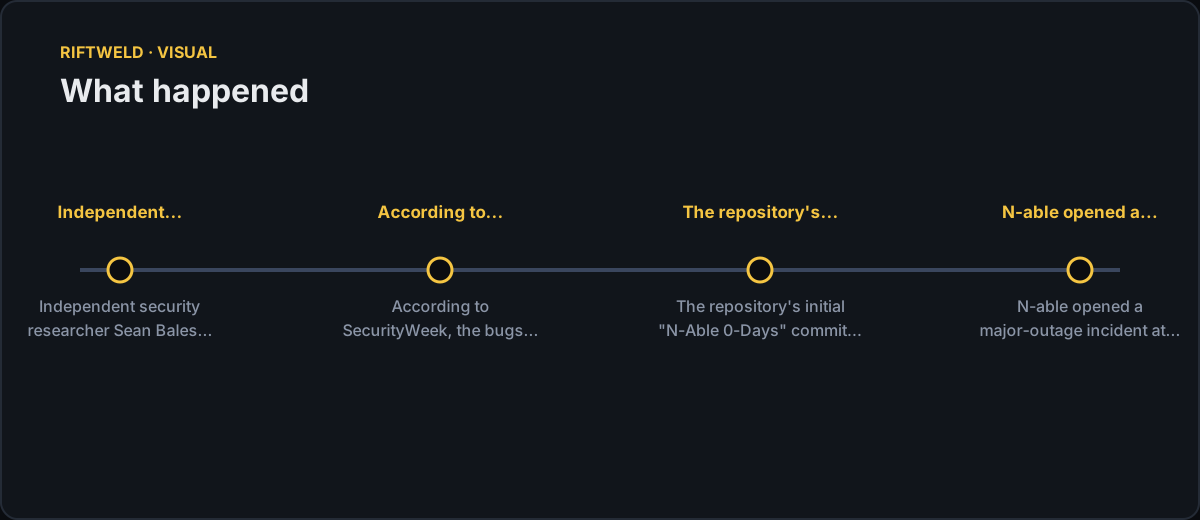
Independent security researcher Sean Bales published the flaws on GitHub under the name "Able2Shell" on Sunday, November 9, 2026. According to SecurityWeek, the bugs had not been assigned CVE identifiers at the time of publication, and Bales released proof-of-concept code targeting every flaw, describing four exploit chains that could produce remote code execution with nable or root privileges (SecurityWeek). The repository's initial "N-Able 0-Days" commit and a same-day README disclaimer commit are both dated November 9, 2026 (Oracle-Security GitHub repository).
N-able opened a major-outage incident at 14:00 UTC on November 9, 2026, with the status "Investigating" and no end time assigned. The company described the event as a critical security incident, said it was observing scanning activity associated with the published proof-of-concept code, and stated it had no evidence that any customer environment had been successfully exploited. Its stated remediation target was mid-day on November 10, EST, with hotfix and validation work described as on track (N-able uptime page).
The shutdown was partial in scope but severe in effect. Hosted N-central classic environments and associated services were unavailable, while Ecoverse services reachable through N-able Login — including Asset View, Patching, Vulnerability Management, scripting, policies and tagging — remained online. N-able also made N-able.app available, Take Control from Asset View, and a preview of on-demand Windows Patching (N-able uptime page). The result was degraded management capability rather than a total loss of endpoint operations.
| Claim | Status | Basis |
|---|---|---|
| More than 30 previously unknown N-central flaws were publicly disclosed with PoC code | Reported | SecurityWeek account of Bales's disclosure |
| Hosted N-central was taken offline across the Americas, APAC and Europe | Confirmed | N-able status page, incident 202580 |
| On-premises operators were advised to keep N-central offline until patched | Company statement | N-able status page guidance |
| Scanning activity tied to the published PoC code is under way | Company statement | N-able status page |
| Any customer environment has been successfully exploited | Not established | N-able reports no evidence of successful exploitation |
| The Able2Shell hotfix version | Not established | No version identified in the status page or SecurityWeek report |
The management-plane exposure
The repository's file listing is more informative than a bare count of vulnerabilities because it shows distinct post-exploitation objectives rather than one bug repeated. The clearest execution paths are named anonymous_mms3_xss_ognl_rce.py, anonymous_mms3_xss_root_rce.py, anonymous_xxe_nable_rce.py and audit_export_root_rce.py. Taken with SecurityWeek's description of four RCE chains, these names indicate that the researcher did not rely on a single injection point: XSS chained into OGNL evaluation, XXE and an audit-export path each represent a different route to server-side execution (Oracle-Security GitHub repository).
For defenders, the implication is that a single blocked endpoint or a single input filter is not a defensible containment strategy. The attack surface is distributed across request handling, XML parsing and administrative export functionality. Containment by perimeter filtering alone would also conflict with N-able's own instruction to keep instances offline until the hotfix is available and successfully applied.
The credential and configuration primitives are the pivot point of the incident. The repository includes anonymous_asset_job_credentials.py, anonymous_mms3_ecosystem_credentials.py, anonymous_sysconfig_write.py and anonymous_mms2_cross_appliance_write.py. Combined with anonymous_probe_inventory.py, which indicates an enumeration primitive aimed at inventory discovery, these scripts form a coherent path from initial access to fleet-wide impact: identify what the platform manages, obtain credentials, and write configuration across appliances (Oracle-Security GitHub repository).
Persistence and anti-forensics deserve equal attention. SecurityWeek lists unauthorized administrative account creation among the disclosed outcomes, and the repository adds anonymous_remote_control_audit_tampering.py, anonymous_remote_control_disconnect.py and appliance_registration_customer_binding.py. The operational inference is that an attacker may be able to create an account that survives the patch, interfere with remote-control sessions, or alter the binding between appliances and customers. A patch therefore restores code integrity, not necessarily trust in an exposed instance's administrative state.
Limits of the record
Several boundaries should be stated plainly. First, the flaws are described by the researcher and reported by SecurityWeek; the record contains no CVE identifiers, no N-able advisory confirming the individual findings, and no independent reproduction. The repository's filenames corroborate the breadth and naming of the claimed primitives, but a filename is not a technical validation of exploitability.
Second, exploitation is not established. N-able reports scanning activity associated with the published PoC code and no evidence of successful exploitation in any customer environment. That is a company statement, not an independently audited finding, and it describes the state of knowledge at the time of the status update rather than a guarantee about later activity (N-able uptime page).
Third, attribution is limited. SecurityWeek states that Bales explained the zero-days were dropped after N-able failed to patch security defects he previously reported in another product. That is a disclosure motive, not evidence of state or criminal sponsorship. The tradecraft to watch is opportunistic use of public weaponized code by unaffiliated actors, not a named intrusion set.
Fourth, the Able2Shell hotfix version is not identified in the record. The status page separately lists N-central 2026.4 HF1, released to address three AlmaLinux CVEs, with hosted environments already patched. That release addresses a different vulnerability class and should not be treated as the Able2Shell remediation (N-able uptime page).
Method and sources
This analysis draws on three sources: N-able's uptime and incident page, which supplies the vendor's operational posture, affected regions, remediation guidance and exploitation statement; SecurityWeek's report, which supplies the researcher's account of the disclosure, the number of flaws, the four RCE chains and the stated outcomes; and the Oracle-Security GitHub repository, which supplies the published file listing and commit dates.
Claims are separated by evidentiary status. Vendor operational actions and guidance are treated as company statements. The scale and consequences of the disclosure are treated as reported by SecurityWeek from the researcher's account. The interpretation that N-central functions as a credential cache and control plane, and that patching alone may not restore trust in an exposed instance, is an inference from the platform's role and the published primitives. The record does not establish successful exploitation, the identity of any attacker, the technical validity of each individual proof of concept, or the version of the Able2Shell hotfix.