On November 11, 2026, a fake CAPTCHA page on quill-kraee-um2gf[.]pro pushed a macOS user toward Terminal, and the resulting payload posted to 171.22.131[.]24:8133 four times before macOS moved it to Trash. The same campaign had already been tracked across more than 1,650 compromised websites, showing how a user-assistance trick scales on familiar domains.
In this article
Why this matters
The Macfinger campaign does not need to defeat macOS code signing, notarization, or Gatekeeper. It asks the user to defeat them by running a shell command directly. That assumption — that the operating system’s application trust path governs what executes on a Mac — is what fails, and it fails in the user’s hands rather than in a vulnerability.
The scale of the delivery layer makes the technique more consequential than a single phishing domain. Ransom-ISAC tracked the infrastructure from July 28 to September 14, 2026, identifying more than 1,650 compromised websites, mostly small and mid-sized WordPress sites, and 154 rotating command-and-control hostnames (Ransom-ISAC). Those are site and hostname counts, not infection counts, and the number of infected Macs remains unknown.
For defenders, the practical consequence is that domain reputation alone is a weak signal. A familiar business site can serve a full-page bot-protection overlay that instructs the visitor to open Spotlight, type “Terminal,” paste a command, and press Return. The site’s own reputation, TLS posture, and hosting history may all look normal while the injected script does the work (SANS ISC diary 33360).
What happened
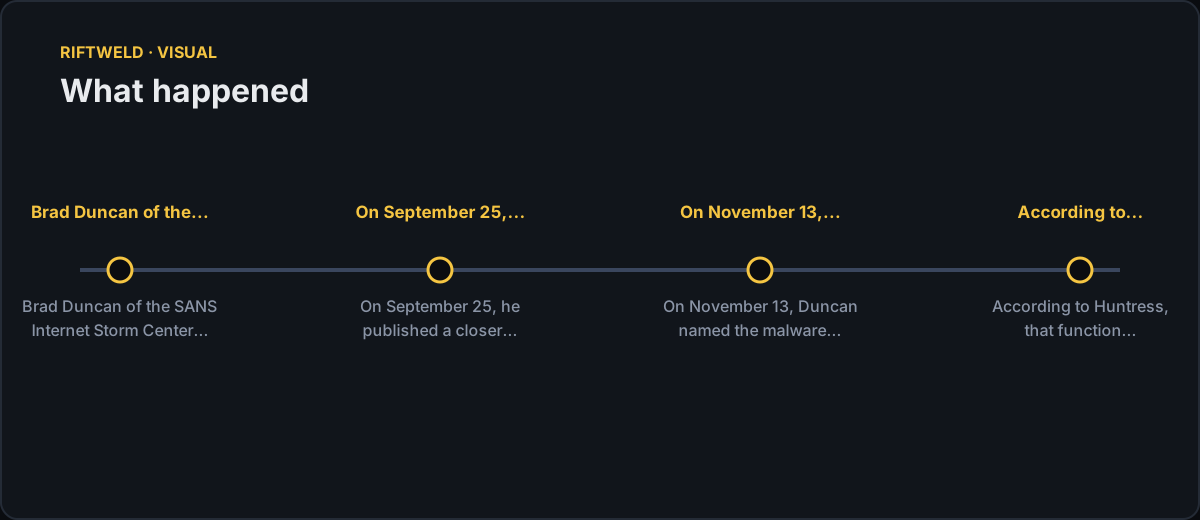
Brad Duncan of the SANS Internet Storm Center first documented the Macfinger ClickFix campaign on September 22, 2026, naming it for its macOS-focused fingerprinting and explicitly noting it was unrelated to the decades-old MacFinger utility. On September 25, he published a closer analysis of an infection on a physical host running macOS 27.0 (Golden Gate) and concluded the malware was not an Atomic macOS (AMOS) Stealer variant, citing differences in data collection, exfiltration, persistence, and the use of separate arm64 and x86_64 binaries rather than a combined installer (SANS ISC diary 33368).
On November 13, Duncan named the malware DownTheDRAIN, borrowing the label from a DRAIN function documented by Andrew Brandt at Huntress. According to Huntress, that function “identifies various cryptocurrency wallet addresses and can redirect the contents to a wallet controlled by the threat actor,” and the associated DRAIN_PCT variable can partially drain Bitcoin, Litecoin, Dogecoin, Ethereum, and XRP wallets (Huntress).
The November 11 infection reviewed in the seed diary ran on Duncan’s mac mini running macOS 26.7.3. The fake CAPTCHA domain was quill-kraee-um2gf[.]pro. A 5,011-byte Bourne-Again shell script was retrieved from 45.150.32[.]130, and it in turn fetched a 35,143,984-byte arm64 Mach-O binary from the same address. A second arm64 Mach-O of 34,957,760 bytes was saved to $HOME/Library/Caches/com.apple.update, then blocked and moved to Trash by macOS before any sensitive data was exfiltrated (SANS ISC diary 33518).
The delivery chain and the failed assumption
The chain begins with a compromised legitimate website carrying injected script. Ransom-ISAC described an injected t.js loader impersonating Google Analytics, with a ganalytics-tracker-js identifier in some variants, that performs bot filtering and then presents a full-page reCAPTCHA-style challenge available in 14 languages. The overlay instructs the macOS user to open Spotlight, type “Terminal,” paste the command, and press Return (Ransom-ISAC).
The pasted text is not merely a download link. It contains multiple parts, including an echo that prints a verification ID as the only human-readable portion, followed by the retrieval and execution of the loader. The loader checks the host architecture with uname -m and downloads the matching Mach-O binary, arm64 for Apple silicon or x86_64 for Intel systems. In the September 24 infection, the loader saved its payload under the user’s /Library/Caches/com.apple.securityd/ directory as com.apple.periodic, and killed any existing process with that name before proceeding (SANS ISC diary 33368).
Because the user runs the command in Terminal, the flow can bypass parts of the normal macOS application trust path, including quarantine handling, code-signing evaluation, and notarization checks applied to downloaded applications. Microsoft Threat Intelligence documented the same operation evolving from openly served lures to a server-side browser-fingerprinting gate that shows the malicious payload primarily to visitors resembling genuine macOS browsers (Microsoft Threat Intelligence).
That is the control failure in precise terms. The assumption that a familiar domain plus macOS’s application trust checks will protect the user is false, because the payload is never presented as an application. It is presented as a text command, and the user becomes the execution mechanism.
What the record establishes
| Claim | Status | Basis |
|---|---|---|
| Macfinger delivers a macOS infostealer through a fake CAPTCHA and a user-pasted Terminal command | Confirmed | Duncan’s controlled infections on September 22 and September 24, 2026 |
| The November 11 sample was blocked and moved to Trash before exfiltration | Observed | Duncan’s mac mini running macOS 26.7.3 |
The November 11 sample posted to 171.22.131[.]24:8133/api/t four times before being blocked |
Observed | SANS ISC diary 33518 |
| The malware requests access to Notes, Documents, Desktop, Downloads, the administrator password, and the Keychain password | Observed | Pop-ups captured during the September 24 infection |
The stealer uses WebSocket traffic plus HTTP POSTs to /api/credentials for exfiltration |
Observed | September 24 infection; /api/credentials also appears in September 22 traffic |
| The November 2026 DownTheDRAIN sample is the same family as the August 2026 Huntress sample | Inferred | Shared DRAIN function; infrastructure differs |
The DRAIN wallet-draining function executed in the November 11 sample |
Not established | The binary was blocked before exfiltration |
| More than 1,650 compromised websites and 154 C2 hostnames supported the campaign | Reported | Ransom-ISAC infrastructure tracking |
| The number of infected Macs | Not established | No infection count in the record |
| The operator’s identity | Not established | Russian-language strings in related analyses do not attribute this campaign |
The September 24 host also produced a Go-http-client/1.1 User-Agent on later /api/t requests and reported exec_start and exec_ok status messages to the C2 server, indicating that the payload did execute on that host even though the November 11 sample did not get that far (SANS ISC diary 33368).
Attribution and scope limits
The DownTheDRAIN label is a naming decision, not a confirmed family attribution. Duncan connects the November sample to the August Huntress sample through the shared DRAIN function, but the infrastructure differs: Huntress listed profitnow[.]io, 193.29.224[.]151, 77.221.152[.]34, and 138.124.118[.]69, while the Macfinger chain used quill-kraee-um2gf[.]pro, 45.150.32[.]130, and 171.22.131[.]24 (SANS ISC diary 33518; Huntress).
Several related families should not be folded into this campaign. Jamf Threat Labs analyzed AmnesiaStealer, a distinct multi-stage Rust-based macOS infostealer also delivered via ClickFix through a counterfeit GitHub page, and Duncan’s own analysis separated Macfinger from AMOS Stealer. ISC diary 33466, “Yet Another ClickFix Campaign,” describes a separate macOS and Windows operation using fake Cloudflare verification pages (Jamf Threat Labs; SANS ISC diary 33466).
Huntress tied its sample’s hosting to Aeza Group infrastructure, AS210644, which it described as sanctioned by the United States in July 2025 and joined by the United Kingdom and Australia in November 2025. That is a statement about the hosting provider in the Huntress case, not an attribution of the Macfinger operator (Huntress).
Method and sources
This analysis draws on the SANS Internet Storm Center diaries of September 22, September 25, and November 13, 2026, which provide the primary infection observations, indicators, file hashes, and traffic captures, together with the Ransom-ISAC infrastructure report, the Huntress analysis of the DRAIN function, Microsoft Threat Intelligence’s account of the campaign’s fingerprinting gate, and Jamf Threat Labs’ analysis of the separate AmnesiaStealer family (SANS ISC diary 33518; SANS ISC diary 33360; SANS ISC diary 33368).
The record is detailed on mechanics and thin on attribution. It supports a confirmed delivery chain, observed indicators, and a documented capability set. It does not establish infection totals, operator identity, or whether wallet draining occurred in the November 11 sample, and this analysis does not treat those gaps as resolved.