Two cooperating AI agents reproduced a 1024-bit RSA signature-forgery computation in 391 CPU core-years, against 1,380 for the original run. Yet the headline gains of roughly 1,600x and 30x remain theoretical, and no live key was factored.
In this article
Why this matters
Cryptographic key sizes are usually justified by extrapolating the cost of factoring. The work behind DeepMind's announcement attacks a different assumption: that a signing device exposed through an API cannot be used as a mathematical shortcut around its own protections. The measured benchmark required 391 CPU core-years to forge a signature on an already-solved 1024-bit key, while direct factoring of that modulus was estimated at 500,000 to 1,000,000 core-years.
That distinction matters because the announcement was widely framed as AI making RSA cheaper to attack. The record supports a narrower claim: human-supervised agents engineered a faster implementation of an existing attack, and produced new theoretical results for two related problems. Neither result threatens 2048-bit or larger RSA, and neither recovered a private key from a live system. The failed control was the assumption that padding and key size jointly bound the cost of oracle-assisted forgery; the work shows that the amount of caller-controlled data, not padding alone, determines how much protection remains.
What happened
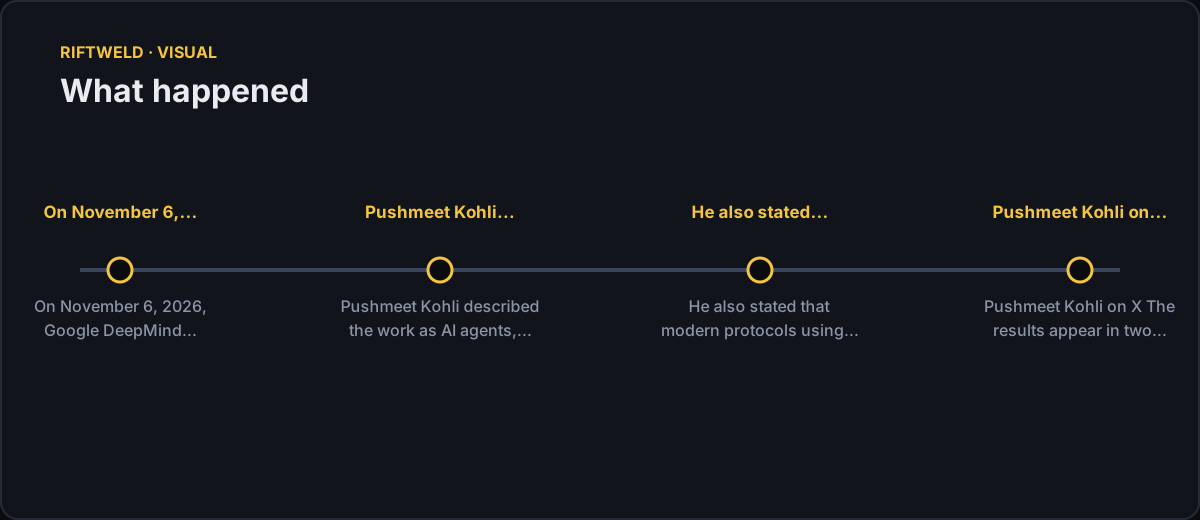
On November 6, 2026, Google DeepMind announced two results from its Science team, led by Krishnamurthy Dvijotham and Abhradeep Thakurta with Nadia Heninger of UC San Diego and Inria and Emmanuel Thomé of Inria. Pushmeet Kohli described the work as AI agents, guided by human supervision, uncovering weaknesses in legacy 1024-bit RSA systems that can be compromised with a lower computational budget than previously thought possible. He also stated that modern protocols using 2048-bit or larger keys remain secure. Pushmeet Kohli on X
The results appear in two working papers. "Modular Roots from a Restricted Oracle: Faster Affine Roots and a 1024-bit Computation" addresses signature forgery under partial control of the signed block. "Fan Factories: Multiple Number Fields in Factorization Factories and Batch NFS" addresses the cost of factoring many same-sized integers. Both papers state that their findings do not threaten deployed systems based on 2048-bit or larger RSA. Modular Roots paper and Fan Factories paper
The chronology is important. The underlying signature-forgery algorithm dates to 2007, and the 1024-bit implementation was submitted to the IACR ePrint archive in September 2026 by Shea, Haller, Suhl, Heninger, and Thomé, without AI involvement. DeepMind's contribution was a faster re-implementation of that computation plus new theoretical results, not the invention of the attack itself. IACR ePrint 2026/2131
| Claim | Status | Basis |
|---|---|---|
| Agents reproduced a 1024-bit forgery benchmark in 391 core-years | Confirmed | DeepMind working paper |
| The measured run used 3.5x less CPU time than the original | Confirmed | 391 versus 1,380 core-years |
| The affine 32-byte-digest gain is about 1,600x | Reported | Theoretical estimate; not run at 1024 bits |
| Batch factoring costs about 30x less per additional key | Reported | Asymptotic result; no implementation or factored key |
| A live 1024-bit key was broken | Not established | No such demonstration reported |
| 2048-bit or larger RSA is threatened | Not established | Both papers exclude it |
| Independent reproduction has occurred | Not established | None reported at time of writing |
The measured result
The only experimental result in the record is a re-run of the Shea et al. benchmark on the same 1024-bit instance, using the same algorithm, polynomials, and factor-base bounds. The original run consumed 1,380 CPU core-years over about five calendar months, split into 1,200 core-years of offline precomputation and 180 core-years for the first root. DeepMind's agents completed the equivalent work in 391 core-years: 318 offline and 73 online. Two cooperating agents designed, ran, and debugged the computation in under four days. Modular Roots paper
The original attack used a hardware security module as a black-box signing oracle, demonstrating impersonation through API interactions without exfiltrating the key. The ePrint abstract reports 232 oracle queries for that run. The research report's timeline instead attributes roughly 2^32, or about 4.07 billion, oracle queries to the same work, and separately describes the signature attack as requiring roughly 4 billion queries made in advance. Those figures cannot both describe the same measured run, and the primary abstract does not support the larger number. The query count for the DeepMind re-run is therefore not established by the record reviewed here. IACR ePrint 2026/2131
The measured gain is therefore real but bounded: a 3.5x reduction in core-years on one benchmark, with the underlying attack still requiring substantial precomputation and access to a signing oracle. It is not a demonstration that RSA-1024 keys can now be factored cheaply.
Two theoretical claims
The first theoretical result concerns an affine oracle, a signer that accepts only residues of the form c + z for a fixed c and a small caller-chosen z. The paper shows that once z can range up to roughly the square root of the modulus, the format constraint stops mattering. In that regime, PKCS#1 v1.5 padding offers no additional protection against this style of forgery, and the problem becomes as hard as the unrestricted-oracle case. At 1024 bits, that corresponds to more than half a block of caller-controlled data, or equivalently a 64-byte digest. Modular Roots paper
For the harder affine case, such as a 32-byte digest, the authors report lowering the asymptotic cost of computing one root from LN[1/3, 1.8171] to LN[1/3, 1.5803], with a larger offline phase reducing online cost toward LN[1/3, 1.3867]. The associated estimate of roughly 1,600x improvement for 1024-bit keys is explicitly asymptotic; the paper states it was not run at that size. SecurityWeek characterized the figure as theoretical rather than a completed attack. SecurityWeek
The second result, "Fan Factories," shares a precomputed rational side across a family of number fields, one per target integer. With a precomputation budget equal to one factorization, each additional 1024-bit integer is estimated to cost LN[1/3, 1.793], against LN[1/3, 1.902] for the previous best batch method, Coppersmith's multiple number field sieve. At leading order that is about 1/58 of an NFS run per additional key, or roughly 30 times less than MNFS. Without precomputation, the per-integer exponent improves by at most 0.018. No fan factory was built and no key was factored. Fan Factories paper
Limits and open questions
Both papers' algebraic identities and feasibility witnesses are machine-checked in the Lean 4 proof assistant, using a two-agent harness in which one model generates proofs and a second verifies them. That is a meaningful methodological claim: the agents' mathematical output was checked by an independent formal system rather than accepted on assertion. It does not substitute for peer review, and neither paper had been peer reviewed at the time of the report. Modular Roots paper
Several boundaries remain. The 1,600x affine estimate has not been demonstrated at concrete 1024-bit parameters. The batch-factoring result rests on standard NFS smoothness heuristics and has no implementation. The exact AI model used is not named in the material reviewed. Independent reproduction of either result has not been reported. PiyushAI
The attack model also constrains applicability. It requires temporary access to a raw signing or decryption oracle and does not work against devices that hash messages internally, such as CKM_SHA256_RSA_PKCS. A comment on Kohli's post claimed that 75 of 88 discovered 1024-bit DKIM keys among 105 large US companies remained published, but that observation is an unverified single comment, not a survey with a stated methodology. Pushmeet Kohli on X
Method and sources
This analysis draws on DeepMind's two working papers, Kohli's November 6, 2026 announcement, the IACR ePrint abstract for paper 2026/2131, and secondary reporting from SecurityWeek and Data Studios. Primary documents were used for the measured core-year figures, asymptotic exponents, the Lean 4 verification claim, and the explicit statement that the affine result was not run at 1024 bits. Secondary sources were used only for attributed framing of the 1,600x and 30x estimates.
Where the record conflicts, the primary abstract was preferred: the ePrint listing states 232 oracle queries for the original attack, which does not reconcile with the roughly 4 billion figure appearing in the research report's timeline and secondary summary. That discrepancy is flagged rather than resolved. The record is otherwise narrow but sufficient to separate one measured benchmark reproduction from two theoretical advances, and to state plainly that no live key was factored and no modern RSA system was broken.