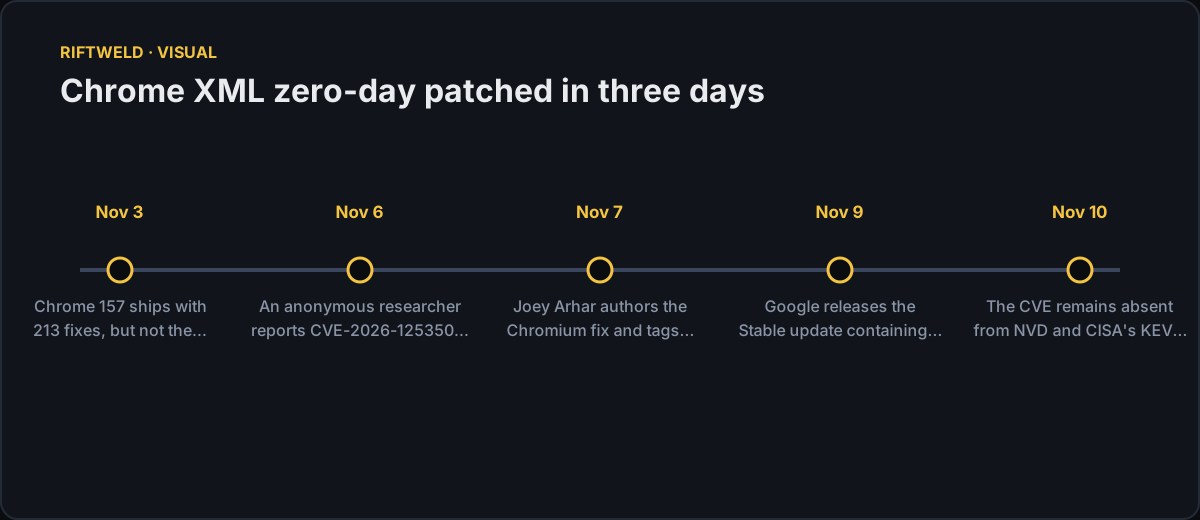
Chrome 157 shipped on November 3 with 213 security fixes, yet the XML use-after-free exploited in the wild was not among them. Google fixed the flaw in a commit dated November 7 and released it on November 9, leaving a three-day window between anonymous reporting and public patching.
In this article
Why this matters
The November 9 Chrome update patched nine vulnerabilities, but only one carried Google's explicit statement that an exploit exists in the wild: CVE-2026-125350, a high-severity use-after-free in the XML component. The distinction matters because the other eight fixes address defects that Google had not linked to active exploitation, and defenders should not treat all nine as equivalent indicators of active campaign risk (Chrome Releases).
The operational problem is a version trap. Chrome 157 reached Stable on November 3 with 213 security fixes and seven critical flaws, but CVE-2026-125350 was not among them. The zero-day fix landed later on the same 8103 branch, meaning an endpoint reporting “Chrome 157” could still be running the vulnerable build 157.0.8103.38/.39 (SecurityWeek).
| Claim | Status | Basis |
|---|---|---|
| An exploit for CVE-2026-125350 exists in the wild | Confirmed | Google's November 9 Stable Channel advisory |
| The flaw is a use-after-free in Chrome's XML component | Confirmed | Google advisory and Chromium fix commit |
| The fix shipped in 157.0.8103.50/.51 on Windows and Mac and 157.0.8103.50 on Linux | Confirmed | Google Stable Channel advisory |
| The flaw was reported to Google on November 6, 2026 | Confirmed | Google advisory credits an anonymous reporter |
| Exploitation is delivered through a crafted web page | Inferred | Standard browser attack vector; no source confirms the delivery method |
| Exploitation achieved code execution or sandbox escape | Not established | Google has confirmed no impact, and no public exploit or campaign details exist |
| The CVE was listed in CISA's KEV catalog as of November 10 | Not established | CISA added four other vulnerabilities that day; the catalog did not list this CVE |
| ChromeOS and ChromeOS Flex are affected | Not established | Google's November 6 ChromeOS Stable post does not list the CVE |
What happened
An anonymous researcher reported CVE-2026-125350 to Google on November 6, 2026. The Chromium fix was authored on November 7 by Joey Arhar in commit 049750111b1e5c11565c792b2aeed5541f332bad, tagged 157.0.8103.50, and Google published the Stable Channel update on November 9. That sequence indicates a rapid response once Google learned of exploitation, but it does not establish how long the flaw had been exploitable before the report (Chromium source).
The same November 9 update carried seven high-severity and two medium-severity fixes. The high-severity set covered WebGL, FileSystem, Compositing, GPU, V8, and two XML use-after-free defects; the medium pair were GPU uninitialized-resource issues. Google reported most of the non-zero-day flaws internally, while Arni Hardarson of Neonix Security reported the second XML use-after-free, CVE-2026-125346, on October 12 (Chrome Releases).
CVE-2026-125350 is the eighth Chrome zero-day that Google has said was exploited and patched in 2026, following CVE-2026-2441, CVE-2026-3909, CVE-2026-3910, CVE-2026-5281, CVE-2026-11645, CVE-2026-85046, and CVE-2026-87491. BleepingComputer reported eight more actively exploited Chrome zero-days in 2025, many tracked by Google's Threat Analysis Group, bringing the two-year count to 16 by that measure (BleepingComputer).
The failed assumption in the XML cache
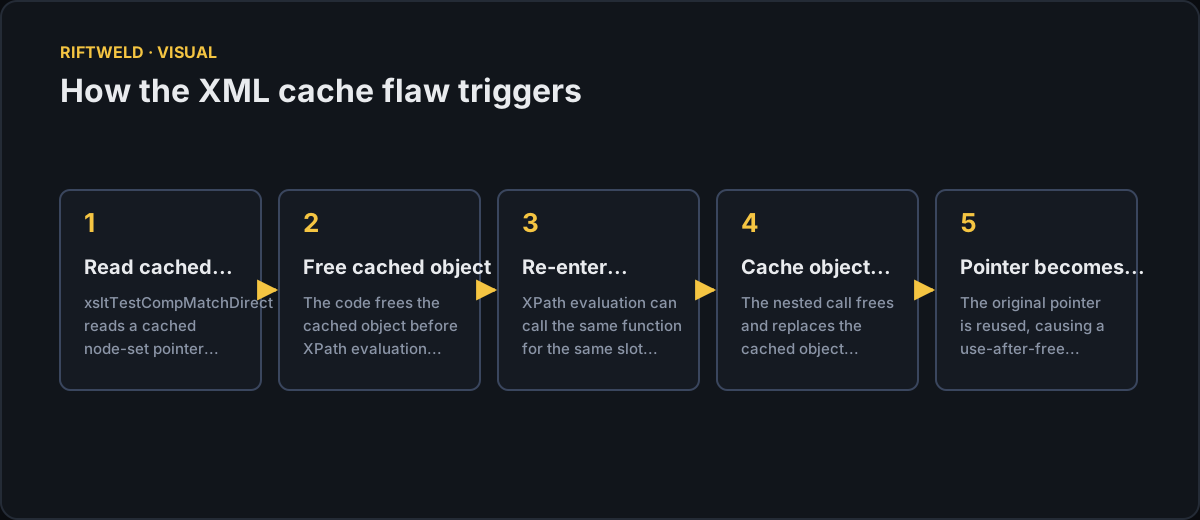
The defect sits in libxslt, the XML/XSLT library Chrome bundles. The commit message describes xsltTestCompMatchDirect reading a cached node-set pointer from the transform context's runtime extras, freeing it, and then calling xmlXPathEval. XPath evaluation can re-enter the same function for the same cache slot—for example, through a lazily evaluated global variable whose value runs xsl:number—and the nested call can free and replace the cached object. The original pointer then dangles, producing a use-after-free that manifests as a double free (Chromium source).
The control that failed was an assumption about ownership and lifetime, not a missing checklist item. The code assumed that the cached object it had read would remain the object it operated on after XPath evaluation returned. Because evaluation could re-enter and mutate the cache, that assumption did not hold. The fix re-reads the cache slot after evaluation so the code operates on the current object rather than a freed one.
This mechanism is confirmed from the primary source, but its exploitability is not. Google restricted access to bug details and links until a majority of users are updated, and the public Chromium issue record for issue 582442907 returns an access-denied response. No exploit code, proof of concept, indicators of compromise, domains, IP addresses, or file hashes have been published by Google or by the outlets reviewed (The Hacker News).
Exposure and response
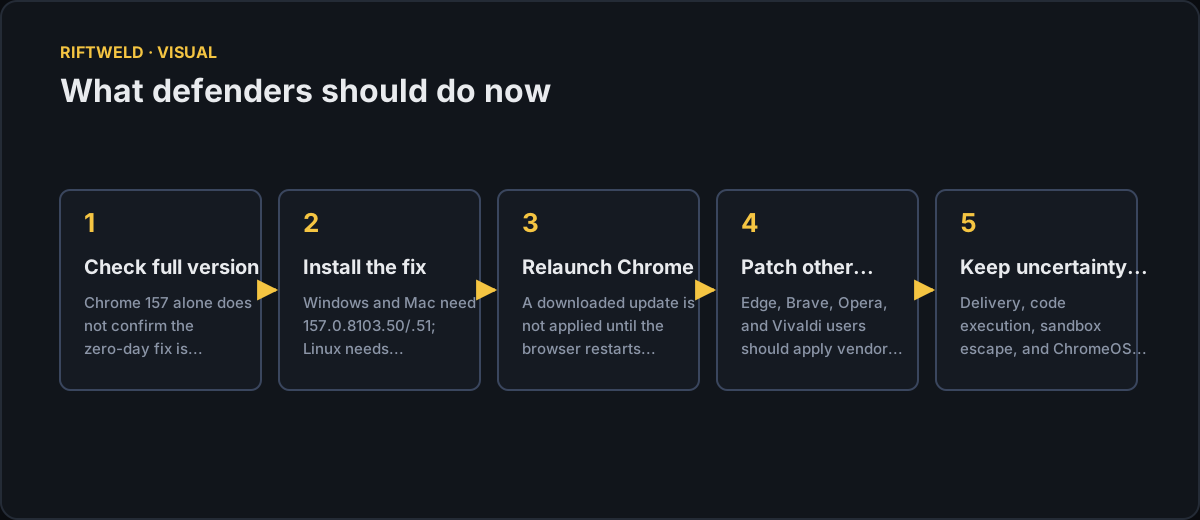
The authoritative patch state is the full version number, because Google's rollout proceeds over days and weeks. Windows and Mac users need 157.0.8103.50/.51; Linux users need 157.0.8103.50. Extended Stable users need 156.0.8078.96, and the earlier 156.0.8078.88 build does not contain the fix. Chrome for Android received 157.0.8103.50 in a same-day release (Chrome Releases).
The likely trigger is a crafted or malicious web page that causes Chrome to parse XML or XSLT content, including through XSLT transformations and embedded XML islands. That is an inference from the affected component and the standard drive-by browser vector; no source describes the actual delivery chain, and no source describes required user interaction beyond navigation. Google has not confirmed remote code execution, sandbox escape, or any specific post-exploitation effect for this flaw (SecurityWeek).
The practical response is to update and relaunch. A downloaded update that has not been applied to a running browser is not a fix, and The Hacker News notes that users of other Chromium-based browsers, including Edge, Brave, Opera, and Vivaldi, should apply fixes as their vendors release them. Those vendors' patch status is not stated in the sources reviewed (The Hacker News).
Limits of the record
The public record is thin on the attack and firm on the fix. Google has not disclosed the attacker, targets, delivery method, or exploit capabilities, and no independent outlet reviewed has published campaign details. The attribution of exploitation to a crafted web page remains an inference; the attribution of arbitrary code execution to this specific CVE remains unconfirmed, even though use-after-free defects generally carry that potential (HKCERT).
Several catalog gaps also limit assessment. As of November 10, the CVE was not published in the NVD, where it returned a reserved status, and cve.org returned no record, so no CVSS score exists. CISA added four other vulnerabilities to its KEV catalog on November 9 but did not list CVE-2026-125350. Whether CISA will add it later is unknown, and its absence should not be read as evidence that exploitation is unimportant (CISA).
Two further boundaries matter. CVE-2026-125346, fixed by the same commit, is a distinct XML use-after-free that Google has not identified as exploited; the two identifiers should not be conflated. And ChromeOS and ChromeOS Flex exposure is unconfirmed, because Google's November 6 ChromeOS Stable post for browser 156.0.8078.93 does not list the CVE (Chrome Releases).
Method and sources
This analysis relies on Google's November 9, 2026 Stable Channel advisory for the fix list, severity ratings, reporter credits, and the in-the-wild statement, and on the Chromium commit and tag 157.0.8103.50 for the technical mechanism. SecurityWeek, The Hacker News, BleepingComputer, and HKCERT supplied corroborating reporting on the zero-day count, patch versions, and risk assessment.
Catalog status was checked against NVD, cve.org, and CISA's KEV announcement as described in the record. Claims about delivery method, code execution, sandbox escape, attacker identity, victim counts, and ChromeOS exposure are marked as inferred or not established because no source reviewed confirms them.