Nearly 3,300 malicious emails in late October and early November 2026 carried a Colombian court-themed attachment that assembled its own ZIP archive inside the browser, so the compressed payload never crossed the email gateway. The contradiction is instructive: the message passed through corporate mail controls while the malicious archive was created only after a recipient opened it.
In this article
Why this matters
The campaign's most consequential feature is architectural rather than novel. Blind Eagle did not need to defeat attachment scanning or exploit a mail client. It needed a recipient to open an SVG-disguised XHTML file, at which point the browser generated a password-protected ZIP archive locally. Zenox states that the email gateway never inspects the locally generated ZIP, meaning the compressed content that eventually executes on the endpoint was never present in the message as it traversed mail infrastructure (Zenox).
That assumption — that what the gateway inspects is what the user receives and executes — is the control that failed. Email security products evaluate the message body, headers and attachment as delivered. Here, the attachment was a container for a rendered page, and the executable archive was a downstream artifact created by the endpoint itself. The technique does not require a zero-day, a novel browser exploit or a malformed file; it requires only that the recipient trust an authoritative-looking judicial notice and continue interacting with it.
The stakes are amplified by the target set. Zenox observed recipients in justice, public-administration and education contexts, and the final RAT was built to capture judicial and tax documents, log keystrokes, stream from the host and take over the interactive session. The Hacker News quoted Zenox's assessment that targeting judicial, fiscal, administrative and educational organizations gives the operation access to highly sensitive legal, financial and institutional information (The Hacker News).
What happened
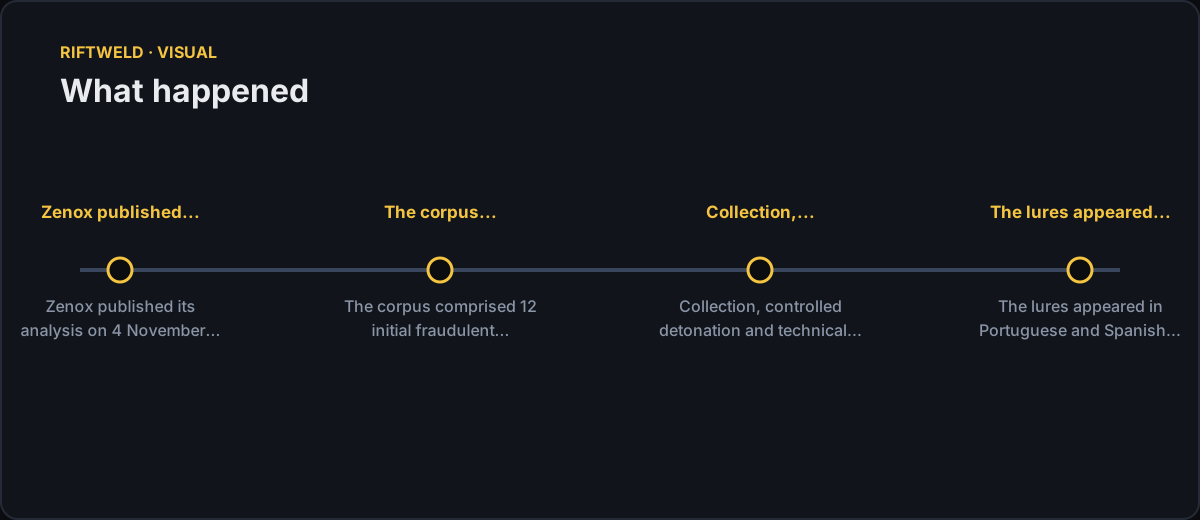
Zenox published its analysis on 4 November 2026, describing a phishing wave themed around judicial and administrative matters. The corpus comprised 12 initial fraudulent emails, multiple ZIP archives, JavaScript and Visual Basic Script files, judicial query pages, email headers and the final RAT. Collection, controlled detonation and technical analysis took place in separate virtual machines over approximately seven days (Zenox).
The lures appeared in Portuguese and Spanish and resembled court notifications, prosecutorial notices, tutela proceedings and administrative documents. The first observed message carried a file named 43262 CONSTANCIA-Despacho.COL.97-126.xhtml, approximately 4.2 MB, and claimed that a decision had been issued and was available through a judicial-management system. A second message used a tutela proceeding and an urgent circular as its theme. The social engineering relied on authority, urgency, apparent confidentiality and a protected document rather than on any exploit visible in the captures.
The scale of the wave was measured by Zenox, which observed roughly 3,300 malicious emails between late October and early November 2026. That figure describes observed malicious mail, not confirmed infections, and The Hacker News noted that not all messages targeted organizations in Colombia, although Colombia remained a priority target (The Hacker News).
The delivery chain
Zenox reconstructed ten stages. The attachment is an SVG disguised as XHTML; when opened, it renders a fake "Consultas, Fiscalía General de la Nación" page impersonating Colombia's Office of the Attorney General. The page then uses HTML smuggling to generate a ZIP archive with ZipCrypto and a password displayed on the page, following a filename pattern of Demanda_Ejecutiva_*__EXP2026-XXXX.zip (Zenox).
Inside the archive is a JavaScript dropper presented as "Network Configuration Auditor v2.7.298," also approximately 4.2 MB and containing noise markers. It performs host reconnaissance: reading environment variables such as %APPDATA%, %OS%, %NUMBER_OF_PROCESSORS%, %LOCALAPPDATA%, %COMPUTENAME% and %TEMP%, querying registry keys for installation date, network profile, product name and physical memory, and enumerating directories localized in English, Portuguese and Spanish. The dropper then decodes and chains later stages, deletes the original XHTML artifact and removes Mark-of-the-Web through Zone.Identifier manipulation.
A Visual Basic Script stage performs AMSI and ETW bypass, stores the encrypted payload in environment variables and displays a distraction page titled "CITACION PENAL, FISCALIA." It establishes persistence by writing a reversed copy as a fake XHTML file under %APPDATA%\Microsoft\index\_ZNn4r6.xhtml and to C:\Users\Public\, plus a Startup-folder shortcut named SvcConfigZNn4r6.vbs. PowerShell then decodes the final payload through AES-256-ECB, custom Base85 and GZIP, loading the native x64 RAT in memory through Reflection without persisting a final file to disk.
The RAT creates its own virtual desktop via CreateDesktopW, runs a layout-aware keylogger using GetKeyboardLayout and ToUnicodeEx, performs d3d11 screen capture and MFPlat media streaming, and supports token impersonation. The operator can control the session through the hidden desktop, block keyboard and mouse input with BlockInput, and exfiltrate judicial and tax documents over an encrypted channel (Zenox).
Attribution and limits
Zenox classifies the final payload as an AsyncRAT fork with DCRat lineage, with high confidence in the technical lineage based on code, configuration, build characteristics and observed behavior. Recurring development signatures include Boss/Client77, client77_rat.bin and classes such as CryptoCore, MutexControl and MsgPack. Zenox cautions that these are development signatures, not automatic attribution to a person. The classification is consistent with the group's historical use of AsyncRAT, DCRat, Remcos, NjRAT, Quasar RAT, BitRAT and LimeRAT (MITRE ATT&CK).
Attribution to APT-C-36 as a Brazilian operational cluster rests on convergence: hosting in Cotia, Brazilian ASN 265919, an America/Sao_Paulo timezone, Portuguese code references and Portuguese-language lures. Zenox assesses this with high confidence while explicitly noting that it identifies no person, company or provider and does not eliminate false-flag or rented-VPS explanations. By contrast, Zscaler attributed a separate December 2025 Blind Eagle campaign with only medium confidence (Zscaler).
The limits are equally clear. Zenox could not confirm whether any attack succeeded against a real-world target. All malware capabilities were demonstrated in a laboratory environment, and there is no confirmed evidence of compromise, persistence or lateral movement against a real victim organization. CyberFrogSecurity characterized the demonstrated capabilities as potential consequences rather than verified outcomes for specific victims (CyberFrogSecurity). Page-generation and email-header dates also belong to the surface shown to the recipient or email transport; they do not establish when the code, domain or server was created.
Defensive implications
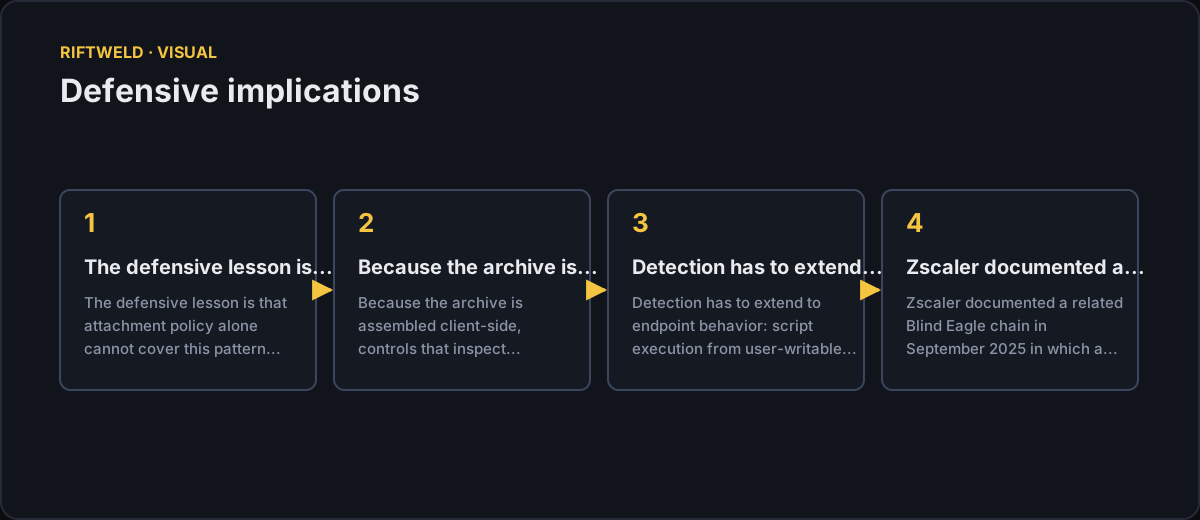
The defensive lesson is that attachment policy alone cannot cover this pattern. Because the archive is assembled client-side, controls that inspect message attachments will see the SVG-disguised XHTML file rather than the ZIP, the JavaScript dropper or the RAT. Detection has to extend to endpoint behavior: script execution from user-writable paths, browser-driven archive creation, Zone.Identifier removal, AMSI and ETW bypass attempts, and Startup-folder artifacts.
Zscaler documented a related Blind Eagle chain in September 2025 in which a phishing email appeared to come from a compromised account inside the targeted Colombian agency, with DMARC, DKIM and SPF checks not applied because the message remained within the organization's Microsoft 365 tenant. That case reinforces a second assumption worth challenging: that a message passing authentication checks is therefore legitimate (Zscaler).
Method and sources
Zenox treated the messages as evidence of social engineering rather than proof of institutional authenticity, comparing subject, theme, attachment type, use of a password, observed recipients and available headers. Static analysis was complemented by controlled execution in separate virtual machines, with triage, decompilation and controlled observation tools. The public report is sanitized: host, port, key, mutex and certificate values are withheld, and primary artifacts remain in the segregated laboratory.
The analysis draws primarily on Zenox's 4 November 2026 report, with The Hacker News and CyberFrogSecurity as secondary coverage of the same wave. Historical context comes from MITRE ATT&CK's G0099 entry, Check Point's 2023 Ecuador analysis, Kaspersky SecureList's group overview, Trend Micro's 2021 campaign research, eSentire's North America reporting, Darktrace's detection work, Fortinet's DCRat analysis, Recorded Future's TAG-144 tracking, Lumu's supply-chain advisory, Zscaler's 2025 campaign analysis and Brandefense's 2026 group profile. The record is detailed on tradecraft and thin on confirmed impact: the chain is established, the attribution is reasoned, and the compromise count remains unknown.