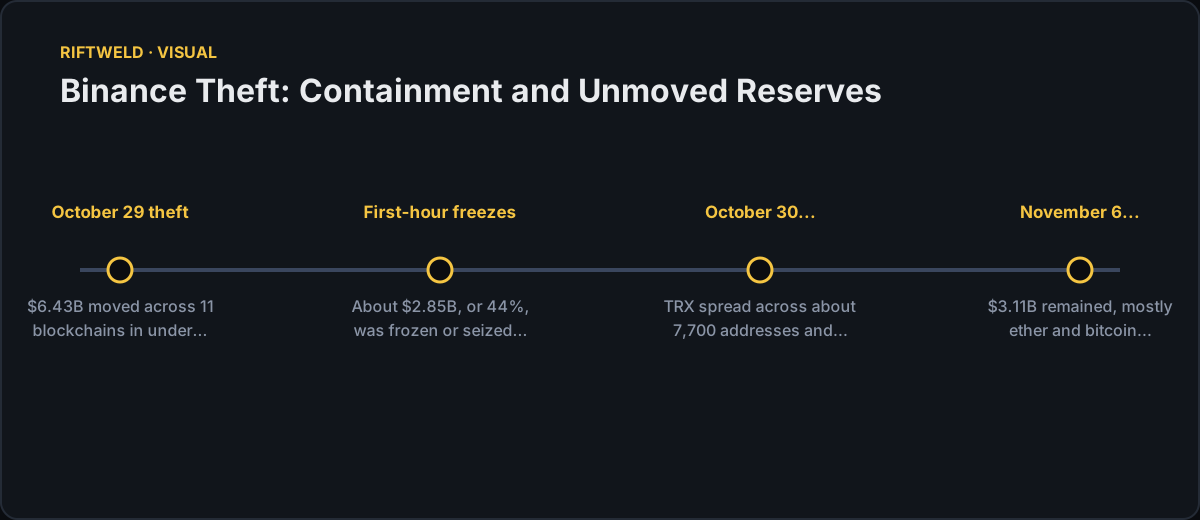
$3.11 billion of the $6.43 billion stolen from Binance remained in theft-linked addresses by November 6, 2026, even as the laundering network touched more than 20,000 wallets. The contradiction is stark: 44% of the haul was frozen within hours, yet the largest ether and bitcoin positions had barely moved.
In this article
Why this matters
The Binance incident is often framed as a containment story: approximately $2.85 billion, or 44% of the haul, was frozen or seized, mostly stablecoins blocked by issuers such as Tether and Circle within an hour of the October 29 theft. That response was materially faster than after the February 2025 Bybit hack, where Elliptic estimated roughly 3% of stolen funds had been frozen (ATLABYTE).
But issuer-side freezes only reach centrally issued tokens. The approximately $3.11 billion still sitting in addresses linked to the theft is mostly ether and bitcoin, assets no issuer can freeze. The containment mechanism therefore protected users and the financial system at its edge while leaving the operationally decisive reserves intact (Decrypt).
That distinction changes the security posture. The remaining funds are not static evidence awaiting prosecution. They are a live, high-value asset pool whose movement should be monitored as an adversarial operation. Elliptic expects the main ether holdings to be swapped into bitcoin and then cashed out through over-the-counter brokers and exchanges over months, drawing on the pattern of the Bybit case (Elliptic).
What happened
The theft ran from 20:05 to 23:56 UTC on October 29, 2026, moving $6.43 billion across 11 blockchains. Stablecoins accounted for $3.46 billion, or 54%, of the total, making conversion into non-freezable assets the operator’s first priority (Elliptic).
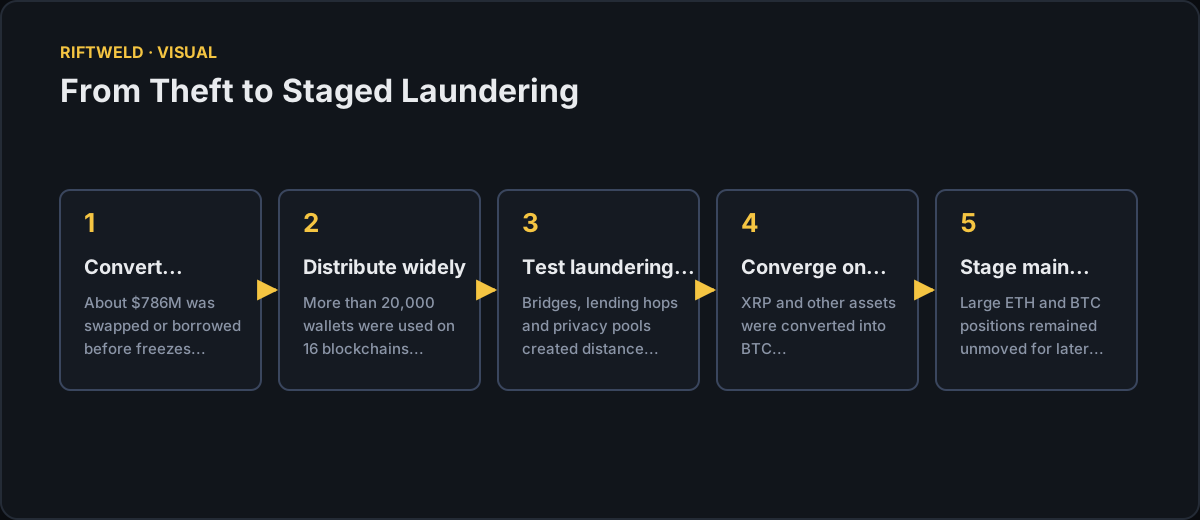
The race against freezes was already lost in part. On Ethereum, Tether froze the stolen USDT 37 minutes after it arrived, but the attacker had swapped 434 million USDT for ETH on decentralized exchanges including Uniswap and borrowed 19,762 ETH on Aave against a further 59.9 million USDT. On Tron, 234 million USDT was swapped for TRX on SunSwap before Tether froze the remainder. Circle froze all 823 million stolen USDC before any of it was swapped. In total, around $786 million of stablecoins was converted before the freezes landed (Elliptic).
The laundering then became an industrial distribution system. After roughly five hours of inactivity, a single wallet began sending 684.6 million TRX in small amounts to hundreds of new addresses at 02:19 UTC on October 30, spreading the funds across about 7,700 addresses. Within two and a half hours, the operator made its first transfers through six cross-chain bridges, mostly with test-sized amounts, and almost all of the TRX was paid out as ETH on Ethereum (Elliptic).
Throughput rose on October 31. Distribution increased from under 12 million TRX per hour to as much as 37 million TRX per hour, with around 1,300 transactions in the busiest hour. The operator also routed 128 million TRX through a JustLend vault, depositing from one address and withdrawing to 16 new ones with no direct transfer links between them, and swapped some TRX for USDD, a stablecoin that markets itself as freeze-free (Elliptic).
By the November 6 update, the operation had used more than 20,000 wallets on 16 blockchains, at least 36 services and at least 65,000 transactions—roughly one new wallet every 30 seconds and one transaction every 10 seconds. All stolen Solana, about $87 million at current prices, had been swapped, bridged or mixed; about $50 million of XRP had been swapped, mostly into bitcoin; and roughly 1,650 BTC, worth about $124 million, had been converted from other stolen assets (Elliptic).
The control that failed was trust in the signing path
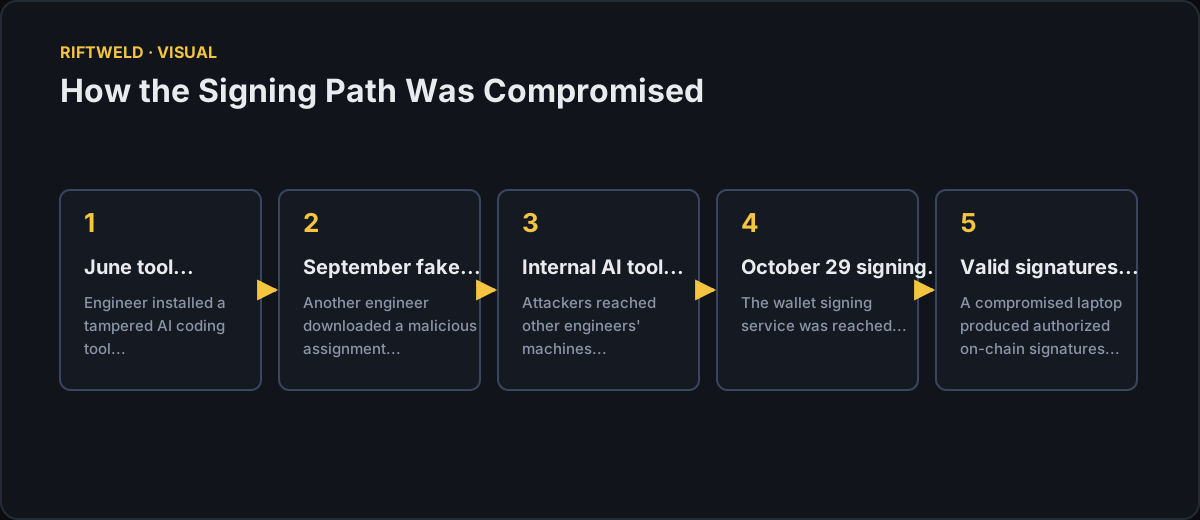
The intrusion was not a break in cryptography or a single exchange flaw. Binance describes a multi-stage campaign: in June, an engineer installed a tampered copy of an AI coding tool that exposed the wallet team; in September, attackers posing as recruiters put another engineer through fake interviews and had him download a malicious “assignment” onto his work computer. From there, they used an internal AI tool to reach other engineers’ machines and, on October 29, reached the wallet signing service (Elliptic).
The failed assumption was that developer workstations and hiring channels were outside the trust boundary of privileged signing operations. A tampered AI coding tool is dangerous precisely because developers routinely install such tools and treat them as productivity aids rather than as code executing near production credentials. Fake recruiting weaponizes the engineer not as the target, but as a privileged node in a path to signing authority (Elliptic).
Blockworks’ daily recap adds that the operation exploited a compromised DevOps engineer’s laptop and used valid on-chain signatures, including an EIP-7702 delegation on Ethereum. That detail matters because it shifts the defensive question away from “how do we detect a forged signature” and toward “how do we prevent an untrusted endpoint from producing an authorized one” (Blockworks).
Staging, not stalling
The apparent inactivity of the largest holdings is better read as deliberate staging than as a stalled laundering campaign. The 18,270 stolen BTC—worth about $1.5 billion at the time of the theft—was split into 19 addresses on the day of the hack and had not moved since. On Ethereum, the nine largest addresses, holding 89% of the attacker’s ether, had not moved since October 30 (Decrypt).
Smaller balances were being spent to test routes and build infrastructure. Test-sized bridge transfers, fresh-address distribution, lending-market hops and privacy-pool deposits all created distance between origin and destination without requiring a mixer in every case. The Aave position adds a distinct detection surface: if the borrowed ether is used as collateral or liquidated, the movement pattern changes from a simple outflow into a lending-market event (Elliptic).
The final stage is visible in miniature. About 33 BTC had been put through Wasabi-style coinjoins since November 1, and about $1.1 million in ETH and SOL had been deposited into the Privacy Cash privacy pool since November 3. The convergence on bitcoin is consistent with Elliptic’s expectation that the main ether holdings will be converted and then cashed out through brokers and exchanges over months (Elliptic).
Limits of the record
Several boundaries should be stated plainly. First, the on-chain record identifies wallets and flows, not the people controlling them. Elliptic explicitly notes that “the attacker” means whoever controls the wallets now holding the funds. The assessment that unmoved funds are “very likely” still held by North Korea is an attribution judgment, not a direct observation (Elliptic).
Second, the FBI has attributed the theft to North Korean hackers it calls TraderTraitor, and North Korea has denied involvement. The record therefore supports a government attribution that is publicly contested, while the laundering mechanics themselves are independently visible on-chain (Decrypt).
Third, the claim that the operation was automated is well supported by its scale and regularity, but the specific mechanism is not established. ATLABYTE notes speculation about AI agents making decisions, while Elliptic’s position is that the evidence points to conventional automation. The defensible conclusion is deterministic, high-throughput execution—not that AI agents were directing it (ATLABYTE).
Finally, “not yet laundered” is a snapshot, not a permanent status. Elliptic’s analysis was last updated on November 6, 2026, at 08:45 UTC, and the firm warns that the description may be incomplete because the funds are moving quickly. The $3.11 billion figure, the negligible cash-out estimate and the expectation of a multi-month bitcoin conversion are all time-bounded assessments (Elliptic).
| Claim | Status | Basis |
|---|---|---|
| $3.11 billion remained in theft-linked addresses, mostly ETH and BTC | Confirmed | Elliptic on-chain analysis, updated November 6, 2026 |
| $2.85 billion, or 44%, was frozen or seized | Confirmed | Elliptic; reported by Decrypt and ATLABYTE |
| Only a negligible amount has likely been cashed out | Reported | Elliptic assessment |
| Unmoved funds are very likely still held by North Korea | Inferred | Elliptic attribution judgment |
| The operation was automated | Observed | More than 20,000 wallets, 16 blockchains and 65,000 transactions |
| AI agents directed the laundering | Not established | Speculation noted by ATLABYTE; Elliptic points to conventional automation |
| Main ETH will be swapped for BTC and cashed out over months | Inferred | Elliptic projection based on the Bybit case |
Method and sources
This analysis relies on Elliptic’s incident research, last updated November 6, 2026, for the on-chain timeline, asset movements, freeze figures and laundering topology; Decrypt for the FBI attribution, North Korea’s denial and the stationary BTC and ETH holdings; ATLABYTE for the freeze comparison with Bybit and the AI-agent speculation; and Blockworks for the intrusion mechanics and user-reimbursement reporting. The Yahoo Finance link and the Blockworks index were listed, but the accessible Blockworks material was limited to a daily recap, and the Yahoo Finance page did not yield substantive article text. No independent transaction-level dataset was available for verification, so all quantitative claims are attributed to their originating source rather than independently recomputed.