Some ARTEX-driven intrusions reached privileged access in under three hours, according to the FBI. Yet the original GitHub repository was removed on 8 October 2026, and researchers still counted more than 1,600 publicly exposed ARTEX consoles by early November, showing that deleting one source did not remove the tool from the attack surface (FBI advisory; BleepingComputer).
In this article
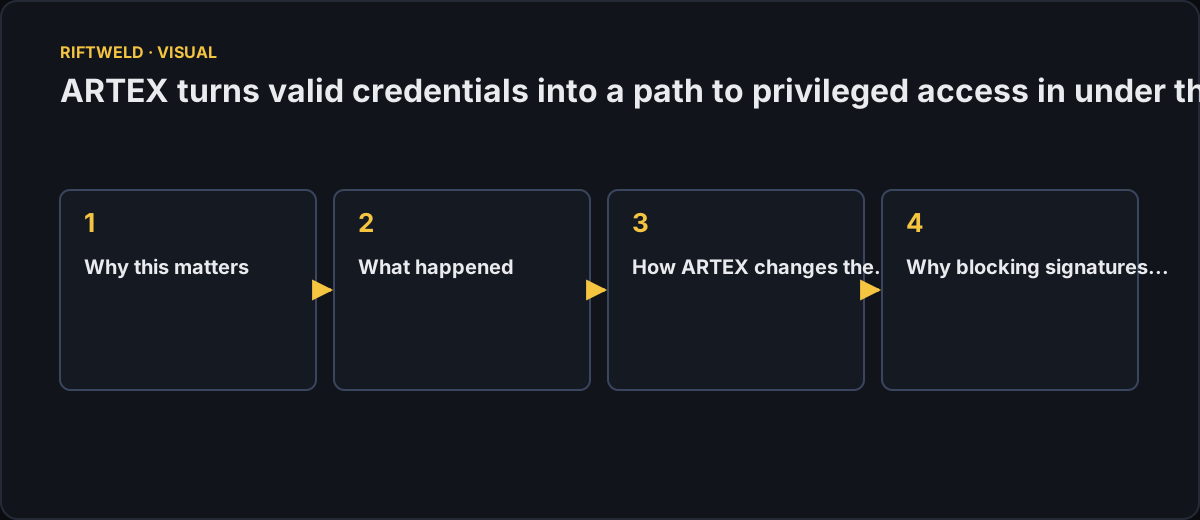
Why this matters
ARTEX changes the pace of an intrusion, not merely its vocabulary. The FBI says some campaigns moved from initial targeting to privileged access in less than three hours, while Microsoft observed Storm-0940 use the framework to accelerate scanning, password spraying and abuse of cloud application permissions across hundreds of organizations (Microsoft).
That speed compresses the interval between a defender's first alert and an attacker's control of a cloud environment. Automated activity can generate enough traffic to trigger security tools, but the volume of requests and the rapid movement between stages can leave little time for a coordinated response before credentials are altered or persistence is established (Microsoft).
The exposure is broad because ARTEX is built to find the parts of an environment that receive less attention. The FBI specifically points to partner portals, employee applications, legacy services and third-party integrations, which can sit outside the assumptions built into a security team. Any organization with internet-facing systems can become a target, including banks, hospitals, government agencies and software companies (BleepingComputer).
What happened
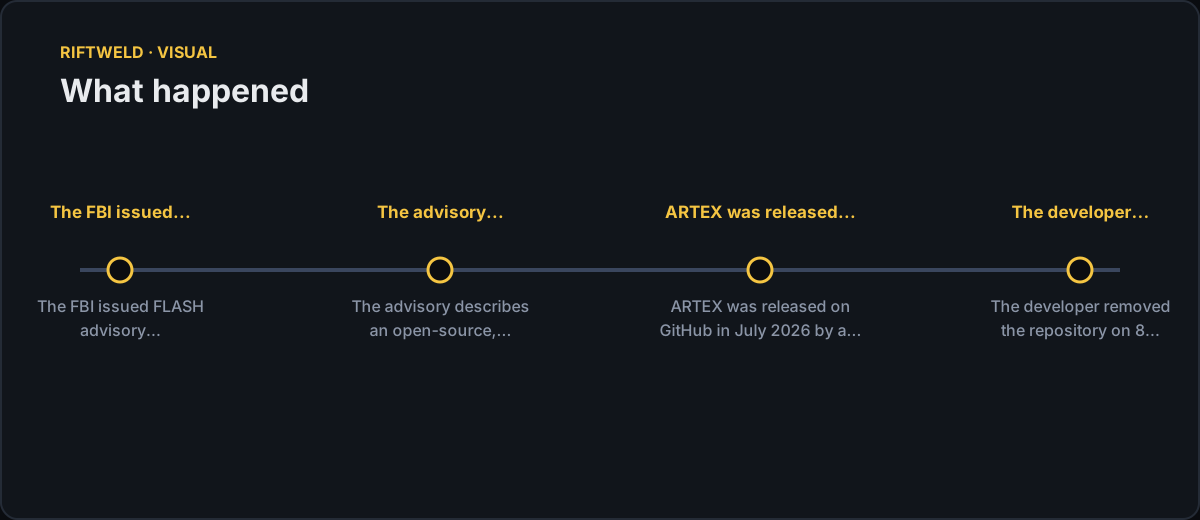
The FBI issued FLASH advisory FLASH-20261113-001 on 13 November 2026, warning that multiple threat actors had weaponized ARTEX since at least August. The advisory describes an open-source, LLM-driven penetration testing framework that can automate intrusion work from reconnaissance through data exfiltration, with little human intervention (FBI advisory).
ARTEX was released on GitHub in July 2026 by a developer known as Autumn-27. The developer removed the repository on 8 October after reports of abuse, but the FBI says copies continued to circulate through community forks, archived versions, localized builds and a commercial edition called ARTEX PRO. Censys counted 1,465 exposed consoles on 4 November, while Check Point Research counted 1,608 live public instances among 2,557 systems observed hosting ARTEX panels (Censys; Check Point Research).
The clearest supply chain case involved ConnectWise Cloud Backup, formerly SkyKick Cloud Backup. Microsoft attributed the compromise to Storm-0940, a China-state-aligned actor active since 2021. After taking over application identities, the actor used ARTEX to attempt authentication against more than 2,250 downstream Microsoft 365 tenants, with some intrusions reaching credential modifications and attempts at persistent access (Microsoft).
The scale of that attempt did not equal confirmed theft in every tenant. Huntress identified at least 162 compromised tenants, while Microsoft cautioned that an affected application or successful authentication does not necessarily mean customer data was accessed or exfiltrated. The distinction matters because defenders must investigate each environment rather than treat a broad targeting campaign as proof of uniform compromise (BleepingComputer).
Other campaigns show the framework's appeal to financially motivated actors and espionage groups. A Chinese-speaking actor combined ARTEX with Claude Code agents against South Korean banks, exposing personal information tied to approximately 67,000 people. Separately, South Korean police arrested seven suspects linked to intrusions at more than 90 organizations and the theft of about 8.2 million records, with ARTEX reportedly used in most of those intrusions (BleepingComputer; BleepingComputer).
How ARTEX changes the attack
ARTEX is a multi-agent system written in Go with a Next.js console. It does not include its own model. Operators connect it to external providers such as Anthropic Claude, OpenAI GPT, DeepSeek, GLM, Grok and Kimi, then give the agents objectives that the system converts into commands for specialized tasks (FBI advisory).
In plain terms, an operator can describe a target and a goal while the agents search for exposed assets, test weaknesses and pursue different routes when an attempt fails. Microsoft says ARTEX agents can perform reconnaissance, exploit web applications, establish web shells, collect credentials, enumerate APIs and dump databases. They can also use utilities such as netcat and curl to download remote access trojans, including WISP, vshell and AdaptixC2 (Microsoft).
The framework's default tools are familiar. Microsoft lists Nmap, curl, wget, Python HTTP clients and headless Chromium through Playwright. That familiarity cuts both ways: defenders may recognize the traffic, but an agent can quickly change user agent strings or other characteristics, so a block tied to one signature is easy to sidestep (Microsoft).
Why blocking signatures won't be enough
The central defensive problem is that ARTEX often arrives with legitimate authority. In the ConnectWise case, attackers authenticated to customer tenants using permissions previously granted to compromised applications. Microsoft observed follow-on activity through Microsoft Graph, including reconnaissance and attempts to change application credentials or privileges, without requiring an interactive user sign-in (Microsoft).
That behavior can look ordinary to tools built around malware signatures. A service principal sign-in may resemble normal application activity, and a password spray may resemble a burst of failed authentication. The useful signal is the combination and sequence: automated requests, unusual retry patterns, unexpected credential changes and a sudden move toward sensitive data (Google Cloud Threat Intelligence).
Infrastructure indicators also have a short shelf life. The FBI warns that listed IP addresses may have changed, and MalwareMustDie's detection pack warns that infrastructure indicators can become outdated or produce false positives. The pack therefore covers suspicious network requests, identity abuse, cloud activity and automated attack patterns rather than relying on addresses alone (MalwareMustDie).
What defenders should do
The FBI's guidance starts with exposure. Organizations should secure internet-facing applications, restrict access to cloud administration interfaces, review application permissions and authentication logs, and apply rate limits to sensitive APIs. Monitoring should focus on bursts of automated requests, suspicious cloud activity, unexpected credential or privilege changes and large data transfers (BleepingComputer).
Microsoft adds a defensive mechanism that treats the agent's speed as the target. Honeypots, decoys, tarpits and fake wins can give an autonomous attacker a convincing but worthless objective, consuming its time and drawing traffic away from real assets. In Microsoft's testing, those controls reduced traffic reaching real assets and produced high-confidence signal (Microsoft).
Neither approach depends on trusting a fixed list of malicious addresses. Both ask defenders to model normal identity and application behavior, then notice when that behavior changes at machine speed. That is the practical response to a framework whose operators can keep using forks and commercial copies after the original repository disappears (FBI advisory).
Method and sources
This analysis draws on the FBI's 13 November 2026 FLASH advisory and reporting from BleepingComputer, Microsoft Threat Intelligence, Censys, Check Point Research, Google Cloud Threat Intelligence, CrowdStrike, Zscaler and Recorded Future. The advisory supplies the central claims about attack speed, exposed consoles and continued availability of ARTEX. Vendor research supplies campaign detail, while the exposed-console counts differ by collection method and date (FBI advisory; Censys).
One date conflict remains in the record. Check Point Research refers to deletion of the original ARTEX project on 8 September, while the FBI, Censys and BleepingComputer place the removal on 8 October 2026. The analysis follows the October date because three sources support it, and treats the September reference as a likely reporting error (Check Point Research).