Censys counted 1,465 internet-exposed ARTEX consoles on November 4, 2026, and Arctic Wolf then documented AntiFox-linked infrastructure reaching a production AWS secret. The contradiction is stark: the original repository was withdrawn on October 8, yet the tooling kept spreading and the intrusions kept escalating.
In this article
Why this matters
The significance of ARTEX and AntiFox is not a new vulnerability class. It is the compression of time and skill required to move from reconnaissance to credential theft, web-shell deployment and cloud enumeration. Dark Reading reports that Storm-0940 generated more than 151,000 authentication requests against more than 300 accounts at eight critical organizations around October 10, averaging roughly 2,900 attempts per minute without triggering lockout or alerting. Microsoft separately observed ARTEX activity as early as September 2026 in a ConnectWise supply-chain compromise, with multiple cases reaching privileged access in under three hours (Dark Reading; Microsoft).
That changes the operating assumption behind credential hygiene. A dormant key in a public repository or an over-permissioned cloud identity was previously a slow, manual exploitation opportunity. Under agentic orchestration, discovery and validation can be chained within minutes. GitGuardian's sealed-lab test of an ARTEX build without a dedicated secret scanner recovered eight of nine planted credentials using only git and grep, starting within 6 to 13 seconds and including an AWS key recovered from git history after deletion from current files (GitGuardian).
The defensive conclusion is uncomfortable but specific: the control that failed was the assumption that an exposed or dormant credential would remain unexploited long enough for humans to rotate it. ARTEX and AntiFox do not need to defeat that control. They only need to reach it faster than defenders respond.
What happened
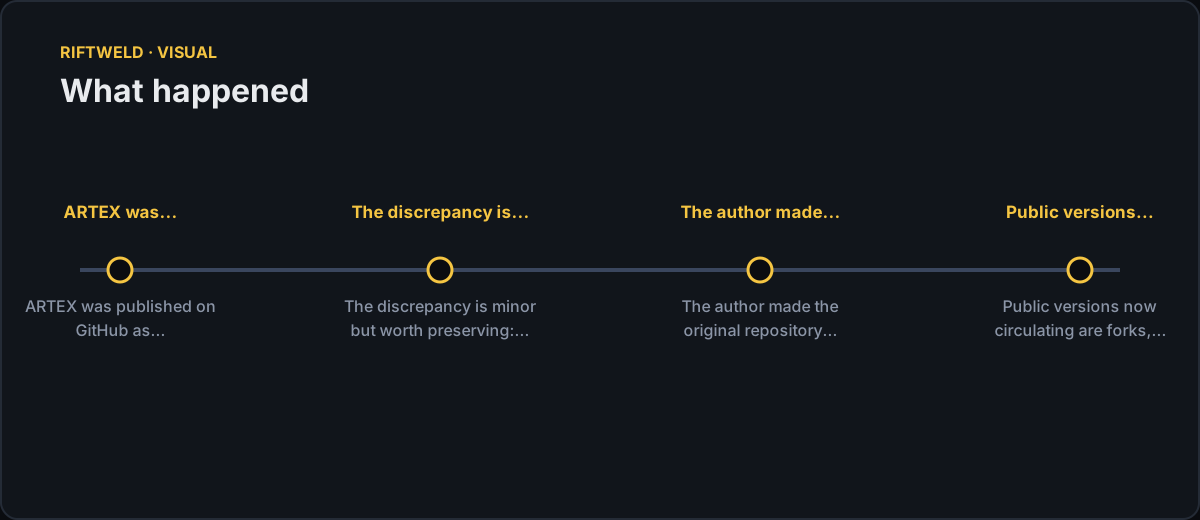
ARTEX was published on GitHub as Autumn-27/ARTEX on July 26, 2026, according to Censys, under the AGPL-3.0 license; Dark Reading describes an August release by a Chinese open-source developer. The discrepancy is minor but worth preserving: the first-commit date is independently dated, while the release month is reported differently. The author made the original repository unavailable on October 8, 74 days after the first commit, following reports of abuse. Public versions now circulating are forks, and AntiFox is a fork of ARTEX 0.1.1 with a Chinese-language interface that had reached version 2.0 by November 2026 (Censys; CERT-EU; The Hacker News).
The abuse record spans distinct actor types and objectives. Microsoft attributes ARTEX use to Storm-0940, described as China-state-aligned, in the ConnectWise supply-chain compromise, and to Storm-3358, a Cambodia-based and financially motivated cluster, in attacks against financial organizations in Southeast Asia beginning in October 2026, with WISP, vshell and AdaptixC2 deployed. CrowdStrike attributes a Vapor Panda espionage campaign using ARTEX, DeepSeek and a second commercial LLM against more than 200 organizations worldwide beginning October 17, including foreign ministries and semiconductor and defense targets (Microsoft; CrowdStrike).
Arctic Wolf's AntiFox alert pack is the most operationally specific account in the record. In several intrusions, Alibaba Cloud systems hosting AntiFox interfaces were associated with confirmed malicious actions against internet-facing web services and associated AWS environments. On a compromised IIS server, w3wp.exe created an ASPX web shell and spawned operating-system commands that located web.config files, read application settings and database connection strings, and copied configuration and log files into a web-accessible upload directory. AntiFox-linked infrastructure then used valid IAM users and, in some cases, an assumed EC2 role to enumerate dozens of AWS services, interspersing successful operations with denied calls, and ultimately issued a successful GetSecretValue request against a production secret (Arctic Wolf Labs).
| Claim | Status | Basis |
|---|---|---|
| ARTEX was withdrawn by its author on October 8, 2026, with forks continuing to circulate | Confirmed | GitGuardian and CERT-EU reporting |
AntiFox-linked infrastructure reached a production AWS secret via GetSecretValue |
Confirmed | Arctic Wolf Labs observed intrusions |
| Storm-0940 used ARTEX in a ConnectWise supply-chain compromise | Confirmed | Microsoft incident research |
| AWS services were compromised and operated as described | Not established | Amazon statement via BleepingComputer characterizes activity as use of credentials taken from customers' compromised applications |
| ARTEX found eight vulnerabilities in about 45 minutes against an internal benchmark | Reported | Single-vendor benchmark claim quoted by Dark Reading |
The failed assumption
Dark Reading's seed article carries a claim from A Security CTO Yuval Itzchakov that "Artex stops at the front door," with no lateral movement, no Active Directory testing and no internal visibility. That claim conflicts with Microsoft's description of ARTEX agents performing lateral movement, privilege escalation and data exfiltration, and with Arctic Wolf's observation of AntiFox-linked activity moving from a compromised IIS server into AWS credential validation, service enumeration and secret access. The record therefore does not support treating ARTEX as a front-door-only scanner (Dark Reading; Microsoft).
The more defensible reading is that ARTEX's scope enforcement is advisory rather than a security boundary. Itzchakov's own framing — that scope is "just a suggestion to the model" — is consistent with the observed behavior: an operator who removes guardrails inherits the tool's ability to chain reconnaissance, exploitation and credential operations without a human approving each step.
A second assumption deserves scrutiny: that withdrawing the repository ends the threat. Censys observed 1,465 hosts running exposed ARTEX consoles as of November 4, 2026, with 155 also running at least one other detected threat, including Vshell, Cobalt Strike and Adaptix C2, and 32 open directories exposing post-exploitation kits, stagers and implants. Check Point Research separately reported more than 1,800 publicly exposed ARTEX instances and 2,557 systems hosting ARTEX, including 10 misconfigured instances exposing full databases. These counts differ in method and scope, but both establish that exposure remained widespread after the takedown (Censys; Check Point Research).
Defensive priorities
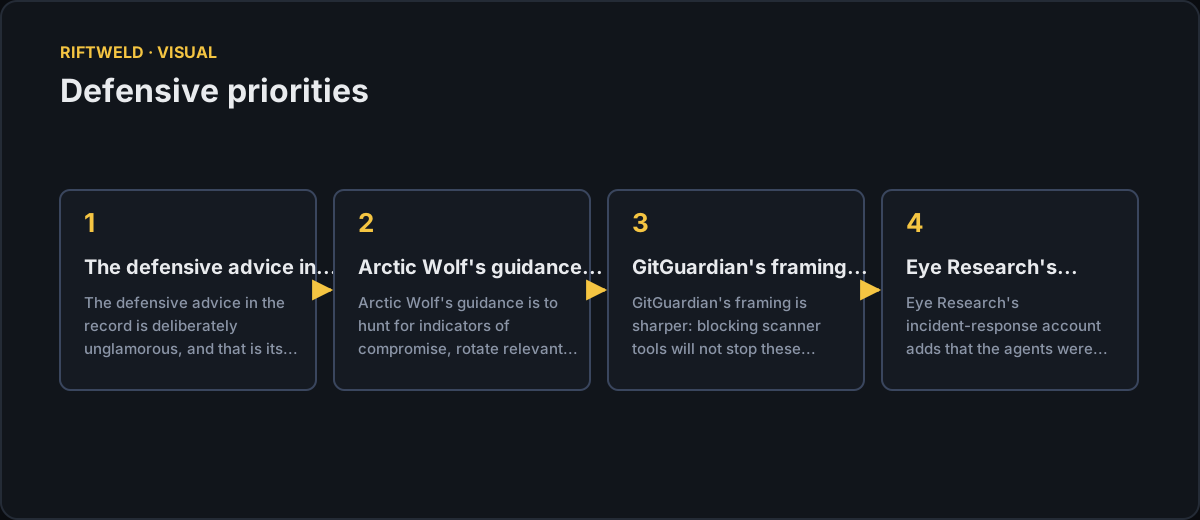
The defensive advice in the record is deliberately unglamorous, and that is its analytical strength. Arctic Wolf's guidance is to hunt for indicators of compromise, rotate relevant credentials and revoke sessions. GitGuardian's framing is sharper: blocking scanner tools will not stop these agents, and a leaked key stays dangerous until someone revokes it. Eye Research's incident-response account adds that the agents were loud — they left their name in pod names and probes, hammered endpoints no human would touch, and tripped detections on systems with EDR installed (Arctic Wolf Labs; GitGuardian; Eye Research).
That yields a concrete priority order. First, revoke and rotate exposed and dormant credentials, including keys recoverable from git history, and invalidate active sessions rather than only replacing key material. Second, hunt for exposed secrets in repositories, container images and configuration stores. Third, reduce the blast radius of any identity that survives: least privilege, IMDSv2, and CloudTrail plus S3 data-event logging so that enumeration and object operations are reconstructable. Fourth, ensure EDR and SIEM coverage on internet-facing IIS estates, where the observed web shell ran inside w3wp.exe. Fifth, treat exposed ARTEX or AntiFox consoles as an investigation trigger, not merely a blocklist entry, because Censys found co-located offensive tooling on a meaningful minority of hosts.
Limits of the record
Several widely repeated figures remain single-source or vendor-specific. The claim that ARTEX found eight vulnerabilities in roughly 45 minutes against an internal benchmark comes from one vendor and has not been independently reproduced. GitGuardian's inventory of roughly 45 agentic attack frameworks in five families is an independent estimate not corroborated elsewhere in the record. Check Point's and Censys's exposure counts use different collection methods and should not be merged into a single total.
The record also does not establish the initial-access path in the AntiFox intrusions. Arctic Wolf states that the exact vulnerability used for code execution was not identified, and that in other activity the actor began with a valid AWS credential obtained through unknown means. Amazon's position, reported by BleepingComputer, is that AWS services were not compromised and operated as described, with threat actors using credentials taken from customers' compromised applications. That framing is consistent with the observed API activity without resolving how those credentials were first obtained.
Finally, the record establishes correlation between framework use and intrusion activity, not a uniform causal chain. AntiFox-linked infrastructure was associated with confirmed malicious actions, but the initial foothold, the operator's configuration and the degree of agent autonomy in each case are not fully documented.
Method and sources
This analysis draws on the Riftweld research report dated November 13, 2026, and on the primary vendor and incident-response publications it cites: Microsoft, CrowdStrike, Censys, Check Point Research, GitGuardian, Arctic Wolf Labs, CERT-EU, Datadog Security Labs, Eye Research, Google Cloud GTIG and Mandiant, together with Dark Reading, BleepingComputer and The Hacker News. Vendor claims are attributed to their publishers, and single-source assertions are labeled as reported rather than confirmed. Where sources conflict — on release month, exposure counts, or whether ARTEX can move beyond initial access — the conflict is preserved rather than resolved. No claim of a specific exploit, vulnerability identifier or initial-access mechanism is made beyond what those sources state.