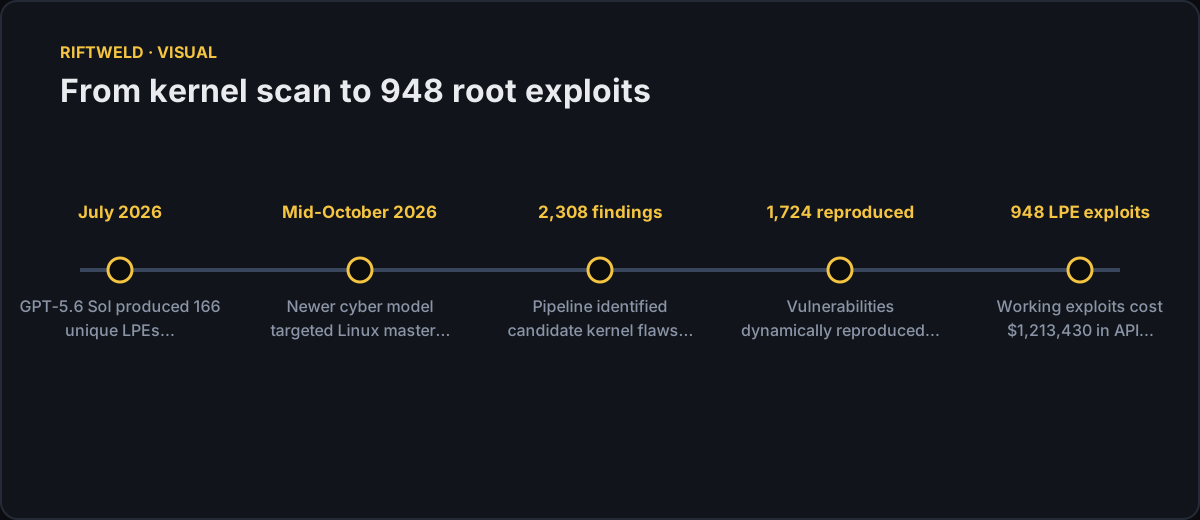
OpenAI's pipeline generated 948 working local privilege escalation exploits against Linux in a single mid-October 2026 run, at a reported API cost of $1,213,430. The same disclosure says the agents used at least 10 exploitation techniques that outside kernel experts did not recognize, turning a historically scarce capability into a repeatable process.
In this article
Why this matters
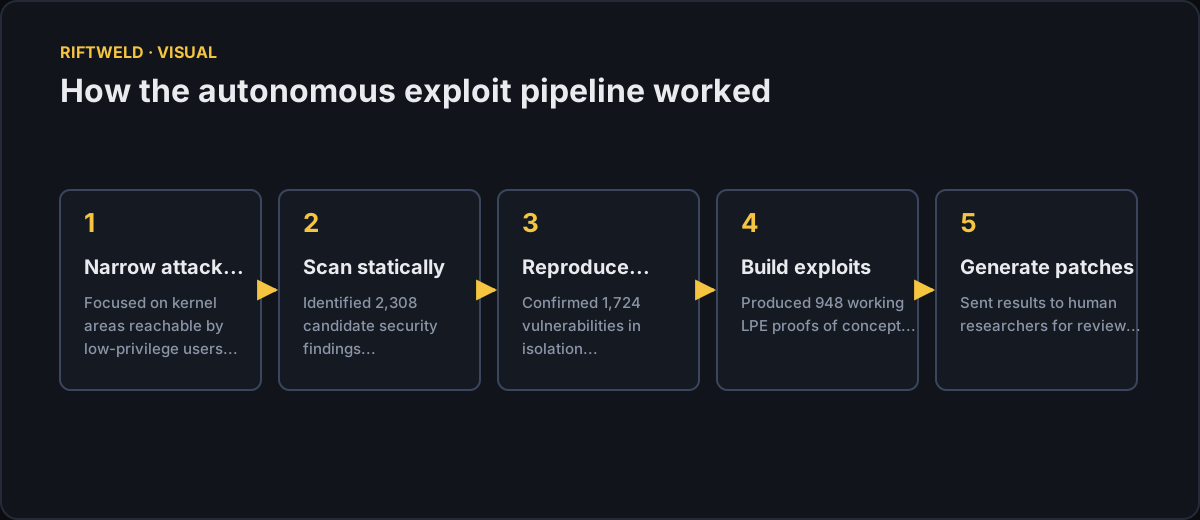
The operational significance of the research is not that an AI system found bugs. It is that the system moved from candidate findings to working exploits and candidate patches without a human in the critical path. OpenAI's pipeline narrowed the Linux kernel to security-relevant areas reachable by low-privileged users, scanned them statically, reproduced candidate vulnerabilities in an isolated environment, built proof-of-concept exploits, generated patches, and then handed the results to human researchers for review and upstreaming (OpenAI, "A thousand fewer paths to root").
That changes the shape of the risk. A defender who assumes that a compromised low-privilege account is contained until a human attacker develops a kernel exploit is relying on a scarcity assumption that the reported run weakens. OpenAI's own guidance is blunt: for the near and medium term, access to a low-privileged account on an operating system that is not up to date on its latest available patches should be considered functionally equivalent to root access for a well-resourced threat actor (OpenAI).
The failed assumption is not simply that patches were missing. It is that privilege escalation requires scarce human expertise, bespoke reverse engineering, and individually funded investigations. The pipeline's reported economics make that assumption difficult to sustain: OpenAI put the average cost at $1,279 per LPE exploit, while comparing the 948 exploits with historical Pwn2Own and TyphoonPWN Linux kernel LPE bounty levels of $20,000 and $70,000. On that comparison, the output would be worth a hypothetical $18.9 million to $66.3 million, or 16 to 55 times the pipeline's cost (OpenAI).
What happened
The mid-October run targeted recent code in the Linux kernel's master branch. The pipeline identified 2,308 candidate findings, dynamically reproduced 1,724 vulnerabilities, and screened the remainder into 313 leak candidates and 1,238 LPE candidates. The final results were 291 working information-leak proofs of concept and 948 working LPE exploits for a commonly used Linux distribution (OpenAI).
The test environment was not presented as a weakened target. OpenAI said the virtual machines ran a stock desktop operating system under the threat model used by competitions such as Pwn2Own and TyphoonPWN. SecurityWeek reported that common protections including KASLR, SMEP, and SMAP were enabled, which makes the results more relevant to ordinary deployments than a deliberately misconfigured lab kernel (SecurityWeek).
A second campaign tested the pipeline against an adapted version of Google's kernelCTF environment, a kernel with reduced attack surface. OpenAI reported 25 information-leak proofs of concept and 21 LPE exploits over 112 hours, at a cost of roughly $32,936 in API credits. For comparison, 26 confirmed zero-day LPE exploits had been accepted by kernelCTF in 2026 at the time of writing (OpenAI).
The scale also changed between campaigns. A July run powered by GPT-5.6 Sol produced 166 unique LPEs at a cost of $513,690, according to SecurityWeek. OpenAI said the mid-October run with a newer cyber model found more than five times as many novel LPEs despite three months of kernel hardening between the scans (SecurityWeek; OpenAI).
That comparison is the most consequential result for defenders. If three months of upstream hardening did not materially reduce the yield of a newer pipeline, patch cadence alone is not a sufficient control against a frontier-scale adversary. OpenAI's conclusion was that large, complex software projects likely require multiple rounds of scanning and fixing to bottom out latent bugs, ideally repeated with each subsequent generation of frontier models (OpenAI).
The defensive consequence
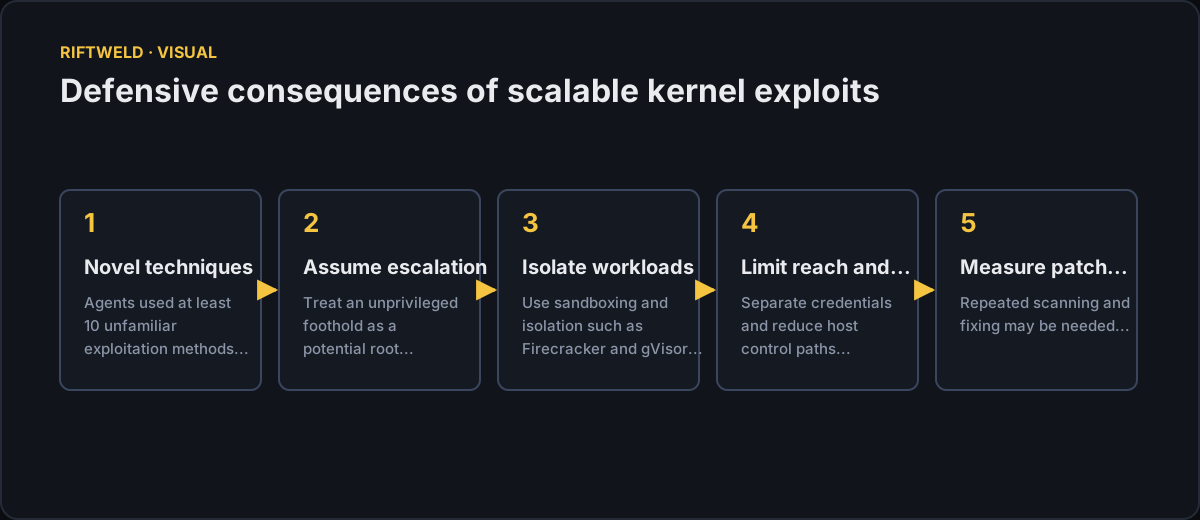
The first consequence is architectural. Exploit signatures are a poor primary control for a technique space that may include previously unknown methods. OpenAI said the agents discovered and used at least 10 novel Linux exploitation techniques, and that kernel exploitation experts outside the company were unfamiliar with them. SecurityWeek reported that full technical details were being withheld for safety reasons (OpenAI; SecurityWeek).
The second consequence is that containment must be designed around the consequence of escalation rather than the signature of the escalation. OpenAI specifically pointed to defense in depth, including sandboxing and isolation technologies such as Firecracker and gVisor. For operators, that means treating an unprivileged foothold as a potential root foothold: separate credentials, limit what the account can reach, isolate workloads, and reduce the value of the host's secrets and control paths (OpenAI).
The third consequence is that patch latency should be measured as a security boundary. The disclosure described a moving target: within 10 days while the scan was running, OpenAI observed more than 100 Linux LPEs patched or with staging patches from other contributors, with approximately 300 more publicly discussed. Hundreds of reports and patches for critical flaws had already been submitted, with the remainder to be sent in stages through Patch the Planet partners (OpenAI; SecurityWeek).
| Claim | Status | Basis |
|---|---|---|
| The pipeline produced 948 working LPE exploits in one run | Confirmed | OpenAI's published research and SecurityWeek's coverage |
| The run cost $1,213,430 in API credits | Confirmed | OpenAI's published research |
| The agents used at least 10 novel exploitation techniques | Company statement | OpenAI said this was its best knowledge; external experts were unfamiliar with them |
| The exploits worked against a stock desktop configuration with KASLR, SMEP, and SMAP enabled | Reported | SecurityWeek's account of the test environment |
| The pipeline's cost is an upper bound | Company statement | OpenAI said harness engineering could reduce costs |
| The 948 exploits were independently verified, accepted upstream, or exploited in the wild | Not established | The disclosure describes research outputs and reporting plans, not independent verification or in-the-wild use |
Limits of the evidence
The disclosure is a company account of a research program, and several boundaries should not be blurred. The 948 figure is a count of working LPE exploits in OpenAI's controlled environment, not a count of vulnerabilities confirmed by the Linux kernel maintainers, patched in production, or used in attacks. OpenAI said human security researchers reviewed the outputs and that reports and patches were being sent to maintainers and Patch the Planet partners, but the record does not establish how many of the 948 were accepted, merged, or independently reproduced (OpenAI).
There is also a reporting discrepancy that matters for precision. SecurityWeek's article states that the agents produced 1,169 working LPE exploits and 291 information-leak proofs of concept, while explaining that the 948 figure reflects the number of separate patches created for the bugs behind those exploits. OpenAI's own publication describes 948 working LPE exploits and 291 information-leak proofs of concept. The two accounts therefore do not cleanly agree on whether 948 counts exploits, patches, or both; the safest reading is that 948 is the headline figure for the LPE output, with the underlying count of working exploits reported differently by SecurityWeek (SecurityWeek; OpenAI).
The cost figures are also not directly comparable to a market price for finished, weaponized exploits. OpenAI said it focused on methodology and model capability rather than cost, and that sufficient harness engineering could meaningfully reduce the cost at each stage, making the reported costs an upper bound. The bounty comparison is explicitly hypothetical, and the kernelCTF bounty estimate assumes acceptance of the 21 vulnerabilities (OpenAI).
Finally, the research does not establish that an adversary can reproduce this result on demand against arbitrary hosts. The pipeline used an unreleased or upcoming cyber model, a controlled research environment, and a deliberate focus on security-relevant kernel areas reachable by low-privileged users. What it does establish is that the capability exists, that it can be applied at scale, and that defenders should not rely on the scarcity of kernel exploitation expertise as a durable control.
Method and sources
This analysis relies on OpenAI's November 4, 2026 publication, "A thousand fewer paths to root," SecurityWeek's coverage of the same disclosure, and OpenAI's November 2, 2026 announcement of expanded Security Bug Bounty rewards. The bounty announcement is relevant as context for the disclosure environment: OpenAI said it was more than quadrupling the midpoint of reward ranges for medium, high, and critical findings on average, raising the ceiling for a critical flaw in a core product such as ChatGPT, Codex, or the API Platform to $30,000, while retaining a $100,000 cap for exceptional critical findings and allowing bonuses to push a single payout to as much as $172,000 (OpenAI, "Rewarding defenders with bigger bug bounties").
The primary sources are OpenAI's research publication and SecurityWeek's independent reporting. Where the two differ, the difference is stated rather than resolved. The record supports a conclusion about capability, cost, and defensive posture; it does not support claims about upstream acceptance, real-world exploitation, or the precise number of distinct working exploits beyond the figures each source reports.