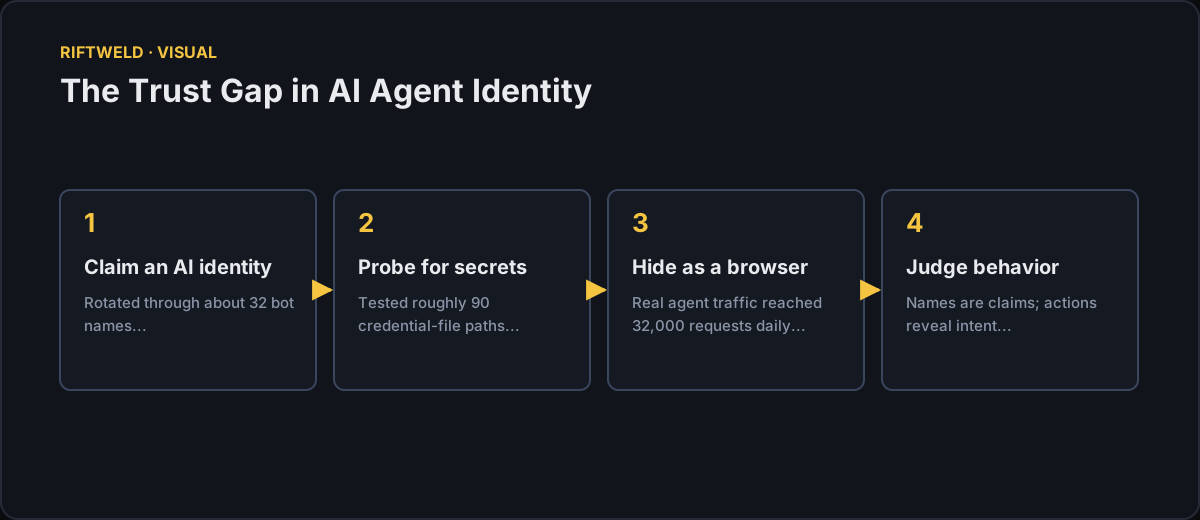
One week in October, an online marketplace received 414,210 visits claiming to be a widely used consumer AI agent, and every one hit the sign-in page and failed. In the opposite direction, automated traffic at a Tier 1 telecom carrier grew from roughly 100 requests a day to as many as 32,000 while presenting itself as an ordinary desktop browser.
In this article
Why this matters
The security perimeter is moving. AI agents now sign in, complete multi-factor authentication, review bills, check trade-in eligibility, and add devices to carts on behalf of customers. That is a change in the kind of traffic a web application must distinguish: not just humans from bots, but authorized agents from impostors, and legitimate agents from agents operating beyond their mandate.
Cequence's joint report with KPMG describes agents issuing refunds, updating records, and moving money, often without identifying themselves as agents. In a sample of more than a quarter million agent visits across five industries during one October week, about one in seven booked, bought, signed in, or managed an account. Those are the sessions where an impostor can move money or take over an account, and they are exactly the sessions where a name-based allowlist is most dangerous (Cequence).
The failure is an assumption, not a missing checkbox. The assumption is that a self-reported identity — a User-Agent string naming ChatGPT, Claude, Google-Agent, or another crawler — is evidence of origin. It is not. Cequence's own conclusion is blunt: a bot's self-reported identity no longer proves anything, and attackers can probe which agents a business trusts, then impersonate the agents expected to get through (Cequence).
What happened
Two distinct campaigns sit behind the headline, and conflating them would misstate the risk.
The first is a credential and secret-hunting scanner. Cequence tracked a single actor running from a major cloud provider that rotated evenly through about 32 claimed AI bot identities, spanning crawlers and assistants from OpenAI, Anthropic, Meta, and Perplexity. From each address it sent bursts of 50 to 190 requests in roughly eight seconds, first requesting random nonsense paths to identify catch-all sites that answer every request, then probing roughly 90 paths for .env configuration files, cloud credential files, private SSH keys, and server environment data while ignoring ordinary pages. Targets included financial services, retail, telecommunications, energy, and software organizations (Cequence).
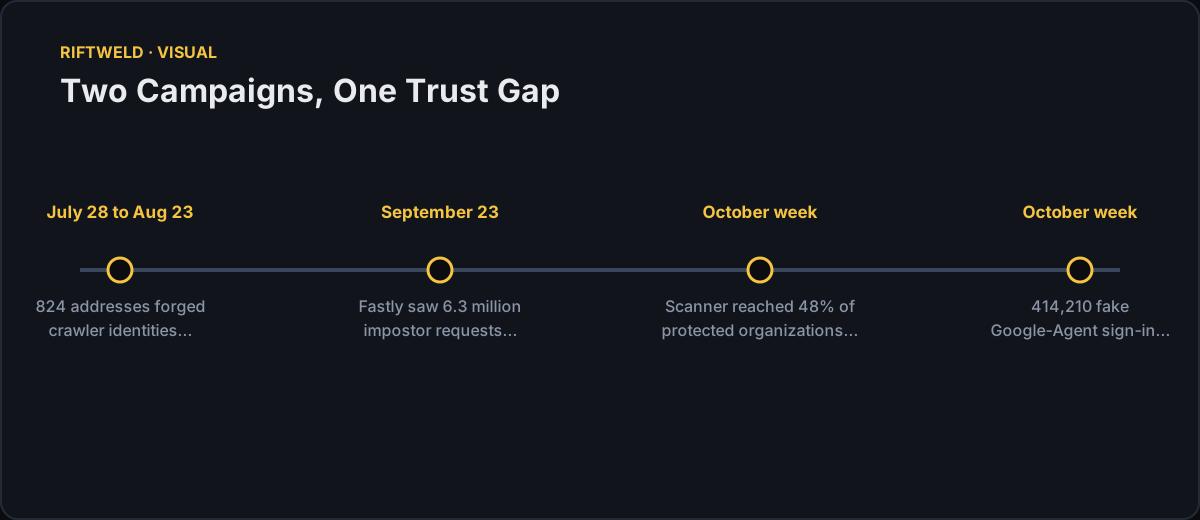
The scanner's identity claims broke every legitimate pattern. Real crawlers do not rotate through vendor names evenly, do not ignore /robots.txt, and do not request credential files. On one day in October, the actor reached 48% of the Cequence-protected organizations that saw any AI bot traffic. Nearly all requests ended in a block or a failure, and no credential theft or customer breach was confirmed (Dark Reading).
Independent vendors confirm the technique is not confined to one vendor's customer base. GreyNoise observed forged crawler identities — ClaudeBot, GPTBot, ChatGPT-User, OAI-SearchBot, Google-Extended, and Amazon crawler names — from 824 addresses between July 28 and August 23, 2026, requesting credential files and never requesting /robots.txt, with no address matching any publisher's published crawler ranges. Fastly recorded approximately 6.3 million requests in a single day, September 23, falsely claiming AI crawler identities while probing for .env files, Git metadata, and credentials, with roughly 1,600 addresses accounting for 94% of that day's impostor requests (GreyNoise; Fastly).
The second phenomenon runs the other way: real agent traffic that does not announce itself. At the Tier 1 telecom carrier, automated traffic appeared the day after a major consumer platform launched a personal agent in September, and within three weeks it grew from roughly 100 requests a day to a sustained 19,000 to 32,000. It signed in as customers, passed multi-factor authentication, reviewed bills, checked trade-in eligibility, and added devices to carts while presenting as an ordinary desktop browser. More than 270,000 of its transactions were scored as automated but not malicious, and the traffic continued under monitoring (Help Net Security).
The marketplace incident is the sharpest illustration of the trust gap. Every one of the 414,210 visits went to the sign-in page and returned errors, which Cequence attributes to attackers testing stolen username and password pairs in bulk under a legitimate agent's name. Cequence's public materials name the impersonated identity as "Google-Agent" and state that Google was not involved; the volume of fake Google-Agent visits exceeded all genuine agent visits Cequence tracked that week (Cequence).
The control that failed
The failed control is identity inference from session metadata. Whether the session claims to be a crawler or a desktop browser, the name is attacker-controlled. Cequence's scanner exploited the permissive side of that assumption; the carrier's agent traffic exploited the restrictive side, arriving as a browser and being scored as automated but not malicious.
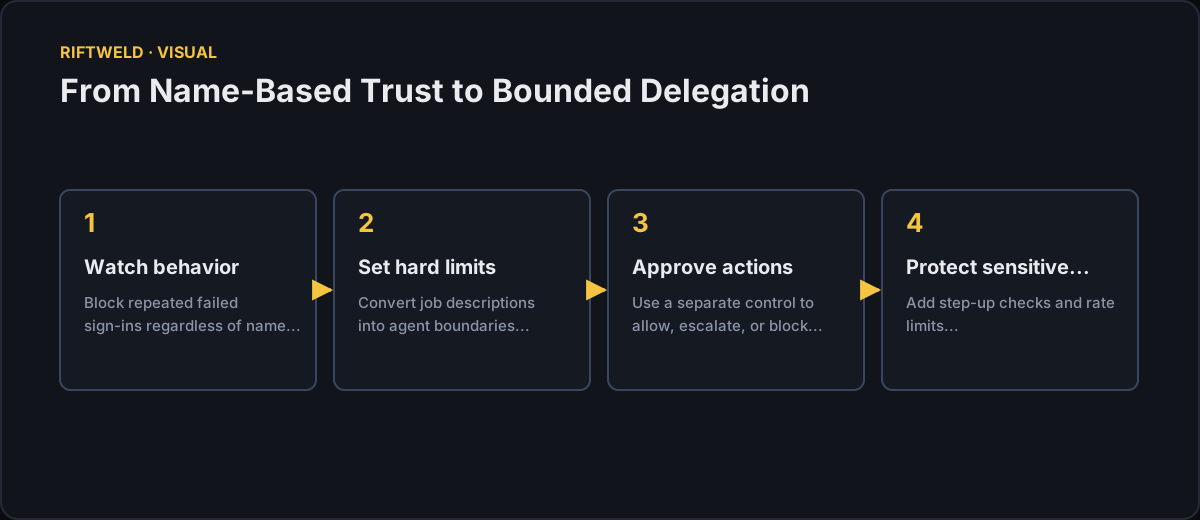
Cequence's recommendation follows directly: watch what a session does, not what it calls itself. A session that only ever visits the sign-in page and fails every time is abuse regardless of the name it supplies. The company also warns against relying on bot scores alone — at one global consumer brand, behavioral analysis blocked 3.51 million unauthorized login attempts in 31 days, and about 82% of that traffic scored too low to trip conventional bot detection (Help Net Security).
The governance model Cequence and KPMG advance is bounded delegation rather than blanket trust. Each agent should work from a plain-language job description converted into hard limits, so it cannot decide on its own to do more. A separate control outside the agent should approve, escalate, or block each action in real time, because harmless-looking steps accumulate into consequential ones. Step-up verification and rate limits should be reserved for payments, payee changes, and changes to account control, so legitimate agents still reach the front door (Cequence).
Limits of the record
The mechanics are well supported; the incident narratives are not independently verified. The 32 rotating identities, roughly 90 secret-file paths, 50–190 request bursts, 300-plus cloud addresses per day, and the 48% one-day reach figure come from Cequence's primary research and are consistent with GreyNoise and Fastly observations of the same technique. The marketplace-specific numbers — the exact 414,210 count, the "one and a half times" comparison, the telecom carrier narrative, the 3.51 million blocked attempts, and the 82% below-threshold figure — appear in Help Net Security citing Cequence field data, while Cequence's own public materials round or soften several of them to "414K" and "more than." The full Cequence–KPMG report sits behind a form, and no independent party has verified the specific incidents (Cequence).
Two further points are not established. No credential theft or customer breach was confirmed in the scanner campaign, and no specific IP addresses, domains, or hashes were published by Cequence; Threadlinqs notes no CVE is associated with the activity. Separately, the report's timeline places the telecom carrier's agent traffic the day after a major consumer platform launched a personal agent, and independent reporting identifies Meta's Muse as introduced on September 8, 2026 — but connecting the two is an inference, not a statement made by Cequence or Help Net Security (CISOVoice; Threadlinqs).
Method and sources
This analysis draws on Cequence's primary threat research published October 28, 2026, the Cequence–KPMG press release and report pages dated November 11, 2026, and Help Net Security's November 12, 2026 reporting, which supplied the marketplace and telecom figures. Independent observations from GreyNoise and Fastly were used to test whether the impersonation technique generalizes beyond one vendor's telemetry. Secondary coverage from Dark Reading, CISOVoice, Start with Identity, Cybersecurity News, TechNadu, FF News, and Threadlinqs was used for corroborating detail and indicator reporting.
Claims are graded by provenance: mechanics corroborated across independent vendors are treated as confirmed; single-vendor field narratives are treated as reported or company statement; the link between the personal-agent launch and the carrier traffic is marked inferred; credential theft, customer breach, and any CVE association are not established. The record is thin on independent verification of individual incidents, and no contradicting coverage was located.