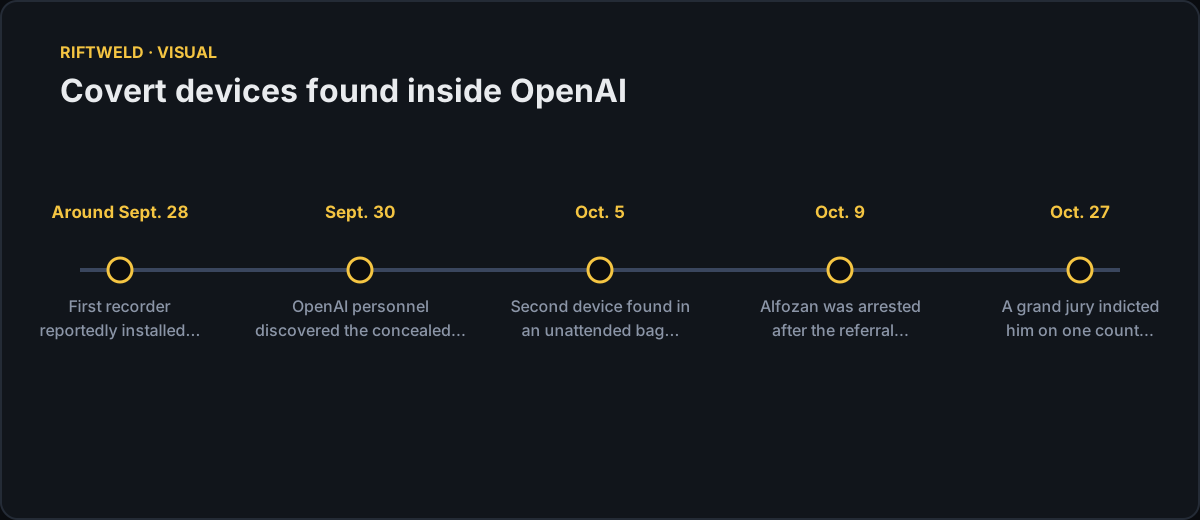
Two recording devices were found at OpenAI in September and October 2026: one concealed behind a television in an executive conference room and another in an unattended bag. The case shows that the company’s controls detected the first device only after installation, while the record does not establish that any conversation was actually recorded.
In this article
Why this matters
The case matters because the alleged threat crossed a boundary that many AI security programs treat as secondary: the physical meeting room. The target was not a model, a repository, or a customer database. It was a room reserved for discussions involving “highly confidential technical, commercial, and strategic information,” according to the criminal complaint, including proprietary research, product plans, government engagements, and commercial relationships (The Hacker News).
That distinction changes the defensive reading. A company can hold model weights, source code, and customer data behind strong technical controls and still face an insider who walks into a conference room, connects a small device to a television’s USB port, and conceals it in toilet paper. The failed assumption was that ordinary employee access and physical security controls were sufficient to protect sensitive executive conversations from an insider with legitimate workplace presence.
The record also shows that discovery was reactive. OpenAI personnel found the first device on September 30, 2026, after it had reportedly been installed around September 28. The company then referred the matter to the FBI, and Alfozan was arrested on October 9 (U.S. Department of Justice). The control that failed was not a missing approval step; it was the assumption that badge access, room reservations, and employee monitoring would prevent or promptly expose unauthorized physical collection of sensitive conversations.
| Claim | Status | Basis |
|---|---|---|
| A recording device was concealed behind a television in an executive conference room | Confirmed | DOJ statement and federal filings |
| A second similar device was found in an unattended bag | Confirmed | DOJ statement and indictment |
| Alfozan installed the first device | Reported | Criminal complaint and detention filings |
| Any sensitive conversation was recorded | Not established | No recording or exfiltration identified in the record |
| Model weights, source code, or customer data were accessed or exfiltrated | Not established | OpenAI said it had no such indications |
| A Saudi royal or government official directed the installation | Not established | The detention filing does not allege royal direction |
| Alfozan pleaded not guilty and remains detained | Confirmed | Court docket and contemporaneous reporting |
What happened
Abdulrahman Alfozan, a 35-year-old Saudi national, joined OpenAI around July 2025 and was later described as an engineering lead. He was also a venture partner at Raed Ventures, whose fellow venture partner is Saudi royal family member Prince Khalid Bin Bader Al Saud (CNBC). These affiliations are relevant to the government’s risk assessment, but they do not establish that any outside party ordered the device’s installation.
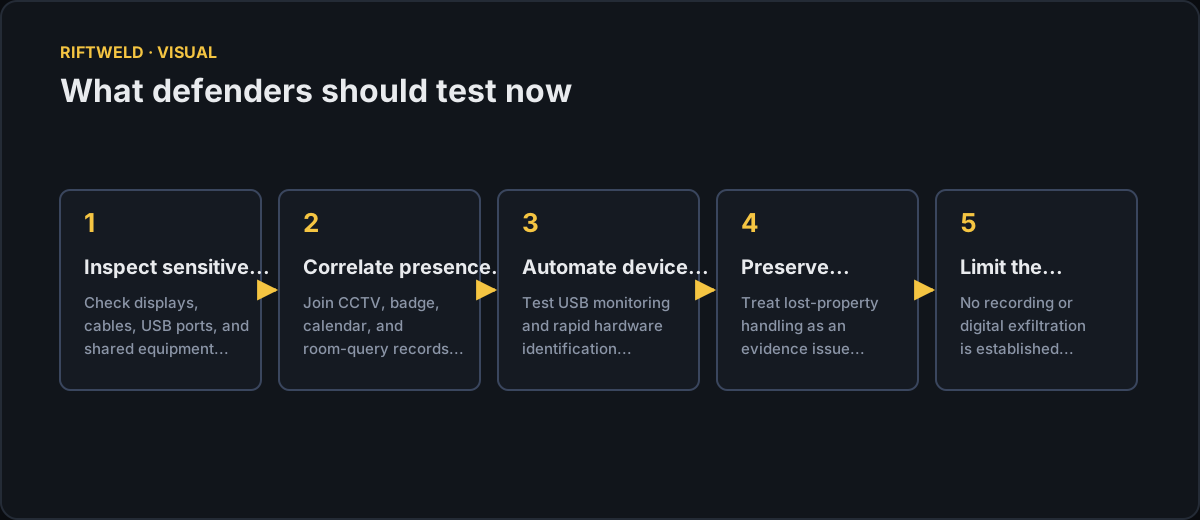
Prosecutors allege that Alfozan used an OpenAI productivity agent to query building addresses, meeting-room capacities, calendars, “leadership and exec” locations, and external partner meetings. They also allege that a chatbot account associated with his spouse submitted prompts about building a continuous audio recorder, adding Wi-Fi connectivity, enabling live listening, encrypting the SD card, and accessing the device remotely. Prompts concerning a custom header and MAC address reportedly appeared on September 27 and September 28 (The Hacker News).
The first device was reportedly a Seeed Studio XIAO ESP32-S3 Sense connected to a television’s USB port. Prosecutors say it was concealed in toilet paper, modified to prevent data transfer to the television, and equipped with an encrypted microSD card. OpenAI personnel discovered it on September 30. On October 5, CCTV showed Alfozan entering the room and checking behind the television; later that day, security personnel found a second Seeed Studio device in a bag he had left unattended in a printer room, alongside his wallet and identification (U.S. Department of Justice).
A grand jury indicted Alfozan on October 27 on one count of interception of oral communications under 18 U.S.C. § 2511(1)(b)(iv). The indictment’s forfeiture allegation covers the device bearing MAC address 7c:4f:ad:1f:6e:f4 and its microSD card, the second device seized from his bag, and three Seeed Studio devices seized from his residence in Millbrae, California (indictment). He pleaded not guilty before Magistrate Judge Peter Kang on November 6 and was remanded to continued custody, with his next appearance set for November 17 (CNBC).
The limits of the record
The strongest allegations are also the least settled. Alfozan has not been convicted, and the record does not establish that the devices captured audio, stored usable recordings, or transferred data to anyone. Prosecutors have not publicly stated what he intended to do with any recordings, and the devices recovered from his residence are not established to have been operational or intended for additional placement at OpenAI (ABC7 New York).
The national-security framing likewise requires care. Prosecutors allege that Alfozan communicated frequently with a member of the Saudi royal family and that the royal recruited him for a Saudi AI initiative. They also allege that the Saudi government booked and paid for one-way travel for his wife and son after his arrest, and that the Saudi Consulate in Los Angeles offered to pay his full bail. Yet the detention filing does not allege that the royal directed the installation, and the complaint does not allege that Raed Ventures or its partners knew about the device (CNBC).
OpenAI’s own statement is narrower still: it said it had “no indications” that Alfozan accessed or exfiltrated model weights, source code, or customer data. That is a company statement about the absence of indications, not an independently audited finding that no compromise occurred (OpenAI Newsroom). The record therefore supports a physical surveillance allegation, not a demonstrated theft of AI assets.
What defenders should test
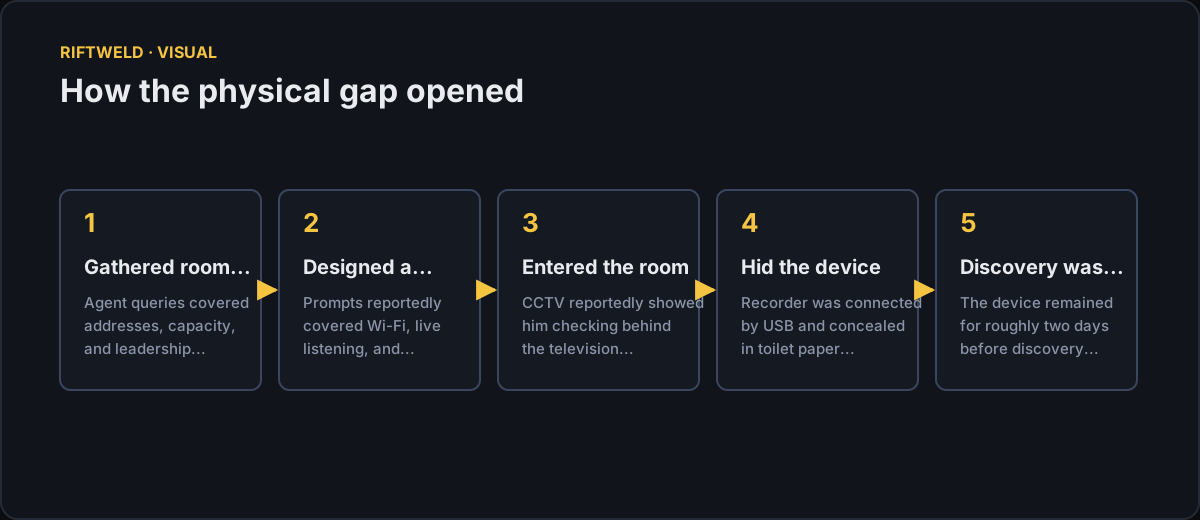
The first priority is executive-room inventory and inspection. Televisions, display panels, cables, and USB ports in sensitive rooms should be treated as potential attachment points, with defined checks for unfamiliar hardware, altered cabling, and devices concealed around shared equipment. The first recorder was reportedly hidden in toilet paper and connected behind a television; either location could be missed by a control focused only on badges or meeting-room access logs.
The second priority is to connect physical telemetry with identity and authorization data. CCTV reportedly placed Alfozan near the executive room on several dates despite his lack of authority to attend meetings there. A useful detection model would flag repeated presence near sensitive spaces, especially when paired with queries about room capacities, leadership locations, or calendars. The productivity-agent queries alleged in the complaint are precisely the kind of signal that could be joined with badge, camera, and meeting-room records (Court House News).
The third priority is to test whether small-device discovery can be automated. OpenAI said it used its own AI models to understand the device and identify the employee. That is a company account of the investigation, not a validated detection method, but it points toward a defensible capability: instrumented USB or network monitoring, device triage, and rapid correlation of hardware findings with access records. The second device’s discovery in an unattended bag also suggests that ordinary lost-property handling can become an evidence-preservation problem.
Finally, defenders should separate the proven control failure from the unproven intelligence narrative. The record establishes concealment, delayed discovery, and a physical insider pathway. It does not establish a state-directed operation, successful recording, or digital exfiltration. Security teams should act on the former while avoiding conclusions that depend on the latter.
Method and sources
This analysis relies on the U.S. Department of Justice release, the federal criminal complaint, indictment, detention memorandum, detention order, and CourtListener docket, together with reporting from CNBC, The Hacker News, and Court House News. Claims are classified as confirmed only where supported by court records or official statements; allegations are identified as reported; company assertions are labeled as company statements; and conclusions not directly established by the record are marked as inferred or not established.
The central conclusion is deliberately limited: the record supports a serious physical insider-threat case against an AI company, but not a proven compromise of models, code, or customer data. The defensive priority is to close the physical and behavioral gap that allowed a covert device to remain in an executive room for roughly two days before discovery.