A password longer than 256 bytes could defeat password authentication on certain Alpine Linux servers. On official Alpine AWS and Azure images, that login could hand an attacker root-equivalent control without a password or key.
In this article
Why this matters
The flaw, tracked as CVE-2026-123158, is not a weak password problem. It is a case where the server's attempt to hide whether a username exists produced a result that OpenSSH accepted as a successful login. An unauthenticated attacker needed no valid password, no SSH key and no prior access to the host.
That distinction matters because password-disabled accounts are often treated as harmless. They exist to permit key-based access while refusing ordinary password logins. On Alpine's official AWS and Azure images, the default alpine account has a * password field and passwordless doas privileges. Authentication as that account is therefore equivalent to root control of the instance (OX Security).
The MITRE CNA assigned the vulnerability a CVSS 3.1 score of 8.1 High, with the vector AV:N/AC:H/PR:N/UI:N/S:U/C:H/I:H/A:H. NVD had not published its own assessment at the time of the record (NVD).
There is also an awkward detection problem. The attack input is an unusually long password, not a sequence of dictionary guesses. Conventional brute-force thresholds and credential-stuffing heuristics are poorly suited to spotting it. A host can therefore look quiet while accepting a login that should have been impossible.
What happened
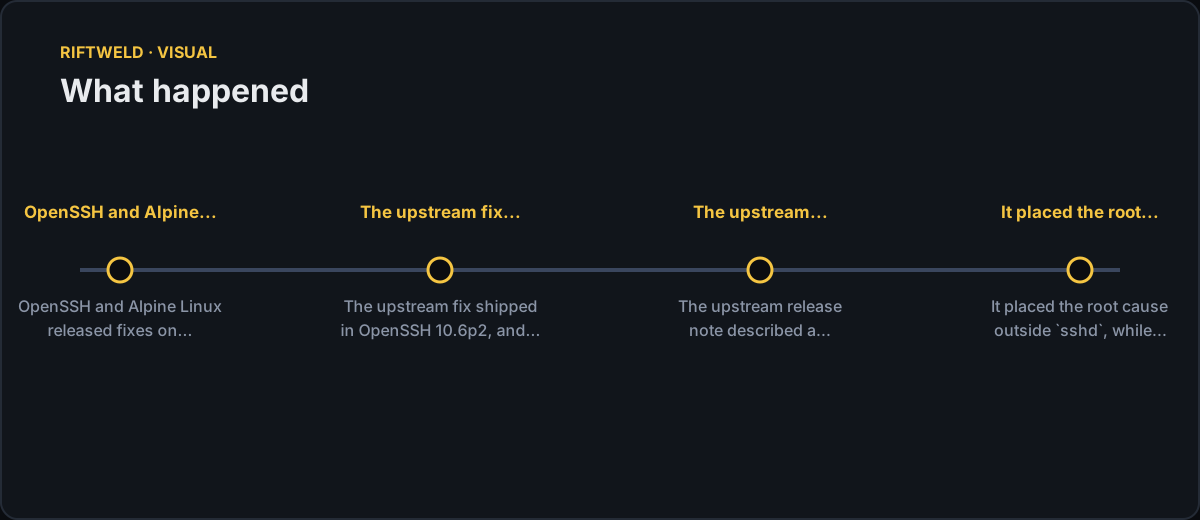
OpenSSH and Alpine Linux released fixes on November 5, 2026. The upstream fix shipped in OpenSSH 10.6p2, and Alpine pushed corrected packages to every branch back to 3.16, including releases that were no longer supported (OX Security).
The upstream release note described a password authentication bypass affecting some Linux systems built and run with PAM support disabled. It placed the root cause outside sshd, while acknowledging that the bug was exploitable through sshd and could be avoided there. The release credited Özgün Kültekin of Wakefield with reporting it (oss-security).
The affected upstream range is OpenSSH before 10.6p2. Because Alpine backports fixes, an upstream version number alone is not enough to establish whether a host is patched. Alpine's fixed packages include 10.6_p2-r0 on edge, 10.3_p1-r2 on 3.24 and 10.2_p1-r1 on 3.23, with further backports covering older branches (OX Security).
The record does not describe observed exploitation, a named threat actor or a campaign using the flaw. The supported attribution is to the researcher who reported the bug to OpenSSH. That absence of a campaign does not reduce the technical exposure, but it does mean operators should not treat this as evidence of a specific intrusion wave (oss-security).
The mechanism in plain terms
Three separate design decisions created the vulnerable path. Each had a defensible purpose on its own.
First, musl's crypt() function refuses passwords longer than 256 bytes. The limit exists so that an excessively long input cannot consume unnecessary processing resources. When hashing fails because of the length, musl returns a failure token. Linux also uses * in /etc/shadow to mark an account with no valid password hash, so the returned value collides with a meaningful account state (OX Security).
Second, OpenSSH introduced password-checking behavior in 2016 to reduce information leaks that could help an attacker determine whether a username existed. In affected configurations, sshd could hash against settings taken from another account even when the target account had no valid password hash. The idea was to perform fake authentication and then discard the result, keeping the timing of responses similar regardless of the account state (OX Security).
Third, Alpine changed its default account posture in 2022. Beginning with Alpine Linux 3.16, the default root account used * in its password field, allowing SSH key authentication while blocking ordinary password logins. Key-only users and the default user on certain Alpine cloud images can carry the same field value (OX Security).
Solar Designer's later correction sharpened the sequence. musl returns * only when the setting string passed to it is not itself *; when the setting is *, musl returns x. The developers expected the usual strcmp() comparison to fail. OpenSSH instead authenticated one user while using another user's password hash as the setting, and it did not discard the synthetic authentication result. That result could then be treated as a real login (oss-security).
Rich Felker stated the contract plainly: if P is the candidate password and H is the stored password value, authentication should assert that strcmp(crypt(P,H),H)==0. Allowing a user in without that assertion is a bypass. He also warned that H might not be a hash at all, but a string chosen by tooling or by someone editing passwd or shadow to make an account unmatchable (oss-security).
The reason the flaw persisted is now visible. Each component behaved as designed, and the caller failed to enforce the contract that connected them. The fix makes OpenSSH reject the synthetic result rather than treating it as a successful authentication, so an oversized password can no longer stand in for a real credential.
Exposure and detection
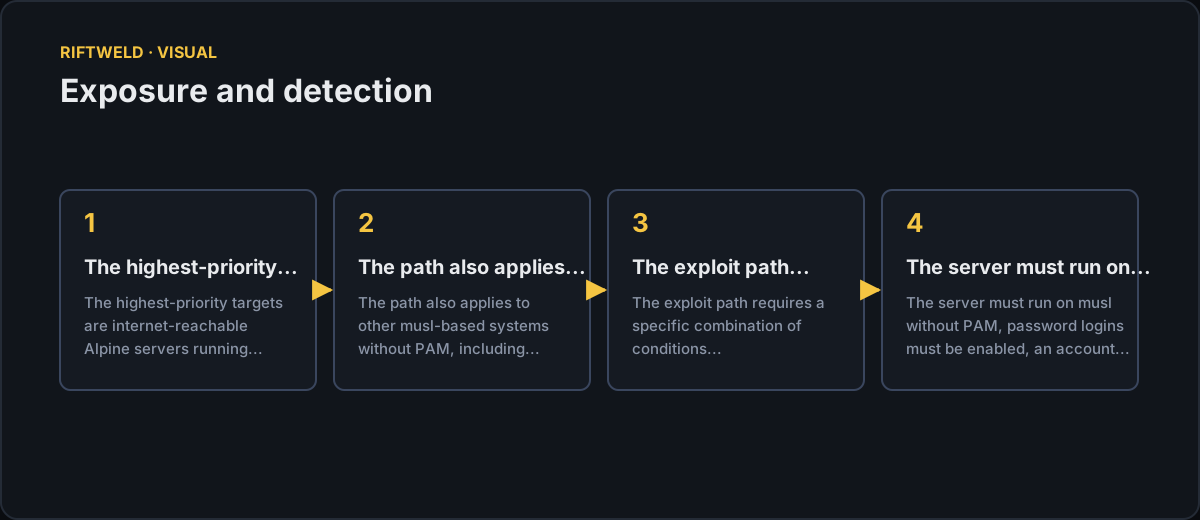
The highest-priority targets are internet-reachable Alpine servers running unpatched OpenSSH with password authentication enabled. The path also applies to other musl-based systems without PAM, including OpenWrt, Buildroot and Yocto, although the record does not establish that their default configurations reproduce Alpine's exact account and privilege arrangement (OX Security).
The exploit path requires a specific combination of conditions. The server must run on musl without PAM, password logins must be enabled, an account must have a * password field, and at least one other account must have a real password. That second account supplies the hash setting that drives the vulnerable comparison (OX Security).
Systems outside that configuration are not affected by this path. OX Security excludes Debian, Ubuntu, Fedora and other glibc systems using this authentication path, as well as SSH servers using PAM. It also excludes hosts with PasswordAuthentication no, accounts whose password field contains ! rather than *, and deployments running Dropbear or OpenBSD's SSH implementation (OX Security).
Detection should therefore focus on configuration and access history rather than password-guessing patterns. Operators should identify musl hosts with password authentication enabled, then look for successful SSH logins by accounts whose password field is *. On Alpine cloud images, any such login warrants an immediate privilege review because the alpine account can run doas without a password (OX Security).
Fixing the failure mode
The immediate action is to upgrade to OpenSSH 10.6p2 or install the fixed Alpine package for the branch in use, restart sshd and confirm the running version rather than relying on package metadata alone (NVD).
Where patching cannot happen immediately, setting PasswordAuthentication no in /etc/ssh/sshd_config removes the vulnerable authentication path. The tradeoff is direct: password logins stop working, so operators must confirm that key-based access and recovery procedures are in place before making the change (oss-security).
Patching closes the bypass, but it does not settle the underlying API question. musl's developer said musl 1.2.7 would probably adopt libxcrypt's *0 and *1 failure tokens, with the possibility that future versions would return NULL instead. On November 9, Alpine developer Loganaden Velvindron wrote that he was taking the NULL-on-error approach in his Alpine build and wanted to submit a musl patch offering it as a build option (Openwall musl list).
Solar Designer cautioned that NULL is not automatically safer. It can cause crashes on dereference, while wrappers and scripting languages may map it to an empty string or a non-object. He observed Perl on Rocky Linux 9 and 10 returning an undefined value that becomes an empty string when used blindly as a string, which could later be stored in a password field and interpreted as an empty password (oss-security).
The broader lesson is that error signaling in password APIs is part of the authentication boundary. A caller must treat a failed hash operation as failure, not as a string to compare loosely. OpenSSH's own timing defense should also always fail, regardless of password hash length, when it performs fake authentication. Those are checks that belong in the caller, because the caller is what turns a library result into a login decision.
Method and sources
This analysis draws on the OpenSSH and Alpine disclosure record, the oss-security discussion led by Solar Designer and Rich Felker, OX Security's technical analysis, the NVD entry for CVE-2026-123158 and the Openwall musl mailing list. The primary sources are oss-security, OX Security, NVD and the Openwall musl list.
The analysis separates the technical mechanism from the exposure assessment. It follows Solar Designer's correction that OpenSSH used another user's password hash and failed to discard the synthetic result, rather than relying on the simpler description that musl alone returned a matching failure token. Where the record does not establish exploitation, campaign activity or uniform privilege impact across musl platforms, this analysis says so rather than extending the Alpine cloud-image finding to every deployment.